
Running a small business in Santa Rosa means facing unexpected risks every day, from customer accidents to property damage and employee injuries. Ignoring insurance or relying on personal policies leaves dangerous coverage gaps that could expose both your business and personal assets. Understanding the real role of business insurance as a legal contract that shields your company from devastating financial losses helps you avoid costly mistakes. This guide gives clear answers on what protection California law requires and how insurance safeguards your operation when it matters most.
Table of Contents
- Defining Business Insurance And Common Misconceptions
- Types Of Business Insurance Required In California
- How Business Insurance Protects Your Operations
- Legal Mandates And Compliance For Sonoma County Businesses
- Risks, Penalties, And Financial Impacts Of Being Uninsured
Key Takeaways
| Point | Details |
|---|---|
| Business Insurance is Essential | Business insurance protects against financial losses from unforeseen events, safeguarding assets and ensuring operational continuity. |
| Common Misconceptions | Many business owners mistakenly believe their LLC or personal insurance covers business risks, leading to unprotected exposures. |
| Legal Requirements in California | California mandates specific insurance types, including workers’ compensation, which are crucial for compliance and risk management. |
| Consequences of Being Uninsured | Operating without insurance can result in severe financial penalties, personal liability, and potential business closure after a significant loss. |
Defining business insurance and common misconceptions
Business insurance is more than just a safety net. It’s a legal contract that protects your company from financial losses when unexpected events occur. Whether you face a customer lawsuit, property damage, or employee injury, business insurance steps in to cover costs that could otherwise devastate your operation.
Think of it this way: your personal car insurance doesn’t cover business deliveries, and your homeowners policy won’t protect your salon or construction equipment. Business insurance fills these critical gaps by providing indemnification against specific business risks in exchange for regular premiums.
Many Santa Rosa business owners operate under dangerous assumptions. Here are the biggest myths we see:
-
“My LLC or corporation automatically protects me.” Legal structures limit personal liability, but they don’t cover business losses from accidents, lawsuits, or disasters.
-
“I don’t need insurance until I hire employees.” Liability exists from day one, even as a solo operation.
-
“My personal insurance covers business activities.” It doesn’t. Insurers specifically exclude business use from personal policies.
-
“I understand my policy completely.” Most owners haven’t read the exclusions or coverage limits until a claim arises.
Most business owners underestimate their exposure to risk and overestimate what their current coverage actually protects.
The real issue is clarity. Insurance contracts define what’s covered through specific policy terms, and missing one detail can leave you exposed. A roofing contractor might think they’re covered for ladder accidents only to discover their policy excludes certain heights. A retail shop owner might assume product liability is included when it requires a separate add-on.
Here’s what actually happens: you purchase coverage, pay your premium, and move forward. Then something goes wrong. You file a claim, only to learn the event wasn’t covered, the limit was too low, or an exclusion applies. By then, it’s too late to change your mind.
The good news? Understanding the basics prevents this. Business insurance protects your personal assets, keeps operations running after a loss, and demonstrates responsibility to customers and lenders. It’s not optional for most businesses—it’s essential.
Here’s a comparison of business structures and how insurance impacts risk protection:
| Business Structure | Personal Asset Protection | Business Loss Protection | Insurance Needed |
|---|---|---|---|
| Sole Proprietor | Personal assets at risk | No business loss shield | Critical |
| LLC/Corporation | Limits personal liability | Does not cover accidents | Still essential |
| Nonprofit | Reduced personal risk | Coverage varies | Strongly advised |
| Partnership | Shared personal risk | Business losses possible | Recommended |
Pro tip: Review your current insurance documents today and list exactly what’s covered, what’s excluded, and what your limits are. This one-hour task reveals gaps before they become expensive problems.
Types of business insurance required in California
California has specific legal requirements for business insurance that vary based on your business structure and workforce. Understanding what’s mandatory versus optional is the first step to staying compliant and protected.
If you have employees, workers’ compensation insurance is legally required in California. This covers medical expenses and lost wages if an employee gets injured on the job. You’ll also need unemployment insurance and disability insurance for your staff. These aren’t optional—they’re state mandates.
Solo operators often think they’re exempt. Think again. Even as a one-person shop, you face liability exposure from customer injuries, property damage claims, and professional liability issues. California law doesn’t require coverage for solo operations in most cases, but it’s a dangerous assumption to skip it.
Here’s what most California businesses actually purchase:
-
General liability insurance – Protects against customer injuries or property damage at your location.
-
Product liability – Covers injuries caused by products you sell or manufacture.
-
Professional liability – Essential for service-based businesses like consultants, contractors, or therapists.
-
Commercial property insurance – Protects your building, equipment, and inventory from fire, theft, or disaster.
-
Business owner’s policy (BOP) – Bundles general liability and commercial property at lower cost.
Sonoma County contractors and service providers must verify additional coverage requirements based on contract terms and the populations they serve.
Sonoma County adds its own layer of requirements. If you contract with the county for services, you’ll need general liability and workers’ compensation insurance depending on your work type. If your business serves vulnerable populations, sexual abuse liability coverage becomes mandatory.
The confusion arises because requirements depend on three factors: your business type, whether you have employees, and whether you contract with government agencies or work with vulnerable clients. A landscaping company with three employees needs different coverage than a solo bookkeeper. A childcare provider needs coverage a real estate agent doesn’t.
Don’t assume online research covers your specific situation. California law evolves, and local requirements change. What’s legal today might shift next year.
Pro tip: Contact Jenkins Insurance Agency to review your specific business type and operations—we’ll identify exactly what’s legally required versus recommended for your situation in Sonoma County.
This table summarizes common insurance types, their main purpose, and which California businesses typically use them:
| Insurance Type | Primary Purpose | Typical Business Example |
|---|---|---|
| General Liability | Covers injury/property claims | Retail stores, salons |
| Workers’ Compensation | Protects employee injuries | Restaurants, construction |
| Product Liability | Covers harm from sold products | Manufacturers, distributors |
| Professional Liability | Covers professional mistakes | Consultants, therapists |
| Commercial Property | Protects physical assets | Restaurants, office spaces |
| Sexual Abuse Liability | Covers vulnerable populations | Childcare, therapy centers |
How business insurance protects your operations
Business insurance acts as a financial buffer when things go wrong. Without it, a single incident can drain your savings, destroy your business, and threaten everything you’ve built.
Let’s be specific about what protection looks like. A customer slips on your salon floor and breaks their arm. They sue for medical bills plus lost wages. Your general liability insurance covers the legal costs, settlement, and medical expenses. Without it, you’re paying those bills from your business account.
Your commercial kitchen catches fire. Equipment, inventory, and the building interior are destroyed. Commercial property insurance reimburses you for replacement costs so you can rebuild instead of filing bankruptcy. That’s protection.
Here’s how insurance keeps your business running:
-
Covers unexpected financial losses – Medical bills, property damage, legal settlements, and lawsuits drain operating capital fast.
-
Protects your personal assets – Business liability can exceed company assets. Insurance shields your personal savings and home from seizure in lawsuits.
-
Maintains business continuity – After a loss, you have funds to repair, rebuild, or relocate without shutting down entirely.
-
Satisfies legal requirements – Employees, customers, lenders, and government agencies expect proof of coverage.
-
Builds credibility – Clients and contractors trust businesses with proper insurance more than those operating without it.
Business insurance fills gaps that legal structures alone cannot protect, ensuring your operations survive unexpected events.
Consider what happens without insurance. A wrongful injury claim costs $75,000. A product defect lawsuit runs $150,000. A fire destroys $200,000 in inventory. Most small businesses don’t have those numbers sitting in reserve. One event wipes them out.
With insurance, that same event becomes manageable. You file a claim, the insurance company pays, and you keep operating. Your business survives.
This is why Santa Rosa business owners can’t afford to skip coverage or under-insure. The financial protection isn’t luxury—it’s survival. Insurance keeps one bad day from becoming business bankruptcy.
Pro tip: Audit your current coverage limits today by reviewing what you’d need to replace if disaster struck—equipment, inventory, property, and potential liability costs—then ensure your policies match those numbers.
Legal mandates and compliance for Sonoma County businesses
Sonoma County doesn’t operate in a regulatory vacuum. Operating here means following state law, county ordinances, and local city requirements. Missing even one compliance point can result in fines, license suspension, or liability exposure.
The foundation starts with California state requirements. Workers’ compensation and employers liability insurance are mandatory if you have employees. This isn’t optional—it’s mandated by California Labor Code. Failure to carry it means penalties and personal liability for injuries.
Sonoma County adds its own layer. If you contract with the county for services, compliance gets stricter. The county requires certificates of insurance, reserves the right to verify coverage, and enforces these requirements throughout your contract period.
Specific mandates depend on your business type:
-
All businesses with employees – Workers’ compensation and employers liability insurance required.
-
Contractors and service providers – General liability insurance mandatory for county contracts.
-
Childcare, therapy, and social services – Sexual abuse and molestation liability insurance mandatory when serving vulnerable populations.
-
Licensed professionals – Professional liability insurance often required by licensing boards.
Sonoma County actively verifies insurance compliance and reserves enforcement authority throughout your contract period.
City requirements add another layer. If your business operates in Santa Rosa, Petaluma, or another incorporated city, that city has its own business licensing requirements. Unincorporated Sonoma County areas follow county regulations. You must obtain the correct license from the correct jurisdiction.
What happens without compliance? The county can terminate your contract immediately. Customers injured by uninsured work can sue you personally. Employees can file claims against you directly. Fines accumulate. Your business license gets suspended.
The solution is straightforward: verify your specific requirements before launching. A contractor needs different coverage than a consultant. A solo operator faces different mandates than a business with ten employees.
Pro tip: Call the Sonoma County clerk’s office and your local city business licensing department to verify every requirement for your specific business type, then document compliance in writing before you start operations.
Risks, penalties, and financial impacts of being uninsured
Operating without business insurance isn’t just risky. It’s financially catastrophic. One incident can wipe out your savings, destroy your business, and leave you personally liable for damages.
Let’s talk real numbers. A customer sues you for $150,000 after an accident at your business. Without liability insurance, you’re paying that from your personal bank account. If you don’t have it, they can garnish your wages, seize your assets, and force bankruptcy.

Operating without insurance exposes you to significant financial risks that extend far beyond a single lawsuit. Property damage, employee injuries, product liability claims, and business interruption losses all become your personal financial burden.
Here’s what happens when you’re uninsured:
-
Personal liability exposure – Lawsuits don’t stop at business assets. They come after your house, car, savings, and retirement accounts.
-
Regulatory fines – Operating without mandated insurance in California means state penalties, often $5,000 to $20,000 or more.
-
Contract violations – Banks, landlords, and major clients require proof of insurance. Missing it means lost business opportunities and contract termination.
-
Criminal liability – In some cases, operating uninsured while running certain business types becomes a criminal offense, not just civil.
-
Business closure – Most uninsured businesses fail within months of a major loss because they can’t afford recovery costs.
Legal risk without proper insurance coverage can result in severe financial penalties and potential business closure, making effective legal risk management vital for organizational survival.
Consider this scenario: a fire destroys your retail space and inventory. Total loss: $250,000. With property insurance, the insurer covers rebuilding. Without it, you’re personally responsible. Most small business owners don’t have that cash sitting around. The business closes.
Employee injuries hit harder without coverage. If your employee gets hurt and you lack workers’ compensation insurance, California law allows them to sue you directly for unlimited damages. One serious injury can cost $500,000 or more.
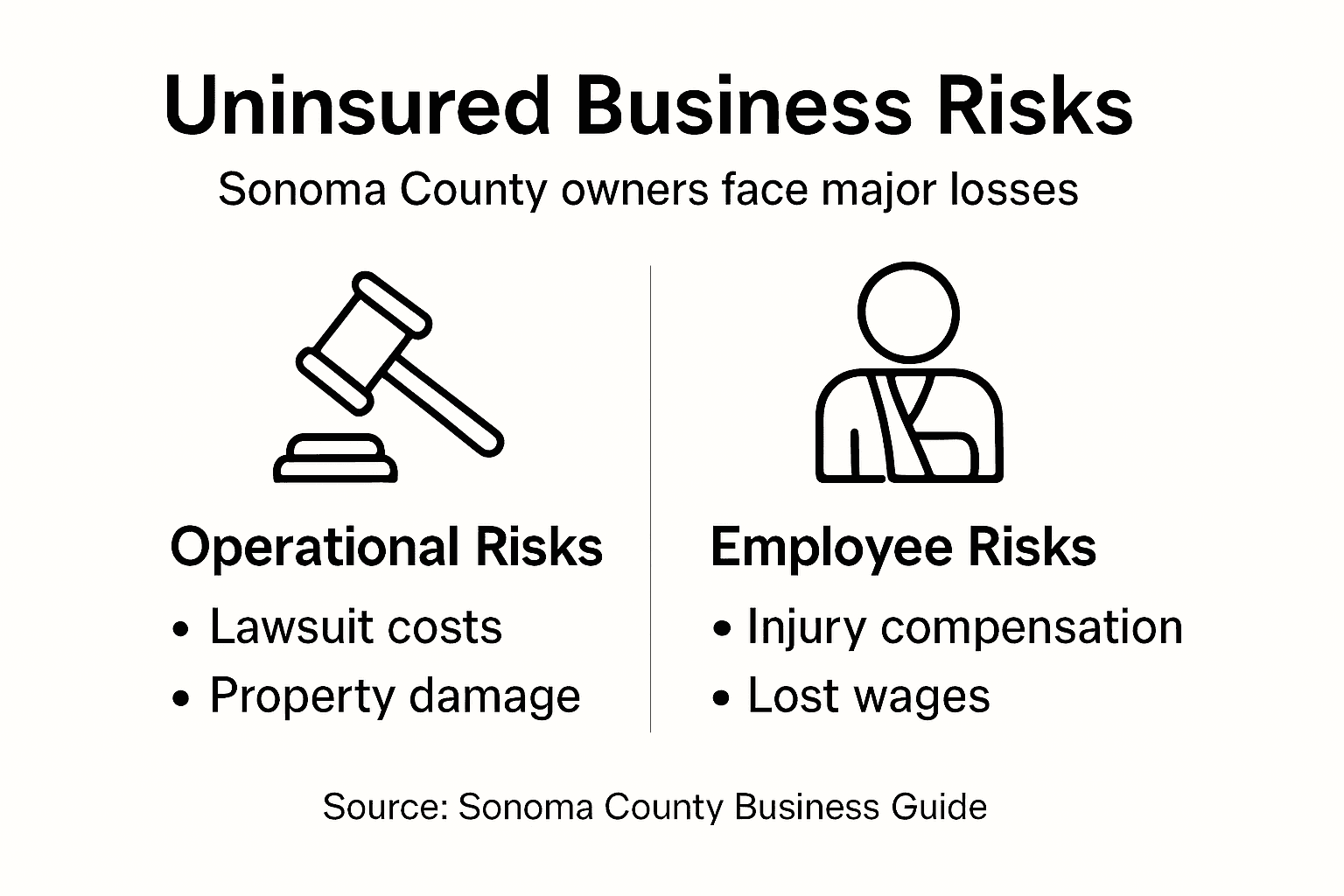
The financial impact compounds quickly. Uninsured businesses face higher interest rates on loans, lose bidding opportunities for contracts, and struggle to attract quality employees who want protection.
Being uninsured isn’t saving money. It’s betting your entire business on luck.
Pro tip: Calculate the replacement cost of your physical assets, potential liability exposure, and employee injury risks, then compare that total to your annual insurance premium—the comparison usually shocks uninsured owners into action.
Secure Your Sonoma County Business with Personalized Protection
Running a business in Sonoma County means facing unique risks—from legal requirements to financial vulnerabilities that can threaten your livelihood if left unprotected. The article highlights critical challenges such as legal mandates like workers’ compensation, the costly consequences of uninsured losses, and the need for clear understanding of your coverage limits. Business owners often underestimate their exposure and overestimate their protection, risking personal assets and business continuity without the right insurance solutions.
At Jenkins Insurance Agency Inc., we understand these concerns and offer tailored business insurance options designed specifically for Sonoma County entrepreneurs. With our local expertise and affiliation with Farmers Insurance, we provide clear guidance to ensure your coverage matches your risks, including general liability, commercial property, workers’ compensation, and specialty policies for vulnerable populations. We focus on helping you avoid costly gaps and compliance pitfalls with personalized service that sees your needs beyond standard policies.
Unlock peace of mind today by exploring your business insurance options with trusted local experts. Visit Uncategorized – Jenkins Insurance Agency Inc. to learn more.

Protect your personal assets and keep your business running smoothly in the face of unexpected events. Contact Jenkins Insurance Agency Inc. now to review your coverage and secure exactly what you need for Sonoma County compliance and financial resilience at https://jenkinsinsuranceagencyinc.com. Your business deserves more than just insurance; it deserves attentive, local partnership.
Frequently Asked Questions
What is business insurance and why is it important?
Business insurance is a legal contract that protects your company from financial losses due to unexpected events, such as lawsuits, property damage, or employee injuries. It is essential for safeguarding personal assets, ensuring business continuity, and meeting legal requirements.
What types of business insurance are required in California?
In California, businesses with employees must have workers’ compensation insurance, which covers medical expenses and lost wages if an employee is injured. Other common types of insurance include general liability, product liability, professional liability, and commercial property insurance.
What risks do business owners face without insurance?
Operating without insurance exposes business owners to significant financial risks, including personal liability for lawsuits, regulatory fines for non-compliance, and potential business closure due to inability to cover losses. One incident can lead to financial disaster.
How does business insurance protect personal assets?
Business insurance protects personal assets by covering costs associated with lawsuits or claims that exceed business assets. Without insurance, owners risk losing personal savings, property, and other assets in the event of a legal claim or significant financial loss.
Recommended
- Business Insurance Benefits for Sonoma County Owners – Jenkins Insurance Agency Inc.
- Business Insurance Concepts: Protecting Sonoma Companies – Jenkins Insurance Agency Inc.
- Step-by-Step Guide to Property Insurance California – Jenkins Insurance Agency Inc.
- The Best Small Business Insurance Plans in Sonoma County – Jenkins Insurance Agency Inc.