
TL;DR:
- California businesses face daily risks beyond wildfires, including theft, floods, and liability.
- Market shifts cause higher premiums and reduced coverage options, forcing reliance on FAIR Plan and layered policies.
- Proper insurance, mitigation, and regular reviews are vital to protect assets and ensure business continuity.
Most California business owners think about property insurance only when disaster strikes. But the real risk isn’t just wildfires or earthquakes. It’s the everyday threats, a break-in, a burst pipe, a liability claim, that can quietly drain your finances before any major event ever occurs. California’s insurance market has also shifted dramatically, with wildfire-driven losses topping $22.4 billion in claims as of late 2025. Understanding why property insurance matters, and how to navigate today’s market, is no longer optional for serious business owners.
Table of Contents
- Understanding the risks to business property in California
- Why business property insurance is essential for California businesses
- Navigating California’s evolving business property insurance market
- How to optimize coverage and minimize costs: Practical tips
- The uncomfortable truth about insuring business property in California
- Protect your business property with expert guidance
- Frequently asked questions
Key Takeaways
| Point | Details |
|---|---|
| California risks are rising | Wildfires and insurer exits make property coverage more critical for businesses than ever. |
| Insurance is essential protection | Business property insurance defends assets, income, and operational continuity. |
| Market changes demand action | Up-to-date guidance and risk mitigation can improve your coverage and costs. |
| Tailored solutions matter | A one-size-fits-all approach will not protect most California businesses in 2026. |
Understanding the risks to business property in California
California is a genuinely unique place to run a business. The climate, the geography, and the economy all create a risk environment unlike any other state. And while wildfires get most of the headlines, they are far from the only threat your property faces.
Here are the major risks California business owners need to account for:
- Wildfires: The most visible threat. Climate-linked insurance risks have pushed insurers to non-renew policies in high-risk areas across the state.
- Earthquakes: California sits on active fault lines. Standard property policies do not cover earthquake damage, so separate coverage is often needed.
- Theft and vandalism: Commercial properties are frequent targets, especially in areas with high foot traffic or valuable equipment on-site.
- Flooding: Heavy rains and storm runoff can cause serious damage, yet flood coverage is typically excluded from standard policies.
- Business interruption: Even a short closure from any of these events can mean lost revenue that is hard to recover from.
By the numbers: Wildfire claims in California reached $22.4 billion as of December 2025, a figure that has accelerated insurer exits from the state and reshaped the entire market.
The California SMB insurance changes happening right now are not abstract policy shifts. They affect whether you can get coverage, how much it costs, and what options remain available to you.
Insurers have been pulling back from high-risk zones at a pace that has surprised even industry veterans. Non-renewals are increasing, and many businesses are being pushed toward the California FAIR Plan, which is the state’s insurer of last resort. The FAIR Plan exists to fill gaps, but it was never designed to replace a full commercial property policy.
Your risk level also varies significantly based on location and the mitigation steps you have taken. A business in a fire-prone area with no defensible space or fire suppression system will face very different options than one that has invested in risk reduction. Understanding underinsurance for small businesses is equally important, because many owners discover their coverage limits fall short only after a loss occurs.
Why business property insurance is essential for California businesses
Once you understand what your property is up against, the case for insurance becomes very clear. But it goes beyond just protecting your building or equipment.
Here are the core reasons why business property insurance is essential:
- Protecting physical assets: Your building, inventory, furniture, and equipment represent real money. Replacing them out of pocket after a fire or theft can be financially devastating.
- Meeting lease and mortgage requirements: Most commercial landlords and lenders require proof of insurance before you can operate. Skipping coverage can put your lease or loan at risk.
- Covering lost income: Many policies include business interruption coverage, which replaces lost revenue while your property is being repaired or rebuilt.
- Managing legal liabilities: If a customer or vendor is injured on your property, liability coverage protects you from costly lawsuits.
- Preparing for the unexpected: No business plan accounts for every risk. Insurance is the financial safety net that keeps a bad event from becoming a permanent closure.
It is worth noting that some larger firms are exploring self-insurance as the market tightens. However, as rising costs and market contraction reshape options, most small California businesses face acute financial exposure without proper coverage. Self-insurance is simply not a realistic option for the majority of small and mid-sized operations.
Investing in fire protection systems can also lower your premiums meaningfully, making coverage more affordable while also reducing your actual risk. It is one of the smartest moves you can make as a business owner in California right now.
Pro Tip: Review your policy limits annually. Property values and replacement costs have risen sharply in recent years, and a policy that was adequate two years ago may leave you underinsured today. Explore the types of business property insurance available to make sure your coverage matches your actual exposure.
Adequate coverage is not just about surviving a disaster. It is about keeping your business running, your employees paid, and your customers served, no matter what happens.
Navigating California’s evolving business property insurance market
The California insurance market has changed faster in the past three years than in the previous two decades. If you have tried to renew or shop for coverage recently, you already know this firsthand.
Here is a clear comparison of your main coverage options:
| Feature | Standard commercial policy | California FAIR Plan |
|---|---|---|
| Fire coverage | Yes | Yes |
| Theft and vandalism | Yes | No |
| Liability coverage | Yes | No |
| Business interruption | Yes | No |
| Coverage limit | Varies | Up to $20M per building |
| Best for | Most businesses | High-risk areas only |
The FAIR Plan serves as insurer of last resort for high-risk properties, and commercial limits were increased to $20 million per building to better serve business owners who cannot find coverage elsewhere. But the FAIR Plan only covers basic fire risk. You will need a Difference in Conditions (DIC) policy layered on top to get protection for theft, liability, and other standard risks.
California’s market hardening reflects a broader national trend. Insurers are exiting high-risk zones due to regulatory pressures and rising reinsurance costs. The growth of the FAIR Plan itself is a signal that the standard market is under serious strain.

If you receive a non-renewal notice, do not wait. Acting quickly gives you more options. Work with a local agent who understands California’s market to explore surplus lines carriers, specialty insurers, and FAIR Plan combinations before your current coverage lapses.
Pro Tip: If you are placed on the FAIR Plan, pair it with a DIC policy immediately. Basic fire coverage alone leaves major gaps that could cost you everything in a real loss event. Check out our FAIR Plan guide and business insurance details for more on how to structure this correctly.
How to optimize coverage and minimize costs: Practical tips
Knowing your options is only part of the equation. The other part is taking concrete steps to strengthen your insurability and control what you pay.
Here is a practical breakdown of cost factors and mitigation actions:
| Action | Potential impact on premium |
|---|---|
| Install fire suppression system | Significant reduction |
| Create defensible space around property | Moderate reduction |
| Update electrical and plumbing systems | Moderate reduction |
| Bundle multiple policies | Additional discount |
| Increase deductible | Lower premium, higher out-of-pocket risk |
Start with a thorough property documentation review. Photograph all assets, keep updated inventory records, and make sure your coverage limits reflect current replacement costs, not original purchase prices. This step alone can prevent a painful underinsurance discovery after a loss.
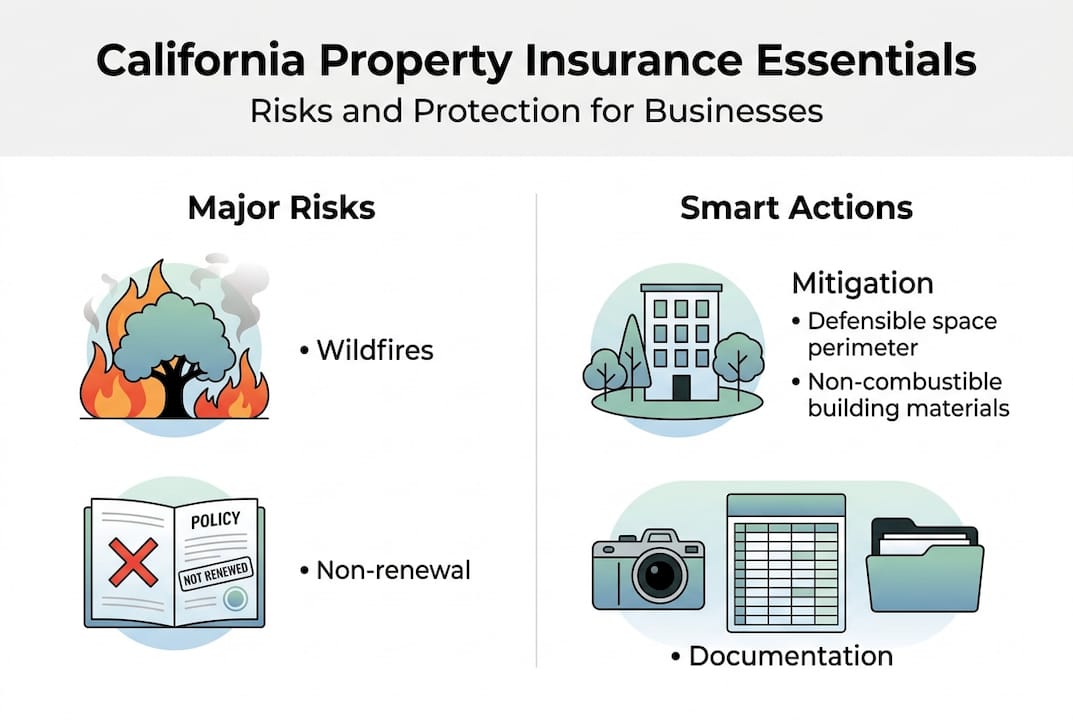
Mitigation is your most powerful tool right now. Mitigation reduces premiums and improves your chances of staying in the standard market rather than being pushed to the FAIR Plan. Installing fire protection systems is one of the most direct ways to signal to insurers that your property is a lower risk.
Here are additional steps to strengthen your position:
- Bundle your commercial property policy with general liability or a Business Owner’s Policy (BOP) for better rates.
- Review your policy every year, not just at renewal time.
- Work with an agent who shops multiple carriers on your behalf.
- Ask about credits for security systems, alarm monitoring, and compliance with local fire codes.
Pro Tip: Do not wait for a non-renewal to review your coverage. Proactively exploring coverages for small businesses and common business policies puts you in a stronger negotiating position with insurers.
The uncomfortable truth about insuring business property in California
Here is what most insurance guides will not tell you: the system is under real strain, and pretending otherwise does not help you make better decisions.
We have seen business owners in Sonoma County and across California struggle to find affordable coverage, even after doing everything right. Mitigation, documentation, compliance, and still facing non-renewals or steep rate increases. That is the reality of this market.
Some industry voices suggest that self-insurance may be viable for large firms with deep reserves. But for most small businesses, that is not a real option. One major loss without coverage can end a business that took decades to build.
Our honest take: skipping or skimping on property insurance is a bigger gamble now than it has ever been, not a smaller one. The market is harder, the risks are greater, and the consequences of being uninsured are more severe. What you need is not just a policy. You need an expert who understands insurance importance for SMBs and can help you navigate this landscape with clear eyes and real options.
Protect your business property with expert guidance
Navigating California’s property insurance market on your own is genuinely difficult right now. Between non-renewals, rising premiums, and the complexity of FAIR Plan combinations, there is a lot to get right.

At Jenkins Insurance Agency Inc., we work with business owners throughout Sonoma County and California to find business insurance solutions that actually fit your situation. We know this market, we know the local risks, and we know how to build coverage that protects what you have worked hard to create. Whether you need help understanding your property insurance options or want a full policy review, we are here to help. Reach out to our team today and let’s build a plan that gives you real peace of mind.
Frequently asked questions
What does business property insurance cover in California?
Typical policies cover damage from fire, theft, vandalism, weather events, and some liability, but often exclude earthquakes and floods unless added separately. FAIR Plan policies cover basic fire risk and require a DIC policy for full protection.
How has wildfire risk affected business property insurance?
Wildfire risk has led insurers to non-renew in high-risk areas, increase rates significantly, and push many businesses toward the FAIR Plan as the only available option.
What is the California FAIR Plan for businesses?
The FAIR Plan is an insurer of last resort offering basic property coverage up to $20 million per building. Businesses need a DIC policy layered on top for theft, liability, and full protection.
Can businesses self-insure instead of buying property insurance?
Large firms with significant reserves may explore self-insurance, but small businesses face acute risks without coverage and are unlikely to absorb major losses without serious financial consequences.
Recommended
- The essential business insurance checklist for California owners – Jenkins Insurance Agency Inc.
- Why business insurance matters for California SMBs in 2026 – Jenkins Insurance Agency Inc.
- Step-by-step guide to business insurance in California 2026 – Jenkins Insurance Agency Inc.
- Why Insure Your Business: Protecting Sonoma County Owners – Jenkins Insurance Agency Inc.
- How Fire Protection System Help Businesses Save Money