
Most California small businesses are growing their revenue, yet 77% remain underinsured, putting their operations at serious risk. This gap stems from widespread confusion about what coverage truly protects a business and which policies are actually required by law. Understanding the real value of comprehensive business insurance isn’t just about compliance, it’s about protecting everything you’ve built. Whether you run a retail shop in Santa Rosa or a consulting firm in San Francisco, the right insurance strategy can mean the difference between weathering a crisis and closing your doors permanently.
Table of Contents
- Understanding California Business Insurance Requirements And Common Gaps
- Key Business Insurance Coverages And Their Role In Risk Protection
- Insurance Coverage Comparison And Strategic Bundling Options For Small Businesses
- Practical Steps For Securing Comprehensive Business Insurance In California
- Protect Your California Business With Trusted Insurance Solutions
Key takeaways
| Point | Details |
|---|---|
| Underinsurance is widespread | Despite revenue growth, most small businesses lack adequate coverage for their actual risks. |
| Workers’ comp is mandatory | California legally requires workers’ compensation insurance if you employ anyone. |
| Liability coverage protects assets | General and professional liability shield your business from costly third-party claims. |
| Business interruption saves operations | This coverage replaces lost income during forced closures, preventing financial collapse. |
| Bundling reduces costs | Combining policies into a Business Owner’s Policy typically lowers premiums while improving protection. |
Understanding California business insurance requirements and common gaps
California law mandates specific insurance coverages for businesses, yet many owners remain unclear about what’s legally required versus what’s simply smart protection. Workers’ compensation is mandatory for any California business with employees, covering medical costs and lost wages if someone gets injured on the job. Similarly, if your business owns vehicles, commercial auto insurance is legally required before those vehicles can operate on public roads.
Beyond these legal requirements, several other coverages are critical but not mandated by state law. General liability insurance protects against third-party injury and property damage claims, which landlords typically require before signing commercial leases. Professional liability covers errors and omissions in service delivery, essential for consultants, accountants, and other professional services. Property insurance protects your physical assets from fire, theft, and other perils, particularly important given California’s wildfire risks.
The confusion around requirements creates dangerous gaps. Approximately 65% of small businesses carry general liability coverage, but far fewer have professional liability or adequate property insurance. Many owners assume their landlord’s policy covers their business property, or that general liability protects against professional mistakes. These misconceptions leave businesses vulnerable to claims that could drain savings or force closure.
Here’s what California businesses need to know:
- Legally mandated: Workers’ compensation (if you have employees), commercial auto insurance (if business owns vehicles), disability insurance (companies with 5+ employees)
- Lease required: General liability coverage, often with specific minimum limits set by landlords
- Strongly recommended: Professional liability (for service businesses), property insurance (for physical assets), business interruption coverage (for income protection)
- Industry specific: Liquor liability (bars/restaurants), cyber liability (businesses handling customer data), errors and omissions (licensed professionals)
Understanding which coverages are mandatory versus recommended helps you build a comprehensive insurance strategy that protects your business legally and practically. Many owners delay securing recommended coverages because they’re not required, only to face devastating losses when claims arise. Smart business owners recognize that recommended coverages often provide the most valuable protection against real-world risks. For businesses using vehicles, reviewing California auto insurance requirements ensures you meet both legal and practical protection needs.
Key business insurance coverages and their role in risk protection
Each type of business insurance serves a distinct protective function, yet many small business owners misunderstand what their policies actually cover. General liability insurance protects your business when someone claims bodily injury or property damage caused by your operations, products, or premises. If a customer slips in your store or your product damages someone’s property, general liability covers legal defense and settlement costs. The average claim now reaches $97,000, making this coverage essential for protecting business assets.
Professional liability, also called errors and omissions insurance, covers claims arising from professional mistakes or failure to deliver promised services. A consultant who provides faulty advice, an accountant who makes a costly error, or a designer whose work fails to meet specifications could face lawsuits that professional liability covers. Surprisingly, 74% of small business owners misunderstand what general liability actually protects, often assuming it covers professional mistakes when it doesn’t.

Property insurance protects physical business assets like buildings, equipment, inventory, and furniture against perils including fire, theft, vandalism, and certain natural disasters. In California, where wildfire risk continues growing, reviewing property policy exclusions is critical. Many standard policies exclude or limit wildfire damage, requiring separate endorsements or specialized coverage. Business owners who assume their property policy covers all disasters often discover gaps only after filing claims.
Business interruption insurance replaces lost income and covers extra expenses when your business must temporarily close due to covered perils. When Cole Hardware’s San Francisco location suffered a major fire, business interruption coverage supported the company through months of closure, covering payroll, rent, and lost profits while they rebuilt. Without this coverage, many businesses exhaust savings within weeks of an unexpected shutdown, forcing permanent closure even when physical damage is repairable.
Pro Tip: Bundling general liability, property, and business interruption into a Business Owner’s Policy typically costs 20 to 30% less than purchasing each policy separately while simplifying management with a single renewal date.
Here’s how key coverages protect different business risks:
- General liability: Third-party bodily injury, property damage, advertising injury, legal defense costs
- Professional liability: Professional errors, omissions, negligence claims, failure to deliver services as promised
- Property insurance: Building damage, equipment loss, inventory destruction, business personal property
- Business interruption: Lost income during closures, continuing expenses like payroll and rent, temporary relocation costs
- Workers’ compensation: Employee medical expenses, lost wages, rehabilitation costs, death benefits for work-related injuries
Understanding what each policy actually covers versus common misconceptions helps you build protection that addresses real business risks. Many owners discover coverage gaps only after filing claims, when insurers deny coverage for losses they assumed were protected. Reviewing common business insurance policies with an experienced agent clarifies what you’re actually buying and where additional coverage might be necessary.
Insurance coverage comparison and strategic bundling options for small businesses
Comparing business insurance options side by side reveals how different policies work together to create comprehensive protection. Each coverage addresses specific risks, with varying costs and legal requirements that California business owners must navigate strategically.
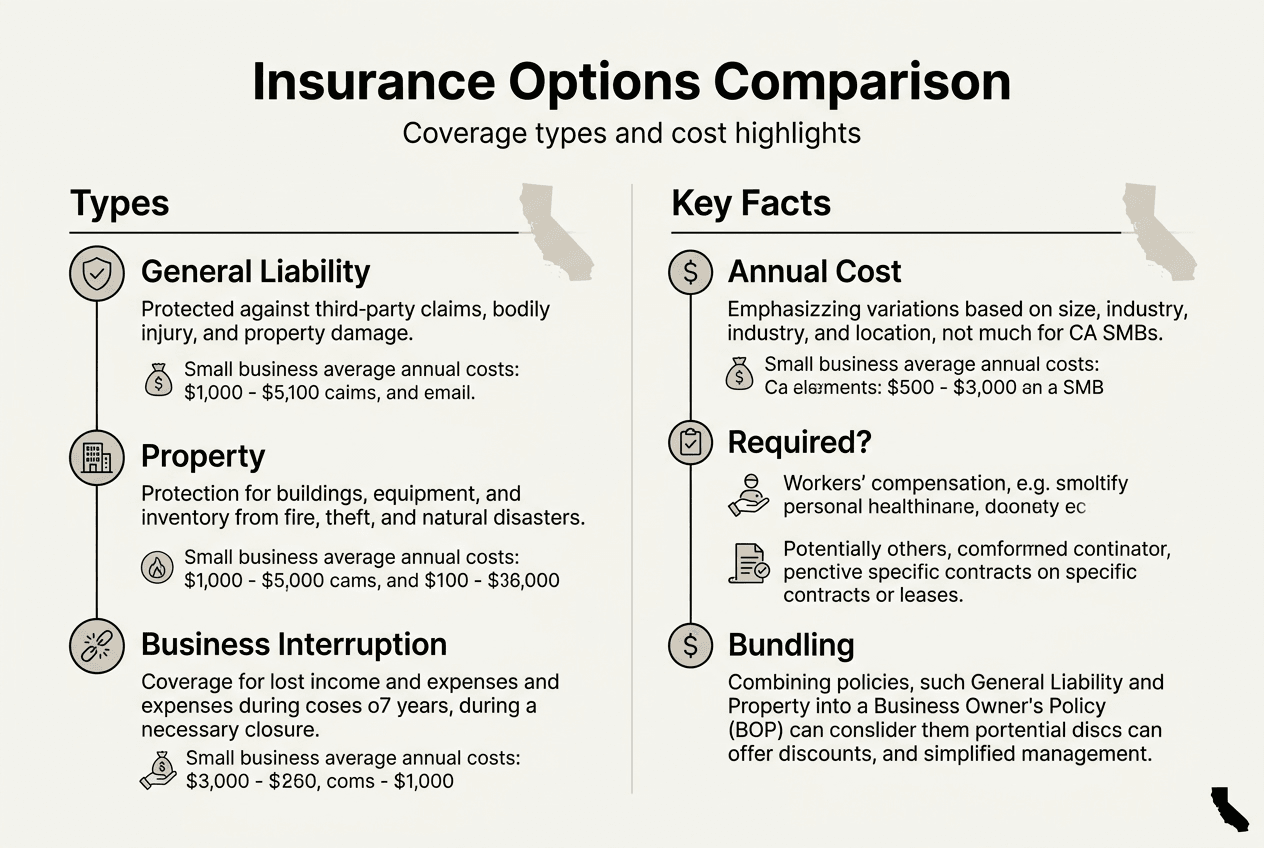
| Coverage Type | Typical Annual Cost | Primary Protection | Legally Required |
|---|---|---|---|
| General Liability | $500 to $3,000 | Third-party injury/property damage claims | No (often lease required) |
| Professional Liability | $800 to $3,500 | Professional errors and omissions | No (industry dependent) |
| Property Insurance | $1,000 to $5,000 | Physical asset damage/loss | No (often lease required) |
| Business Interruption | $500 to $2,500 | Lost income during closures | No |
| Workers’ Compensation | Varies by payroll | Employee injury coverage | Yes (if employees) |
Bundling multiple coverages into a Business Owner’s Policy offers significant advantages beyond cost savings. BOPs typically reduce premiums by 20 to 30% compared to purchasing policies separately, while streamlining policy management with unified coverage limits, deductibles, and renewal dates. This simplification reduces administrative burden and ensures coverage components work together without gaps or overlaps.
A standard BOP combines general liability, property insurance, and business interruption coverage into one package designed for small to medium businesses. Insurance carriers price BOPs based on business type, location, revenue, and claims history, often offering better rates than individual policies because bundled customers typically stay longer and file fewer claims. For businesses meeting BOP eligibility requirements, this bundling represents the most cost-effective path to comprehensive protection.
Pro Tip: While BOPs offer excellent value, confirm your bundled policy addresses California-specific risks like earthquake and wildfire exposure, which often require separate endorsements or specialized coverage not included in standard packages.
Bundling has limits. Businesses with unique risks, high-value assets, or specialized operations may need custom coverage beyond what standard BOPs provide. A tech company handling sensitive customer data needs cyber liability insurance. A manufacturer with significant product liability exposure requires higher limits than BOP packages typically offer. A restaurant needs liquor liability coverage not included in standard bundles. Understanding when bundling works and when custom policies are necessary ensures you’re not underinsured despite having a BOP.
Smart bundling strategies involve:
- Starting with a BOP for core coverages (liability, property, business interruption)
- Adding industry-specific endorsements for unique risks
- Purchasing separate policies for high-limit needs or specialized exposures
- Reviewing coverage annually as your business grows and risks evolve
- Working with agents who understand California’s regulatory environment and local risk factors
The goal is balancing comprehensive protection with cost efficiency. Bundling can save substantial money while ensuring your business has coverage that actually responds when claims occur. Many businesses save on premiums only to discover their bundled policy excludes the specific peril that caused their loss, highlighting why understanding policy details matters more than just finding the lowest price.
Practical steps for securing comprehensive business insurance in California
Securing the right business insurance requires a systematic approach that addresses your specific risks, budget, and legal obligations. Following these steps helps California business owners build protection that actually works when needed.
-
Assess your business risks: Identify potential losses including customer injuries, property damage, professional errors, business interruptions, employee injuries, and industry-specific exposures. Consider your location, operations, assets, revenue, and growth plans.
-
Determine mandatory coverages: Confirm which policies California law requires for your business structure, employee count, and vehicle ownership. Workers’ compensation, commercial auto, and disability insurance have specific legal thresholds.
-
Evaluate recommended coverages: Beyond legal requirements, identify policies that protect your most valuable assets and likely risks. Consider general liability, professional liability, property, business interruption, and cyber coverage based on your operations.
-
Request detailed quotes: Contact multiple insurers or work with an independent agent who can compare carriers. Provide accurate information about your business to ensure quotes reflect actual coverage needs and proper pricing.
-
Compare policies carefully: Look beyond premiums to examine coverage limits, deductibles, exclusions, and policy conditions. The cheapest policy often provides the least protection when you need it most.
-
Consult experienced agents: Work with professionals who understand California insurance regulations and local risk factors. They can explain confusing terms, identify coverage gaps, and tailor policies to your specific situation.
-
Review coverage annually: As your business grows, adds employees, acquires assets, or changes operations, insurance needs evolve. Annual reviews ensure your coverage keeps pace with your business development.
Timing matters significantly. Nearly 45% of small business owners delay securing coverage longer than advisable, operating without protection during critical early growth periods. Starting insurance conversations before signing leases, hiring employees, or launching operations prevents gaps that leave you vulnerable to losses.
Partnering with knowledgeable local agents provides advantages that online-only insurance shopping can’t match. Experienced agents understand California’s unique regulatory environment, can explain how different policies interact, and advocate for you during claims. They help you avoid common mistakes like buying inadequate limits, missing critical endorsements, or selecting policies with exclusions that eliminate coverage for your most likely losses.
Implementing these practical steps positions your business for long-term success by protecting against risks that could otherwise derail your operations. Insurance isn’t just a legal requirement or lease obligation, it’s a strategic business decision that preserves the value you’ve created. Understanding which policies every small business needs and how to secure them effectively gives you confidence to focus on growing your business rather than worrying about potential disasters.
For California businesses in specific regions, local expertise becomes even more valuable. A Santa Rosa business insurance guide addresses regional considerations like wildfire zones, local building codes, and county-specific requirements that affect coverage needs and pricing. Taking action now to secure comprehensive protection ensures your business can weather unexpected challenges and continue serving customers for years to come.
Protect your California business with trusted insurance solutions

Understanding why business insurance matters is just the first step. Jenkins Insurance Agency brings decades of local expertise helping California business owners secure coverage that actually protects their operations when it matters most. Our team specializes in comprehensive business insurance solutions tailored to your specific industry, location, and risk profile, ensuring you’re not paying for unnecessary coverage while avoiding dangerous gaps.
We guide you through every decision, from determining which policies your business truly needs to finding bundling opportunities that reduce costs without sacrificing protection. Our affiliation with Farmers Insurance provides access to competitive rates and comprehensive coverage options backed by a nationally recognized carrier, while our local presence ensures personalized service that understands California’s unique business environment. Don’t wait until a claim reveals coverage gaps, partner with professionals who help you build protection that works.
Frequently asked questions
What types of insurance are mandatory for California small businesses?
Workers’ compensation insurance is legally required if you have any employees, covering medical costs and lost wages for work-related injuries. Commercial auto insurance is mandatory if your business owns vehicles used for operations. Disability insurance becomes required once you employ five or more people. Other coverages like general liability and professional liability are not legally mandated but often required by landlords or essential for protecting business assets.
Why is business interruption insurance important for retail stores?
Business interruption coverage replaces lost income and covers continuing expenses like rent and payroll when your store must close temporarily due to covered events like fires or natural disasters. Cole Hardware’s experience after a major fire demonstrates how this insurance supported recovery by covering months of lost revenue while they rebuilt. Without it, most retail businesses exhaust savings within weeks of an unexpected closure, often forcing permanent shutdown even when physical repairs are possible.
How can I reduce the cost of comprehensive business insurance?
Bundling multiple policies like general liability, property insurance, and workers’ compensation into a Business Owner’s Policy typically reduces premiums by 20 to 30% compared to purchasing each separately. Regularly reviewing coverage ensures you’re not paying for protection you’ve outgrown or missing discounts for safety improvements and claims-free years. Working with an independent agent who can compare multiple carriers helps you find the best combination of coverage and cost.
What’s the difference between general liability and professional liability insurance?
General liability covers third-party bodily injury and property damage claims from your business operations, products, or premises. Professional liability, also called errors and omissions insurance, protects against claims arising from professional mistakes, negligence, or failure to deliver promised services. A consulting firm needs professional liability for advice that causes client losses, while general liability wouldn’t cover these professional service errors.
How often should I review my business insurance coverage?
Review your coverage annually at renewal time and whenever significant business changes occur, such as hiring employees, acquiring major assets, expanding locations, or launching new products or services. Business growth, changing regulations, and evolving risks mean coverage that was adequate last year may leave dangerous gaps today. Annual reviews with your agent ensure your protection keeps pace with your business development.
Recommended
- Small business insurance California 2026: 30% underinsured – Jenkins Insurance Agency Inc.
- Auto Insurance for Business Owners in California – Jenkins Insurance Agency Inc.
- Why Business Owner Insurance Matters Locally – Jenkins Insurance Agency Inc.
- Why Insure Your Business: Protecting Sonoma County Owners – Jenkins Insurance Agency Inc.
- Business Security Needs: Protecting Assets in 2026 – Safes and Security Direct
- Essential features of business routers for SMBs in 2026