
TL;DR:
- Regularly review and update your life insurance policies annually or after major life changes.
- Use the DIME method to accurately calculate your current coverage needs based on debts, income, mortgage, and education costs.
- Keep beneficiary information current to avoid legal disputes and ensure benefits reach the intended recipients.
Life insurance feels like a decision you make once and move on. You sign the paperwork, file it away, and assume your family is protected. But here’s the reality: your life keeps changing, and a policy you bought five years ago may no longer reflect your actual needs. Marriage, new children, a bigger mortgage, or a career change can all shift what your family truly needs to stay secure. In California, where housing costs and education expenses are among the highest in the country, the stakes are even higher. This guide walks you through when to update, how to calculate the right coverage, and what most families miss along the way.
Table of Contents
- Key life events and annual triggers for updating your policy
- How to recalculate the right coverage (DIME approach for Californians)
- Why beneficiary updates are essential, not optional
- How health and lifestyle changes can lower your premiums
- Why most families overlook life insurance reviews, and what actually works
- Secure your family’s future with expert life insurance advice
- Frequently asked questions
Key Takeaways
| Point | Details |
|---|---|
| Update after big changes | Marriage, kids, divorce, or buying a home are all times to review your policy. |
| Use DIME method | Debt, income, mortgage, and education costs determine how much coverage your family needs. |
| Beneficiary accuracy is vital | Keep beneficiary designations current to avoid disputes and missed payouts. |
| Health improvements save money | Lifestyle changes can qualify you for lower life insurance premiums after a review. |
| Annual reviews prevent gaps | Checking your policy yearly ensures your coverage matches your evolving life and California’s high costs. |
Key life events and annual triggers for updating your policy
Now that we’ve highlighted why updates matter, let’s clarify exactly when you should revisit your coverage.
Individuals and families should update life insurance policies annually and after major life events. That’s not just a best practice. It’s a safeguard that keeps your coverage aligned with your real life. Think of your policy as a living document. It should grow and shift as your circumstances do.
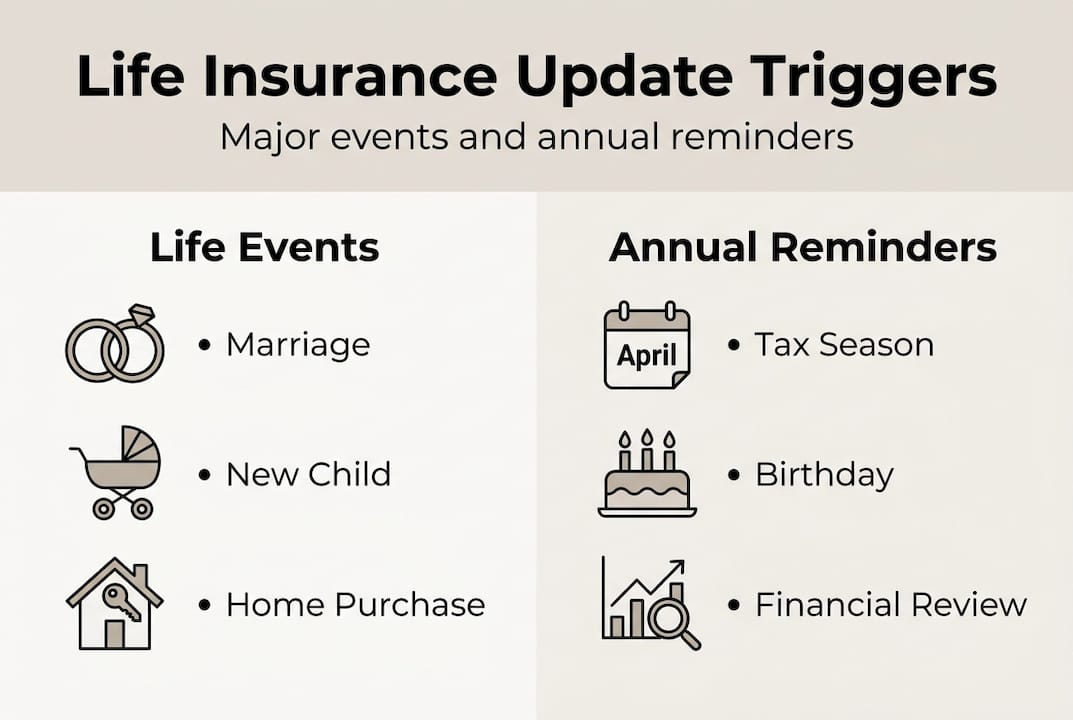
Here are the most common triggers that signal it’s time to review:
- Marriage or entering a domestic partnership — Your financial responsibilities just doubled.
- Having or adopting children — More dependents means more income replacement needed.
- Buying a home — A new mortgage is a major liability that needs to be covered.
- Significant income change — A raise, a job loss, or a new business all affect how much coverage makes sense.
- Divorce — Beneficiary designations and coverage amounts often need to change immediately.
- Relocating within California — Moving from a rural county to the Bay Area or Los Angeles can dramatically change your cost of living.
Beyond the big moments, annual reviews catch the smaller shifts that add up over time. Growing debts, new financial goals, or a child entering college can all quietly change your coverage needs without a single dramatic event.
For families in Sonoma County and across California, life changes and reviews go hand in hand. The state’s dynamic cost of living means that what felt like generous coverage in 2021 may fall short today. Inflation, rising home values, and increased childcare costs all quietly erode the value of a fixed policy.
“A policy review isn’t about finding something wrong. It’s about making sure everything is still right for where you are today.”
Pro Tip: Set a recurring calendar reminder once a year, tied to something you already do. Tax season or the start of a new school year works well. Pair your reviewing your policy timing with a moment that already feels like a fresh start.
How to recalculate the right coverage (DIME approach for Californians)
With the right timing in mind, let’s look at how to calculate the coverage you truly need in California.
One of the most reliable ways to figure out how much life insurance you need is the DIME method. Use DIME methodology to build a clear picture of your financial obligations. DIME stands for:
- Debt — Add up all outstanding debts except your mortgage (credit cards, car loans, student loans).
- Income replacement — Multiply your annual income by the number of years your family would need support (typically 10 to 15 years).
- Mortgage — Include the full remaining balance on your home loan.
- Education — Estimate the cost of college or vocational training for each child.
Here’s how those numbers can look for a California family:
| Family scenario | Annual income | Estimated DIME coverage needed |
|---|---|---|
| Single parent, 1 child, renting | $65,000 | $850,000 to $1.1M |
| Dual income, 2 kids, homeowner | $120,000 | $1.6M to $2.2M |
| Single income, 3 kids, Bay Area home | $95,000 | $2.0M to $2.8M |
These numbers may feel large. But California’s insurance for California residents context matters here. The median home price in many California counties sits well above $700,000. Add four years of UC tuition per child, and education costs alone can exceed $140,000. These aren’t hypothetical numbers. They’re the real financial landscape your family lives in.
The DIME calculation guide is a practical starting point, but your situation is unique. That’s why we always recommend sitting down with someone who knows your full picture, not just running numbers through an online calculator.
Pro Tip: Recalculate your DIME every time a major financial milestone changes, whether that’s paying off a car loan, refinancing your mortgage, or adding a child to your household. Small changes can shift your coverage needs by hundreds of thousands of dollars.
If you’re exploring which policy structure fits your DIME results, reviewing the types of life insurance available to Sonoma County families is a smart next step.
Why beneficiary updates are essential, not optional
Understanding how much coverage you need is important, but keeping your beneficiary list accurate is just as crucial.
Your beneficiary is the person (or people) who receives the policy payout when you pass away. It sounds simple. But outdated beneficiary information is one of the most common and costly mistakes families make. Outdated designations lead to unintended payouts and family disputes that can take years to resolve in court.
Tens of millions of dollars in life insurance benefits go unclaimed or are misdirected every year. In many cases, it’s because the policyholder never updated their paperwork after a divorce, remarriage, or the birth of a child. The insurer has no way of knowing your life changed. They pay whoever is listed.
“Your policy doesn’t know you got divorced. It only knows what’s written on the form.”
Here’s how to make sure your beneficiary information stays current:
- Review your policy documents — Pull out your current policy and check who is listed as primary and contingent (backup) beneficiary.
- Update after every major life event — Divorce, remarriage, birth, adoption, or the death of a named beneficiary all require an update.
- Name contingent beneficiaries — If your primary beneficiary passes away before you, a contingent beneficiary ensures the benefit still reaches someone you trust.
- Notify your beneficiaries — Tell them the policy exists, where to find it, and how to file a claim. Understanding the insurance claim payout process ahead of time saves your family stress during an already difficult time.
- Check employer-sponsored policies too — Many people forget that group life insurance through work has separate beneficiary forms.
For guidance on updating beneficiaries and what documentation you’ll need, connecting with your agent directly is the fastest path forward.
How health and lifestyle changes can lower your premiums
Now that beneficiary accuracy is covered, let’s look at how your health and habits may actually put money back in your pocket.

Here’s something most people don’t realize: if your health has improved since you first bought your policy, you may qualify for lower premiums. Health and lifestyle improvements like quitting smoking or losing weight can qualify you for better rates through a process called re-underwriting. Re-underwriting simply means your insurer reassesses your health risk based on who you are today, not who you were five years ago.
Here’s what a difference it can make:
| Health change | Before monthly premium | After re-underwriting |
|---|---|---|
| Quit smoking (2+ years) | $180/month | $95/month |
| Lost 30 lbs, normal BMI | $145/month | $110/month |
| Controlled blood pressure | $160/month | $120/month |
These are illustrative examples, but the savings are real and worth pursuing. For policy review insights and what to expect from a re-underwriting process in 2026, reviewing current guidance can help you prepare.
When you sit down for your annual review, gather these documents and data points:
- Your current policy declarations page
- Recent medical records or lab results
- A list of current medications
- Updated income and debt figures
- Any new financial obligations (new mortgage, business loan, etc.)
For permanent life insurance policies, your annual review should also include an in-force illustration. This shows how your policy’s cash value is growing and whether the current premium structure still makes sense. Carrier stability matters too. You want to make sure the company behind your policy remains financially strong.
Pro Tip: If you’ve made meaningful health improvements in the past two years, ask your agent directly about re-underwriting. Don’t assume your rate is fixed forever. For a clear breakdown of your options, life insurance explained is a helpful starting point.
Why most families overlook life insurance reviews, and what actually works
Here’s what we’ve seen working with families across Sonoma County and California: most people don’t skip their policy review because they don’t care. They skip it because life gets busy and there’s no built-in reminder.
Even financially savvy families fall into the “set it and forget it” pattern. They assume that as long as the premiums are being paid, everything is fine. But coverage needs drift quietly over time. A policy that once felt generous can become inadequate without a single dramatic event.
What actually works is building a small, consistent habit. Tying your timely life insurance reminders to a seasonal moment, like the start of the school year or the end of tax season, turns a forgettable task into a routine one. It takes less than an hour once a year. That hour can be worth millions to your family.
Waiting for a “big enough” reason to review is the wrong approach. By the time the reason feels urgent, the gap in coverage is already there. Small, annual check-ins are far more effective than reactive scrambles after a major life change.
Secure your family’s future with expert life insurance advice
For those ready to act, connecting with a local expert can turn these insights into true peace of mind.
At Jenkins Insurance Agency Inc., we work with California families every day to make sure their coverage still fits their lives. Updating a policy doesn’t have to feel overwhelming. With the right guidance, it’s a straightforward conversation that can make a real difference for the people you love most.

Whether you’re exploring life insurance options for the first time or looking to update an existing policy, our local team is here to help. We understand the unique financial pressures California families face, from rising home values to education costs. If you’d like a clear, jargon-free walkthrough of your current coverage, explained life insurance resources on our site are a great place to start. Reach out to us and let’s make sure your family is truly protected.
Frequently asked questions
How often should I update my life insurance policy in California?
Review your policy annually or after major life events such as marriage, having children, a job change, or buying a home. Annual check-ins catch gradual shifts that big-event reviews often miss.
What if I forget to update my beneficiaries?
Outdated beneficiary information can result in benefits going to the wrong person or being tied up in legal disputes. Always update your designations after any significant family change.
Can my premium go down if I improve my health?
Yes. Quitting smoking or losing weight can qualify you for lower premiums after re-underwriting, where your insurer reassesses your current health risk.
How much life insurance do Californians typically need?
Many experts suggest 10 to 20 times annual income as a starting point, but California’s high housing and education costs often push that number higher for most families.
Is there a penalty for reviewing or changing my life insurance policy?
There’s no penalty for reviewing your policy. However, making changes or increasing coverage may require new underwriting, which could affect your premium based on your current health and age.
Recommended
- Insurance claims explained: secure your payouts in California – Jenkins Insurance Agency Inc.
- California Insurance Guide 2026: Save 25% with Bundling – Jenkins Insurance Agency Inc.
- Life Insurance Explained: Secure Your Family’s Future – Jenkins Insurance Agency Inc.
- Types of Life Insurance – Protecting Sonoma Families – Jenkins Insurance Agency Inc.