
TL;DR:
- Many California business owners assume renewing last year’s policy suffices, but evolving risks demand regular updates. Outdated coverage can leave new operations, assets, or legal changes uninsured, risking significant financial loss. Regular reviews and timely updates ensure comprehensive protection, cost savings, and enhanced business resilience.
Many California business owners assume that renewing last year’s policy is enough to stay protected. It feels routine, even responsible. But as commercial premiums rose 5-7% in Q1 2026 and business risks continued to evolve, simply hitting “renew” can leave dangerous gaps in your coverage. Your business today likely looks different from your business twelve months ago. New equipment, new staff, new services, or new California regulations may all affect what your policy actually covers. This article walks you through what’s at stake, when to act, and how to make the update process simple and stress-free.
Table of Contents
- The real risks of out-of-date business insurance
- How premium trends and business changes demand annual reviews
- Review checklist: Signs it’s time to update your coverage
- How to update your business insurance: A simple process
- Why the real win isn’t just compliance—it’s business resilience
- Get local help updating your California business insurance
- Frequently asked questions
Key Takeaways
| Point | Details |
|---|---|
| Annual update is crucial | Reviewing your policy yearly helps avoid coverage gaps and overpaying for insurance. |
| Premiums keep rising | California businesses face 5-7% annual premium hikes, making review essential for cost control. |
| Business changes trigger reviews | Major changes like hiring, new assets, or regulatory shifts require a fresh look at your coverage. |
| Regular reviews help you save | Updating insurance can unlock new discounts for risk management and improved safety measures. |
The real risks of out-of-date business insurance
Most business owners don’t realize their coverage has a gap until they file a claim. By then, the damage is already done. Out-of-date business insurance is one of the most common and most avoidable problems we see.
Here are the key risks when your policy hasn’t kept pace with your business:
- New operations go uninsured. If you’ve expanded your services, added a product line, or started taking on different types of jobs, your existing policy may not cover those activities at all.
- New equipment or property isn’t protected. Did you purchase new machinery, technology, or furniture this past year? If it wasn’t added to your policy, a fire or theft could leave you paying out of pocket.
- New locations fall through the cracks. Many businesses open a second location, use a storage unit, or shift to a hybrid model with employees working remotely. Each of these changes can create uncovered exposure.
- California liability law changes can affect your policy. California regularly updates labor laws, contractor regulations, and safety requirements. If your policy doesn’t reflect current legal standards, you could face liability that isn’t covered.
- Missed discounts from risk improvements. Installing new security systems or updating your fire suppression equipment might qualify you for lower premiums. But if you never review your policy, your insurer won’t automatically apply those savings.
Here’s a real scenario worth thinking about. A restaurant owner in Sonoma County added a catering component to their business mid-year. When a catering event resulted in property damage, they filed a claim only to find out the catering operation wasn’t listed on their policy. The claim was denied. That’s a painful lesson, and a completely preventable one.
As industry data confirms, coverage gaps from skipped reviews cost businesses both in uninsured losses and in overpaid premiums.
Failing to update your business insurance isn’t just a financial risk. It’s a gap in the foundation that holds your entire operation together.
Thinking carefully about protecting business assets starts with knowing what your current policy actually says versus what your business actually does today.
Pro Tip: Set a calendar reminder every year, ideally one to two months before your policy renewal date. That gives you enough time to review changes, consult your agent, and make updates before the deadline.

How premium trends and business changes demand annual reviews
Now that you understand the risks, let’s examine why annual reviews matter more in 2026 than ever before.
Insurance isn’t static. Commercial insurance premiums have been climbing steadily, and California is no exception. Commercial premiums increased 5-7% in Q1 2026 alone, which means businesses paying the same premium as last year are likely carrying either less coverage or more cost than they realize.
And it’s not just the cost going up. The nature of business risk is shifting too. Cyber threats are more common. Workforce changes create new liability exposures. Supply chain disruptions affect property values. These forces combine to make annual reviews not just useful, but necessary.
Here’s a snapshot of how premium changes are hitting different sectors in California:
| Business sector | Estimated 2025 premium trend | Estimated 2026 premium trend |
|---|---|---|
| Retail | +4% | +5-6% |
| Construction | +6% | +7-8% |
| Technology | +5% | +6-7% |
| Hospitality | +5% | +6-7% |
| Professional services | +3% | +4-5% |
| Healthcare | +6% | +7% |
These increases mean that paying the same premium you paid in 2024 may no longer get you the same level of protection. Insurers adjust coverage terms alongside pricing. Without a review, you may not even know the terms shifted.
Beyond market pricing, your own business changes drive the need for annual reviews too. Consider the following business events that almost always require a policy update:
- Hiring new employees, especially in roles that involve driving, handling equipment, or working with the public.
- Adding new revenue streams, such as online sales, delivery services, or consulting offerings.
- Signing a new commercial lease, which often requires minimum liability limits that may differ from your current policy.
- Purchasing or leasing new vehicles for business use.
- Reaching a new revenue milestone, because higher revenue typically means higher liability exposure.
Exploring the full range of business insurance benefits can help you understand which coverage adjustments deliver the most protection per dollar as your business grows.
Review checklist: Signs it’s time to update your coverage
With costs on the rise and businesses constantly evolving, here’s exactly how to spot when your policy needs attention.
Most business owners wait for renewal season to think about insurance. But some changes in your business should trigger a review right away, not twelve months later. Use this checklist to know when it’s time to reach out to your agent.
- You hired new staff. New employees expand your workers’ compensation and general liability exposure. Full-time employees, part-time staff, and even independent contractors can change your coverage needs.
- You opened or moved to a new location. Each physical location needs to be listed on your policy. An unlisted location is an unprotected one.
- You added new equipment or technology. Any significant asset that isn’t on your current policy schedule is uninsured.
- Your revenue grew significantly. Rapid growth often outpaces existing liability limits. A business that doubled its revenue may face double the liability exposure.
- You changed your business structure. Moving from sole proprietorship to LLC, or adding a business partner, can change how your policy needs to be written.
- California laws changed. New labor laws, contractor rules, or environmental regulations may create new liability categories that your current policy doesn’t address.
- You’re about to sign a major contract. Contracts often require specific types and amounts of coverage. Review your policy before signing, not after.
- You installed new safety systems. Security cameras, sprinkler upgrades, or fire alarms may qualify you for premium discounts, but only if your insurer knows about them.
Annual checkups help you avoid overpaying and make sure you’re getting every discount your risk management steps have earned.
Here’s a quick comparison to make the decision even clearer:
| Scenario | What updating your coverage provides | What skipping the update risks |
|---|---|---|
| New employee hired | Workers’ comp and liability coverage for their role | Uninsured injury or negligence claims |
| New equipment purchased | Replacement cost if lost or damaged | Full out-of-pocket replacement cost |
| Revenue growth | Adequate liability limits for higher exposure | Claims that exceed your current limits |
| New location opened | Property and liability coverage at that address | Zero coverage at the new location |
| Safety upgrades installed | Potential premium discounts | Missed savings, no credit for improvements |
You can explore your business insurance options and learn more about insurance policy types that may apply to your unique situation.
Pro Tip: Keep a running document or simple notes app entry throughout the year to log every major business change. When your annual review comes, you’ll have everything your agent needs in one place. This makes the review faster and more accurate.
How to update your business insurance: A simple process
Ready to take action? Here’s how to actually update your insurance step by step.
Many business owners put off updating their coverage because it sounds complicated. In reality, the process is straightforward when you work with a local agent who knows your business and the California market. Here’s how it works:
- Schedule a review appointment. Reach out to your agent at least one to two months before your renewal date. Don’t wait until the last week. Give yourself time to think, ask questions, and compare options.
- Audit your business changes from the past year. Before the meeting, go through your business records. Note any new hires, new assets, revenue changes, location changes, or service expansions. Your notes from throughout the year (see the Pro Tip above) will be very useful here.
- Meet with your agent and walk through your current policy. A good agent won’t just quote you a number. They’ll review each section of your existing policy against your current business reality and identify any gaps or redundancies.
- Compare coverage options and costs. If updates are needed, your agent should present you with options so you can make an informed choice. This is also the right time to ask about discounts for new risk controls or safety improvements.
- Update your policy documents and certificates of insurance. Once changes are agreed upon, make sure all updated documents are in your hands. If your business works with clients or landlords who require proof of insurance, request new certificates right away.
Good risk management steps not only protect your business but can also unlock meaningful discounts during your annual review. Ask your agent directly what steps you can take to reduce your premium.
For a deeper understanding of the types of policies that may factor into your review, take a look at common business policies that apply to California operations.
Pro Tip: During your review, specifically ask your agent: “Are there any new discounts I qualify for based on changes I’ve made this year?” Many business owners leave money on the table simply because they never asked.
Why the real win isn’t just compliance—it’s business resilience
Here’s something most business owners overlook. They think of an insurance review as a box to check. Get it done, file the paperwork, move on. But we believe that mindset misses the most valuable part of the process.
Updating your business insurance annually is actually one of the most effective operational strategies you can do for your company. Let us explain why.
When you sit down with your agent and go through the full picture of your business, you’re essentially running a business health check. You’re forced to look at every corner of your operation: your assets, your staff, your revenue, your liabilities. That’s rare. Most business owners don’t pause to do that kind of structured self-assessment outside of tax season. The insurance review forces it.
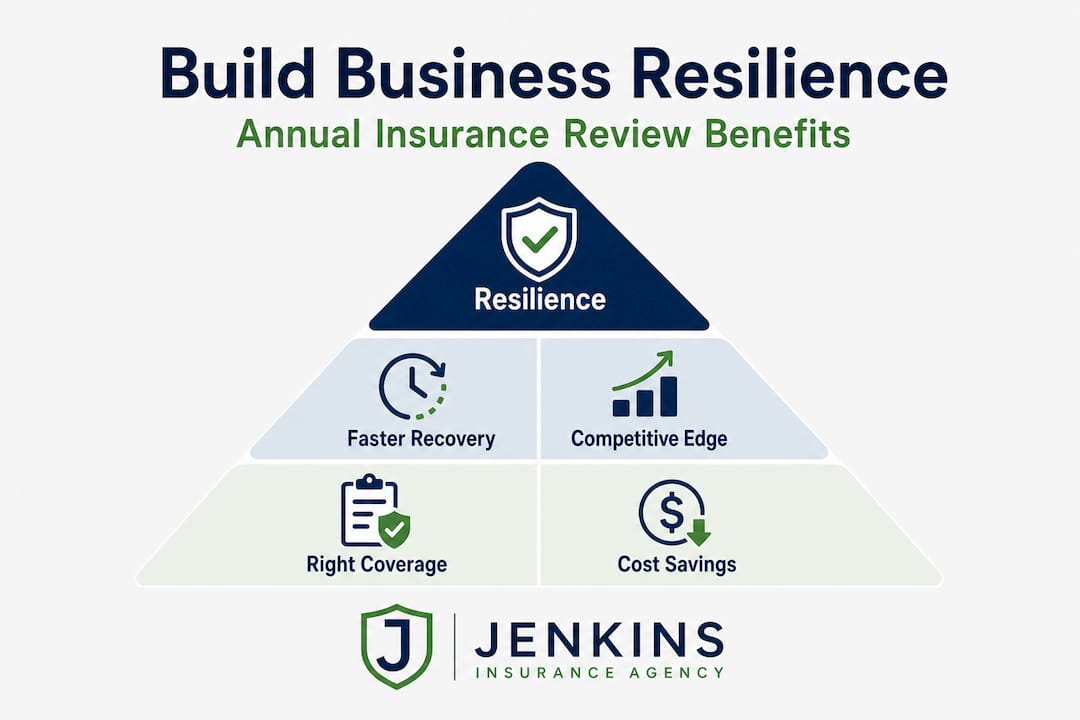
And what happens when you do that check-up? You discover things. Maybe you find that you’ve been paying for coverage you no longer need. Maybe you realize your property values have increased significantly, and you were underinsured without knowing it. Maybe you identify a new area of risk you hadn’t thought about. All of these are valuable insights that make your business stronger.
There’s also a competitive angle that most people miss entirely. When your insurance is current and well-documented, it signals professionalism. Clients and partners who ask for certificates of insurance see that your coverage is complete and up to date. That builds confidence. It can even be a deciding factor in winning a contract. A business with solid, updated insurance is a business that takes its responsibilities seriously.
Recovery from loss is also dramatically faster when your coverage matches your actual operations. A claim on an accurate, up-to-date policy moves quickly. A claim on a policy full of outdated information leads to delays, disputes, and potentially denied coverage. Speed of recovery isn’t just a financial issue. It’s the difference between bouncing back quickly and losing clients while you wait.
Building resilience with coverage is about making your business durable, not just compliant. Annual reviews are where that durability gets built, one update at a time.
Get local help updating your California business insurance
Knowing that your coverage needs a review is one thing. Actually getting it done with confidence is another. That’s where having a local agent who genuinely knows your situation makes all the difference.

At Jenkins Insurance Agency Inc., we work with California business owners every day. We understand the local market, the California regulatory environment, and the real pressures that come with running a business in Sonoma County and beyond. When you work with us, you’re not filling out a web form and waiting for a generic quote. You’re having a real conversation with someone who knows your neighborhood and your industry.
We make the review process simple. Start by exploring your local California business insurance options online, or reach out to us directly for a free policy review. For a deeper look at what’s right for Santa Rosa area businesses, our Santa Rosa business insurance guide is a great place to start. We’re here to help you get covered right, not just covered quickly.
Frequently asked questions
How often should you update your business insurance policy?
You should review and update your business insurance at least once a year, or immediately after any major business change. Rising premiums make annual reviews essential to avoid overpaying and keep coverage optimized.
What are common triggers for updating business insurance?
Common triggers include hiring new staff, expanding to new locations, changing your services, purchasing significant assets, or responding to shifts in California regulations. Any of these changes can create gaps in your existing coverage.
Can annual reviews lower my business insurance premium?
Yes, implementing new risk management strategies and reviewing coverage annually may qualify you for discounts. Annual reviews help you avoid overpaying and earn credit for safety and risk improvements your business has already made.
What risks does outdated business insurance pose?
Outdated insurance may leave new operations, assets, or legal changes completely uninsured, exposing your business to serious financial loss. Failure to update means operational changes you’ve made may have zero coverage if something goes wrong.
Recommended
- How insurance safeguards your California business assets – Jenkins Insurance Agency Inc.
- Why business insurance matters for California SMBs in 2026 – Jenkins Insurance Agency Inc.
- Auto Insurance for Business Owners in California – Jenkins Insurance Agency Inc.
- Why insure business property? Protecting your California assets – Jenkins Insurance Agency Inc.