
TL;DR:
- Office insurance covers property, liability, and business interruption specific to physical workplaces.
- Many small businesses underestimate coverage gaps, risking significant financial loss after damages or claims.
- Regular risk assessments and policy reviews ensure adequate protection as business circumstances evolve.
Running a small business in California means wearing a lot of hats. You manage clients, employees, and daily operations, all while trying to keep costs under control. What many business owners don’t realize is that the insurance they already have may not fully protect their office environment. A standard general liability policy sounds solid on paper, but it often leaves critical gaps that only become obvious after something goes wrong. This guide walks you through what office insurance actually covers, what it doesn’t, and how to make smart decisions that protect your workplace, your assets, and your future.
Table of Contents
- What is office insurance and who needs it?
- Core coverage: What does office insurance typically include?
- Optional add-ons and special coverage: What else should you consider?
- How much office insurance do you need?
- Comparing office insurance with other business coverage
- Why most California businesses get office insurance wrong (and how to get it right)
- Get confidence with custom office insurance for your business
- Frequently asked questions
Key Takeaways
| Point | Details |
|---|---|
| Office insurance overview | Office insurance bundles different protections to cover property, liability, and operational interruptions for businesses. |
| Standard vs. optional coverage | Start with core coverage but consider add-ons like cyber liability for modern risks. |
| Assess the right amount | Calculate your coverage needs based on property value, liability, and unique business threats. |
| Compare with other types | Understand the difference between office insurance and general or professional liability policies. |
| Regularly review policies | Update your coverage yearly and as your office risks or operations change. |
What is office insurance and who needs it?
Office insurance is not a single policy with one fixed definition. It’s a suite of coverages designed to protect businesses from the specific risks that come with operating a physical workplace. That includes damage to your property, legal claims from clients or visitors, and losses tied to disruptions in your day-to-day operations.
Many business owners assume that a general business license or a basic liability policy is enough. That assumption is costly. As the business protections every small business needs resource from Capital for Business explains, coverage gaps are more common than most owners realize. Many small businesses underestimate their risks by assuming general liability policies automatically cover all office-related scenarios.
So who actually needs office insurance? Almost any business that operates from a physical location should think carefully about this coverage. Common examples include:
- Consulting firms where clients visit your space regularly
- Legal and accounting practices that hold sensitive client files
- Tech startups with expensive equipment and digital assets
- Healthcare offices that handle private patient information
- Real estate agencies and financial services firms
The business insurance benefits for businesses in Sonoma County and across California are significant, especially when you consider that even a single lawsuit or fire can shut down operations for weeks or months.
“Thinking your basic policy has everything covered is one of the most common and expensive mistakes a small business owner can make.”
Pro Tip: To check whether your business qualifies as “office-based” under most insurance guidelines, look at whether clients or vendors visit your location regularly. If they do, you almost certainly need office-specific protection, not just a general business policy.
Core coverage: What does office insurance typically include?
After understanding who needs office insurance, it’s important to get clear on what protections you’re actually buying.

Standard office insurance policies include property, liability, and business interruption coverage as core components. These three areas work together to protect your business from the most common and damaging risks an office faces.
Here’s a quick breakdown of how these coverages compare side by side:
| Coverage type | What it covers | What it does NOT cover |
|---|---|---|
| Property insurance | Office furniture, computers, fixtures, building damage | Flooding, earthquakes (need separate policies) |
| General liability | Client injuries on-site, property damage claims | Professional errors or negligence |
| Business interruption | Lost income if your office must close temporarily | Losses from pandemics or government shutdowns (often excluded) |
If property damage occurs and you need to file a claim, the process typically works like this:
- Document the damage immediately. Take photos and make a list of everything affected.
- Contact your insurance agency. Notify your agent as soon as possible. Delays can complicate the claim.
- Complete your insurer’s claim forms. Provide receipts, serial numbers, and replacement cost estimates where possible.
- Schedule an adjuster visit. The insurer will send someone to assess the damage firsthand.
- Receive your settlement. Once approved, your payout will reflect your policy limits and deductibles.
Understanding business property insurance types is essential before you choose a policy. Coverage is rarely one-size-fits-all, and knowing the difference between replacement cost versus actual cash value, for example, can dramatically affect what you receive after a claim.
Most office policies cover at least 80% of property and liability losses, but exclusions vary widely by insurer and industry. That’s why reviewing the fine print with a local agent matters so much. To get a full picture of the common business insurance policies available to California small businesses, it helps to review each option alongside your specific risk profile.
Pro Tip: Read your policy’s language around off-premises equipment carefully. Many standard office policies do not automatically cover laptops, tablets, or mobile devices when they leave your office. You may need to add a specific endorsement to cover portable equipment.
Optional add-ons and special coverage: What else should you consider?
Standard coverage is a starting point, but many California businesses benefit from optional add-ons and upgrades that address modern and industry-specific risks.
Optional add-ons like cyber liability and equipment breakdown insurance are becoming increasingly common as business risks evolve. A data breach or a broken HVAC system can be just as damaging as a fire, yet standard policies rarely cover them. The business exposures entrepreneurs should address are growing every year, especially for office-based businesses.
Common optional coverages worth considering include:
- Cyber liability insurance: Covers costs from data breaches, ransomware attacks, and notification requirements under California’s strict privacy laws
- Equipment breakdown insurance: Pays for repairs or replacements when essential machinery like servers, phone systems, or HVAC units fail
- Employment practices liability insurance (EPLI): Protects your business from employee claims involving discrimination, harassment, or wrongful termination
- Commercial auto insurance: Covers vehicles used for business purposes, including deliveries or off-site meetings. Learn more about auto insurance options for business vehicles
- Home-based business riders: If you operate partly from home, standard home-based business insurance may not cover your equipment or client visits
Here’s a rough look at how premiums shift when you add these protections:
| Coverage add-on | Estimated monthly cost increase | Key benefit |
|---|---|---|
| Cyber liability | $25 to $75 | Data breach and ransomware response |
| Equipment breakdown | $15 to $40 | Covers sudden mechanical failure |
| EPLI | $50 to $150 | Covers employment-related lawsuits |
| Commercial auto | $75 to $200 | Business vehicle accidents covered |
Pro Tip: Some of these add-ons are required by landlords or business contracts even if they’re not written into your lease in obvious terms. Always ask your agent to review any lease agreements or service contracts before you finalize coverage. You may already be obligated to carry coverage you don’t currently have.
How much office insurance do you need?
Beyond what’s available, it’s crucial to answer a practical question: How much coverage should you actually buy?
Business owners should conduct a risk assessment to determine the appropriate coverage level based on property value, liability exposure, and regulatory needs. Here’s a simple framework to help you figure that out:
- Take stock of your physical assets. Walk through your office and document every piece of equipment, furniture, and inventory. Estimate replacement costs, not just what you paid originally.
- Estimate your liability exposure. How often do clients visit? Do you store sensitive customer data? Do employees travel for work? Each factor increases your risk.
- Calculate your monthly revenue. Business interruption coverage is typically based on average revenue. Knowing your numbers helps you choose an appropriate limit.
- Check California’s legal minimums. Workers’ compensation is required for all California employers with one or more employees. Your landlord may also require specific minimums in your lease.
- Review the insurance safeguards for business assets available in your area to understand what local risks like wildfires or seismic activity might require.
In California, the average small business claim for office property damage exceeds $22,000. That figure covers incidents like fires, water damage, and theft, and it does not include legal fees or lost income. For many small businesses, a single uncovered claim of that size could be devastating.
Factors that directly affect your premium include:
- Location: Offices in areas with higher crime rates or wildfire risk pay more
- Industry type: Legal and medical offices often pay higher premiums due to regulatory liability
- Office size and value: More square footage and expensive equipment means higher premiums
- Claims history: Prior claims signal higher risk to insurers and raise your rates
- Number of employees: More staff means higher workers’ compensation and EPLI exposure
Pro Tip: It’s always better to slightly over-insure than to discover a gap when it matters most. A few extra dollars per month in premiums is far less painful than paying $20,000 out of pocket because your coverage limit fell short.
Comparing office insurance with other business coverage
To make truly informed choices, you need to distinguish office insurance from other common business coverages.
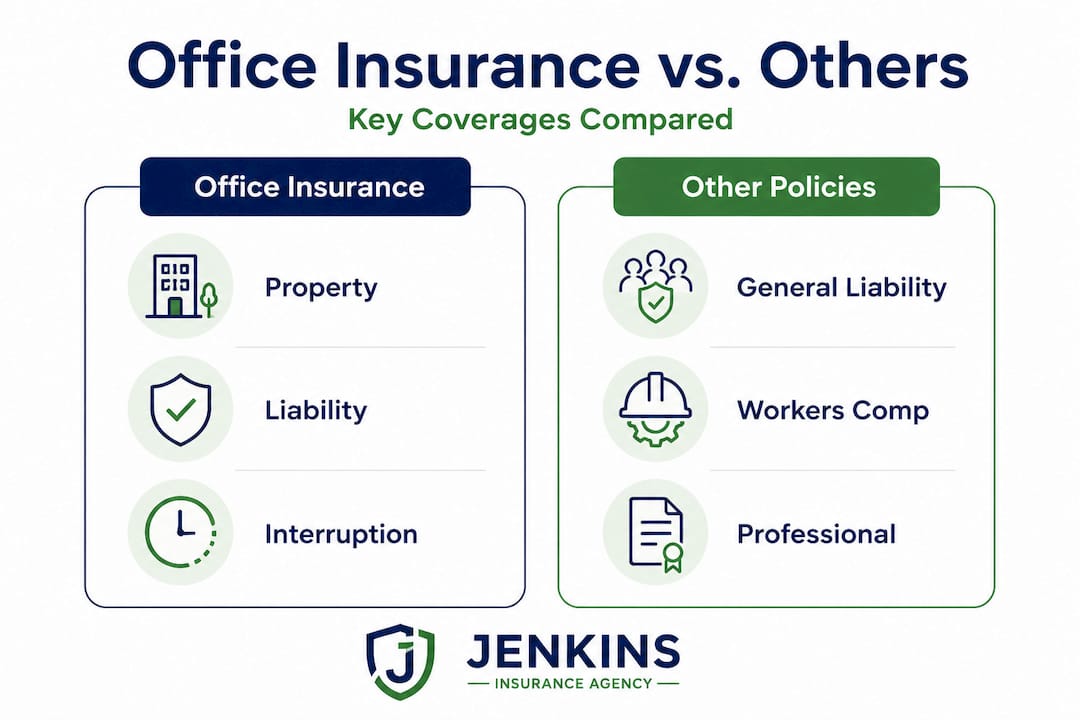
Many business owners confuse office insurance with other types like general liability and professional liability, which cover distinct risks. Understanding the differences can help you avoid both overpaying for redundant coverage and underpaying for protection you actually need. You can also review business insurance types from a broader perspective to see how these categories map globally.
| Policy type | What it protects | Best for |
|---|---|---|
| Office insurance | Physical space, equipment, business income | All office-based businesses |
| General liability | Bodily injury and property damage claims | Any client-facing business |
| Professional liability | Errors, omissions, and negligence in your services | Consultants, accountants, attorneys |
| Business owner policy (BOP) | Bundles property, liability, and interruption | Small to midsize businesses wanting simplicity |
Scenarios that help clarify which policy applies:
- A client slips on a wet floor in your waiting room. General liability pays the claim.
- A consultant gives bad financial advice that costs a client money. Professional liability covers the lawsuit.
- Your office roof leaks and destroys your computers. Office property insurance covers the replacement.
- A fire shuts your office for two months. Business interruption replaces lost revenue.
A business owner policy, often called a BOP, bundles several of these coverages together at a reduced combined rate. It’s one of the most cost-effective options for small California businesses. That said, knowing the full vs liability insurance distinctions across policy types helps you ask the right questions when comparing quotes. And reviewing the insurance policies for small business owners most relevant in California gives you a clearer picture of what a well-rounded plan looks like.
Why most California businesses get office insurance wrong (and how to get it right)
We see this pattern regularly when working with small business owners in Sonoma County and across California. A business owner buys a policy quickly, often based on price alone or because someone else recommended the same insurer. They assume the policy will handle anything that comes up. Then something happens, and they find out the hard way that their coverage had gaps they never knew existed.
The real problem is that office insurance is not static. Your business changes. You hire people, buy new equipment, add services, shift to remote or hybrid work. But most business owners renew their policy every year without reviewing it against those changes. That’s how exclusions quietly become expensive problems.
Here’s a framework we recommend to every business owner we work with:
First, map your risks annually. Sit down and list every scenario that could interrupt or damage your business. Physical risks, legal risks, technology risks, and people risks. All of them. Then check your current policy against that list.
Second, test for exclusions. Call your agent and ask them to walk through your exclusions specifically. Not just what’s covered. Ask what is not covered and under what conditions.
Third, involve the right people. Your insurance agent and a business advisor should both be part of any significant coverage decision. One sees your risk from a policy angle. The other understands your business operations. Together they catch what neither would alone.
Fourth, review more often than you think you need to. Remote work, increased cyber threats, new California regulations, these trends move fast. A policy that worked well two years ago may have gaps today. Understanding business insurance as a living part of your business plan, not just an annual checkbox, is what separates businesses that recover from setbacks from those that don’t.
Get confidence with custom office insurance for your business
You now have a clearer picture of what office insurance covers, what it doesn’t, and how to figure out what your California business actually needs. The next step is turning that knowledge into real protection.

At Jenkins Insurance Agency Inc., we work directly with small business owners across Santa Rosa and Sonoma County to build coverage plans that fit your specific situation. We don’t hand you a generic quote and send you on your way. We take the time to understand your business, your risks, and your goals. Whether you’re looking for California business insurance from scratch or reviewing your existing coverage, we’re here to help. Explore the essential business policies that California businesses rely on, and let’s find coverage that actually works for you. Reach out to our local team today for a personalized consultation.
Frequently asked questions
Is office insurance mandatory for small businesses in California?
Office insurance itself is not legally required in California, but certain coverages within it are. For example, some office-related coverages may be required by law or by your lease contract, such as workers’ compensation for any business with employees.
How do I know if my office equipment is covered off-premises?
Check your policy details carefully. Standard policies often limit off-premises coverage and require specific add-ons or endorsements to fully protect portable equipment like laptops and tablets used away from your office.
Can I bundle office insurance with other business insurance types?
Yes. Business owner policies often bundle several necessary coverages for office-based businesses, combining property, liability, and business interruption into one plan, typically at a lower combined cost than buying each separately.
What factors affect the cost of office insurance in California?
Premiums depend on several variables including your business location, industry, total office value, number of employees, and your claims history. High-risk areas for wildfires or crime can also push premiums higher in California specifically.
Where can I get specialized office insurance advice in California?
Consult with a California-based insurance agency that has direct experience working with small office-based businesses. A local agent who understands your region’s specific risks and regulations will give you far more accurate guidance than an online quote tool.
Recommended
- Small business insurance California 2026: 30% underinsured – Jenkins Insurance Agency Inc.
- How insurance safeguards your California business assets – Jenkins Insurance Agency Inc.
- Auto Insurance for Business Owners in California – Jenkins Insurance Agency Inc.
- Why Insure Your Business: Protecting Sonoma County Owners – Jenkins Insurance Agency Inc.
- Understanding Insurance for Remote Workers: What You Need to Know