
TL;DR:
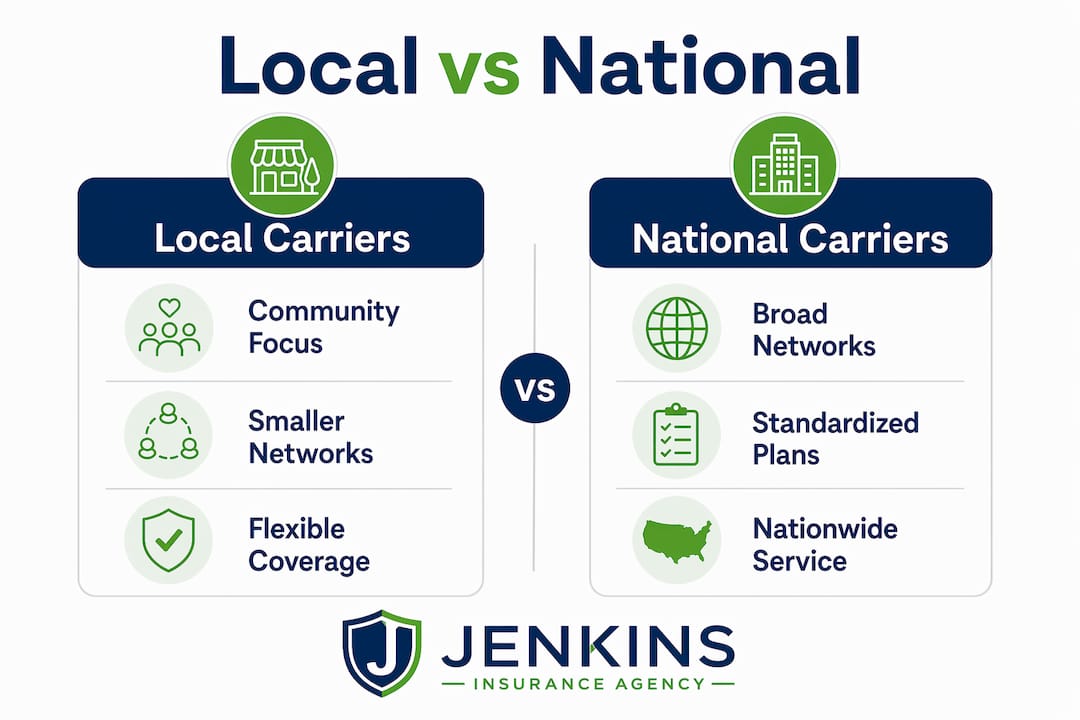
- Local insurance carriers have community-focused networks and regional risk expertise, providing better regional coverage.
- National carriers offer broader geographic options, standardized processes, and digital tools, but may lack local-specific risk knowledge.
Local insurance carriers are regionally focused insurers with deep ties to community providers, while national carriers are large-scale insurers operating across all 50 states with broad networks but less local customization. The debate around local insurance vs national carriers comes down to three practical factors: provider network design, service quality, and cost structure. Understanding how each carrier type performs across these areas gives you a real foundation for choosing coverage that fits your life or business. At Jenkins Insurance Agency Inc., we work with both local and national markets, so we see this comparison play out for real clients every day.
How provider networks shape your coverage and costs
The single most important factor in choosing between local and national insurance is not the carrier’s brand name. It is how the provider network is designed and whether your doctors, contractors, or service providers are inside it. Large carrier brands do not guarantee broader in-network access if your providers fall outside contracted areas. That is a fact many policyholders learn the hard way after their first claim.

Local plans concentrate networks locally, which can lower premiums and out-of-pocket costs, but limits routine care access outside the defined service area. For someone who rarely travels and uses the same local providers year after year, this trade-off is often worth it. National plans offer wider geographic coverage, but that breadth sometimes comes with weaker ties to specific local providers, which can affect whether your preferred doctor or contractor is actually in-network.
Geography also plays a bigger role than most people expect. Urban areas average 42 Medicare Advantage plans, while most rural areas average only 20 plans with fewer prescription options. This means the perceived advantage of a national carrier shrinks considerably if you live outside a major metro area. Rural policyholders often find that a well-connected local carrier delivers better real-world access than a national brand with thin local representation.
| Factor | Local carriers | National carriers |
|---|---|---|
| Network size | Concentrated, community-focused | Broad, multi-state |
| Premium cost | Often lower due to focused risk pools | Varies; may be higher in some regions |
| Routine care access | Strong within service area | Wide but provider ties may be weaker |
| Out-of-network coverage | Limited; emergency care typically covered | More flexible in many plans |
| Rural availability | Stronger local presence | Fewer plan options in rural counties |
Pro Tip: Before choosing any plan, map your most-used providers against the carrier’s in-network list. Out-of-network costs can dominate your true annual spend if your routine care falls outside the plan’s footprint.
What the service experience actually looks like
The difference in service quality between local agencies and national carriers is real, and it shows up most clearly when something goes wrong. Local agents advocate during claims, know local hazards, and can expedite approvals in ways that a national call center simply cannot replicate. When a wildfire threatens a neighborhood in Sonoma County, a local agent who knows the area can move faster and with more context than a claims processor in another state.
National carriers, on the other hand, invest heavily in digital tools and standardized processes. Apps that let you file a claim with photos, telematics dashboards, and 24/7 chat support are genuine advantages for people who prefer self-service. The trade-off is that standardized processes are built for the average case, not your specific situation.
Here is how the two service models compare in practice:
- Local agency strengths: Personalized guidance on coverage gaps, direct phone access to a named agent, knowledge of regional risks like wildfire or flood zones, faster resolution on complex or unusual claims, and the ability to shop multiple carriers on your behalf if the agency is independent.
- National carrier strengths: Robust digital claims apps, 24/7 customer service lines, consistent claims processes across states, and access to large discount programs tied to technology like telematics.
- Captive vs. independent local agents: A captive local agent represents one carrier only, such as a Farmers Insurance agent. An independent local agent accesses multiple carriers and can compare options for you. Both offer personalized service, but independent agents give you more flexibility in finding the right fit.
One scenario worth considering: a business owner in Santa Rosa with a commercial property claim involving both structural damage and inventory loss. A local agent who knows the building, the neighborhood, and the carrier’s local adjusters can coordinate that claim far more effectively than a national hotline. The advantages of independent agencies become especially clear in these multi-layered situations.
Pro Tip: Ask any prospective agent directly: “Will I speak to you personally when I have a claim?” The answer tells you more about the service model than any brochure.
Cost comparisons and discount opportunities
Cost is where the local vs national insurance debate gets genuinely complicated, because neither side wins across the board. National carriers’ telematics programs provide premium reductions of 5 to 25 percent for safe drivers, which is a meaningful discount if your driving profile qualifies. Programs like Farmers Signal, State Farm Drive Safe & Save, and Progressive Snapshot reward low-mileage and careful driving with real savings.
Local carriers and local agencies counter with a different kind of value. A local agent who understands your full picture, your home, your vehicles, your business, can bundle policies in ways that reduce your total premium across the board. They can also steer you away from telematics programs if your driving patterns would actually increase your rate, something a national carrier’s automated system will not do for you.
| Discount type | Local carrier advantage | National carrier advantage |
|---|---|---|
| Bundling (home + auto) | Strong; agent optimizes across policies | Available but less personalized |
| Telematics / safe driving | Agent may avoid if unsuitable for you | 5 to 25% reduction for qualifying drivers |
| Loyalty discounts | Relationship-based; often flexible | Standardized program tiers |
| Credit-based pricing | Agent can explain and contextualize | Automated; less room for advocacy |
| Niche business coverage | Tailored to local industry risks | Standardized add-ons |
The smartest cost strategy is not to pick a side. It is to work with an agent who can access both local and national options and compare them against your specific profile. For auto insurance in Santa Rosa, for example, the right carrier depends on your commute, your vehicle type, and whether bundling with homeowners coverage creates a better overall rate.
How each carrier type handles coverage customization
Coverage flexibility is one of the clearest advantages local carriers hold over national ones, particularly for regional risks. Local plans adjust benefits like wellness programs, prior authorizations, and specialty networks based on local market feedback. In California, that means a local carrier can build wildfire exposure directly into their underwriting and coverage design, rather than applying a one-size-fits-all national policy.
National carriers offer standardized coverage with optional add-ons, which works well for businesses operating across multiple states. If your company has locations in California, Nevada, and Oregon, a national carrier’s consistent policy structure simplifies administration. But if your entire operation is in Sonoma County, that standardization may mean paying for features you do not need while missing coverage that fits your actual risk profile.
Cigna’s LocalPlus plan is a useful example of how this plays out in practice. LocalPlus limits in-network benefits strictly to defined local providers and requires prior authorization for some care, while providing “Away From Home Care” only for emergencies outside the network. This design lowers premiums but demands careful vetting of your providers before you enroll. It is a local network plan offered by a national carrier, which shows that the local vs national distinction is not always clean.
For business owners, coverage customization matters even more:
- A restaurant owner needs liquor liability and food spoilage coverage that a generic commercial policy may not include by default.
- A contractor in Sonoma County needs coverage that reflects local building codes and wildfire rebuild costs, not national averages.
- A home-based business owner needs a rider that a standard homeowners policy typically excludes.
Local agents who specialize in business insurance understand these nuances and build policies around them. National carriers can offer similar products, but the customization usually requires more effort to unlock.
Key takeaways
The most effective approach to choosing between local insurance and national carriers is to evaluate provider network design, service model, and cost structure against your specific location, risk profile, and coverage needs.
| Point | Details |
|---|---|
| Network design matters most | Map your providers against the plan’s in-network list before committing to any carrier. |
| Local carriers offer real service advantages | Local agents advocate during claims and bring community risk knowledge that national call centers cannot replicate. |
| National carriers lead on telematics discounts | Safe drivers can save 5 to 25% through programs like Farmers Signal or State Farm Drive Safe & Save. |
| Coverage customization favors local carriers | Regional risks like wildfire or flood are better addressed by carriers with local underwriting expertise. |
| Geography limits your real options | Rural policyholders often have fewer national plan choices, making local carrier relationships more valuable. |
What I’ve learned from watching clients choose
After years of helping clients in Sonoma County work through this decision, I have come to one clear conclusion: the carrier type matters less than the agent relationship and the network fit. I have seen clients with national carriers get outstanding service because they had a dedicated local agent managing the relationship. I have also seen clients with local-only carriers run into trouble the moment they needed care or coverage outside their immediate area.
The scenario where local carriers genuinely outperform is when your life is rooted in one place and your risks are regional. Wildfire exposure in Northern California, flood risk in low-lying areas, or a business tied to local supply chains. These are situations where a carrier and agent who know the territory deliver measurably better outcomes.
National carriers earn their place when you travel frequently, run a multi-location business, or want the convenience of a fully digital claims experience. The geographic impact on carrier choice is real, and insurer exits from certain counties are reshaping options in ways that make local knowledge more critical, not less.
My honest recommendation is to start with your provider list and your risk profile, not the carrier’s name recognition. Then find an agent who can access both markets and show you the numbers side by side. Regular policy reviews matter too. Life changes, and your coverage should keep up.
— Jason
See how Jenkins Insurance Agency Inc. can help you compare your options
At Jenkins Insurance Agency Inc., we work with both local and national markets to find coverage that fits your actual situation, not just a standard policy template. Whether you are a homeowner in Santa Rosa weighing wildfire coverage, a business owner protecting your operations, or a driver looking for the best rate, we compare options across carriers so you do not have to guess.

Our team knows Sonoma County and the specific risks that come with living and working here. We also have access to Farmers Insurance products and other carriers, which means we can show you real comparisons across local and national options. Start with your homeowners insurance coverage or reach out directly to talk through your full coverage picture. We are here to make this decision straightforward.
FAQ
What is the main difference between local and national insurance carriers?
Local carriers focus on community-specific networks and regional risk expertise, while national carriers offer broad geographic coverage and standardized digital tools. The practical difference shows up most clearly in provider network access and claims service quality.
Are local insurance carriers cheaper than national ones?
Not always. Local carriers often have lower premiums due to concentrated risk pools, but national carriers offer telematics discounts of 5 to 25% for safe drivers. The best price depends on your specific profile, location, and whether you bundle multiple policies.
How do I know if my providers are in-network with a local plan?
Request the carrier’s provider directory before enrolling and cross-check your current doctors, specialists, or contractors against it. Out-of-network costs can significantly increase your total spend if routine care falls outside the plan’s footprint.
Is a local insurance agent the same as a local carrier?
No. A local agent can represent either a local carrier or a national carrier like Farmers Insurance. What makes an agent local is their community presence and personalized service, not necessarily the carrier they represent. Independent local agents can access multiple carriers and compare options for you.
When does a national carrier make more sense than a local one?
National carriers are a stronger fit when you travel frequently, operate a business across multiple states, or want fully digital claims management. They also tend to offer more plan choices in urban areas, where 42 Medicare Advantage plans on average are available compared to 20 in most rural counties.
Recommended
- Why Choose a Local Insurance Agent | Jenkins Insurance
- Auto Insurance for Families: Your 2026 Coverage Guide – Jenkins Insurance Agency Inc.
- Why Local Insurance Agencies Matter in Sonoma County – Jenkins Insurance Agency Inc.
- What’s the Difference Between Full Coverage and Liability Auto Insurance? – Jenkins Insurance Agency Inc.