
California’s insurance landscape is more complex than most residents and business owners realize. Nearly 40% of businesses face penalties each year for insurance compliance violations, often due to unfamiliarity with state regulations. The California Department of Insurance oversees and enforces these rules, protecting consumers while ensuring market stability. Whether you’re a homeowner navigating wildfire coverage options or a business owner managing workers’ compensation requirements, understanding these regulations is essential. This guide clarifies the regulatory essentials, explains compliance requirements for personal and business insurance, and provides practical strategies to avoid costly penalties.
Table of Contents
- Key takeaways
- Role of the California Department of Insurance and regulatory overview
- Key insurance regulations impacting California residents and businesses
- Navigating complex regulations: practical tips for compliance and protecting your insurance interests
- Comparison of California insurance regulations: personal vs. business compliance requirements
- How Jenkins Insurance Agency can help with insurance regulation compliance in California
- Frequently asked questions about California insurance regulations
Key Takeaways
| Point | Details |
|---|---|
| CDI regulates insurance | The California Department of Insurance regulates insurers and enforces compliance to protect consumers and maintain market stability. |
| Prop 103 rate approval | Proposition 103 requires prior CDI approval for auto and homeowners rate changes and prioritizes driving record, miles driven, and experience. |
| Penalty awareness gap | About forty percent of California businesses face penalties annually for insurance compliance violations due to regulatory unfamiliarity. |
| Regulatory transparency and reforms | Recent reforms enhance transparency in rulemaking and improve rate setting using catastrophe modeling and clearer regulatory processes. |
Role of the California Department of Insurance and regulatory overview
The California Department of Insurance (CDI) is the primary regulator of the insurance industry, overseeing insurers, agents, brokers, and enforcing the California Insurance Code. This regulatory body serves as your first line of defense against unfair insurance practices and market instability. The CDI’s authority extends to licensing, rate approval, market conduct examinations, and consumer complaint resolution.
Every insurance company operating in California must obtain a certificate of authority from the CDI. This licensing process requires insurers to meet minimum capital requirements, demonstrate financial stability, and maintain adequate reserves to pay claims. Agents and brokers must also pass state examinations and maintain continuing education to keep their licenses active. These requirements ensure that only qualified professionals handle your insurance needs.
The regulatory framework operates through a structured rulemaking process governed by the Administrative Procedure Act. When the CDI proposes new regulations or changes to existing rules, they must follow specific steps:
- Publish public notice of proposed regulations with detailed explanations
- Provide a minimum 45-day comment period for public input
- Hold public hearings where stakeholders can present testimony
- Review and respond to all comments before finalizing rules
- Submit regulations to the Office of Administrative Law for review
This transparent process ensures you have opportunities to influence insurance regulations that affect your coverage and costs. The CDI maintains detailed records of all rulemaking activities, making it easier for consumers and businesses to track regulatory changes. Understanding these processes helps you anticipate how new rules might impact your California auto insurance requirements or business coverage needs.
The CDI also conducts market conduct examinations to verify insurers comply with state laws. These examinations review claims handling, underwriting practices, rate calculations, and consumer treatment. When violations occur, the CDI has authority to impose fines, require corrective action, or revoke licenses. This enforcement power protects you from unfair practices and ensures insurers honor their contractual obligations.
Key insurance regulations impacting California residents and businesses
Several critical regulations shape how insurance works in California, affecting both your personal coverage and business obligations. Proposition 103 mandates prior approval for rate changes in auto and homeowners insurance and prioritizes driving safety record, miles driven, and experience. This voter-approved initiative from 1988 fundamentally changed how insurers set rates, giving the Insurance Commissioner authority to reject excessive rate increases.
Under Proposition 103, insurers cannot implement rate changes until the CDI approves them. The law requires insurers to use specific rating factors in order of priority: your driving safety record comes first, followed by annual miles driven, then years of driving experience. Other factors like age, gender, or zip code can only be considered after these primary factors. This system aims to reward safe drivers with lower rates regardless of demographic characteristics.
For business owners, workers’ compensation insurance represents a non-negotiable requirement. Businesses with employees must carry workers’ compensation insurance or face hefty fines, stop-work orders, and jail time. California law makes no exceptions based on business size. Even if you employ just one person part-time, you need coverage. The penalties for non-compliance are severe and can devastate your business financially.

Violations trigger automatic fines of $10,000 minimum, with potential increases to $100,000 for serious or repeat offenses. The state can also issue stop-work orders that shut down your operations immediately until you obtain proper coverage. Criminal charges may include misdemeanor or felony counts, potentially resulting in jail sentences. Recent legislation under SB 291 enhanced penalties specifically for misclassifying workers as independent contractors to avoid coverage requirements.
Property owners in high-risk areas face unique challenges accessing coverage. The FAIR Plan provides property insurance for high-risk properties with coverage limits and ongoing reforms to improve availability and catastrophe modeling. This state-mandated program serves as the insurer of last resort when standard carriers decline coverage due to wildfire, earthquake, or other disaster risks.
The FAIR Plan offers basic dwelling coverage but excludes liability protection and Additional Living Expenses. Coverage caps typically max out at $3 million for residential properties, though recent reforms aim to expand commercial coverage limits to $20 million per building. These limitations mean you’ll likely need supplemental wraparound policies to achieve comprehensive protection. Understanding these gaps is crucial when evaluating your property insurance options in California.
Recent regulatory reforms introduced catastrophe modeling into rate calculations, allowing insurers to better assess wildfire and earthquake risks. This change aims to stabilize the market by letting carriers charge rates that reflect actual risk levels. While this may increase premiums in high-risk areas, it also encourages insurers to maintain coverage availability rather than exit the California market entirely. For small business insurance in California, these reforms affect both property coverage and business interruption policies.
Navigating complex regulations: practical tips for compliance and protecting your insurance interests
Understanding regulations is one thing; applying that knowledge to protect yourself is another. The Proposition 103 intervenor process allows public challenges to insurance rates, although it can cause delays; recent reforms improve transparency and timelines. Consumer advocacy groups can formally intervene in rate approval proceedings, presenting evidence and arguments against proposed increases. While this process provides important consumer protections, it can extend approval timelines by months or even years.
Recent reforms streamlined the intervenor process by setting clearer deadlines and improving data transparency. The CDI now publishes detailed actuarial information earlier in the process, giving intervenors more time to analyze proposals. If you’re concerned about a rate increase, you can submit comments during the public comment period or contact consumer advocacy organizations that regularly participate in these proceedings.
For business owners, proper worker classification is critical. Misclassification of workers as independent contractors to avoid workers’ comp leads to enhanced penalties under SB 291 starting 2025. California uses the ABC test to determine worker status: you must prove the worker is free from your control, performs work outside your usual business, and customarily engages in an independently established trade. Failing any part of this test means the worker is an employee requiring coverage.
The enhanced penalties under SB 291 include doubled fines for first offenses and tripled fines for subsequent violations. The state also increased audit frequency for industries with high misclassification rates, including construction, hospitality, and transportation. Protecting your business means properly classifying all workers and maintaining accurate payroll records. Consider consulting with legal counsel if you’re uncertain about worker status, especially when using contractors regularly.
Policy review is essential for identifying coverage gaps. FAIR Plan policies exclude liability coverage, which protects you if someone is injured on your property. They also exclude Additional Living Expenses, which cover hotel and meal costs if your home becomes uninhabitable. Without these coverages, you’re personally liable for significant expenses. Wraparound policies fill these gaps but require careful coordination to avoid overlapping coverage or unexpected exclusions.
Pro Tip: Schedule an annual insurance review with your agent to identify coverage gaps, especially after major life changes like starting a business, purchasing property, or hiring employees. Regulations and your risk profile both evolve, making regular reviews essential for maintaining adequate protection.
Catastrophe modeling now plays a central role in risk assessment for properties in wildfire-prone areas. These sophisticated models analyze factors like vegetation density, historical fire patterns, topography, and climate trends to predict disaster likelihood. Insurers use these models to set rates and determine coverage availability. Understanding your property’s risk score can help you take mitigation steps like creating defensible space, using fire-resistant materials, and installing ember-resistant vents. These improvements may qualify you for better rates or broader coverage options.
Staying informed about regulatory changes protects your interests. The CDI publishes bulletins, alerts, and regulatory updates on their website. Subscribing to these notifications keeps you aware of changes affecting your coverage. Industry associations and consumer advocacy groups also provide valuable updates. For choosing auto insurance as a California resident, understanding regulatory changes helps you evaluate whether rate increases are justified and compliant with Proposition 103 requirements.
Comparison of California insurance regulations: personal vs. business compliance requirements
The regulatory landscape differs significantly between personal and business insurance, though both fall under CDI oversight. This comparison clarifies which requirements apply to your situation:
| Aspect | Personal Insurance | Business Insurance |
|---|---|---|
| Primary regulations | Proposition 103 for auto and homeowners; FAIR Plan for high-risk properties | Workers’ compensation mandate; commercial property and liability requirements |
| Mandatory coverage | Auto liability minimums ($15,000/$30,000/$5,000); no homeowners mandate | Workers’ comp for any business with employees; professional liability for certain industries |
| Rate approval process | Prior approval required; rates based on driving record, miles, experience | Varies by coverage type; workers’ comp uses state-set rates; commercial lines more flexible |
| Penalties for non-compliance | License suspension, registration holds, fines up to $500 for auto violations | Fines up to $100,000, stop-work orders, criminal charges, license revocation |
| Coverage availability | FAIR Plan as last resort; standard market for most risks | Limited market for high-risk industries; state fund available for workers’ comp |
| Consumer protections | Proposition 103 rate controls; CDI complaint process; mandatory policy disclosures | Contract law protections; CDI oversight of claims handling; audit rights |
Personal insurance regulations focus heavily on rate fairness and consumer protection. Proposition 103 gives you significant leverage to challenge rate increases and ensures insurers cannot discriminate based on factors unrelated to risk. The CDI complaint process provides a formal mechanism to resolve disputes over claims denials, coverage interpretations, or billing issues. These protections help level the playing field between individual consumers and large insurance corporations.
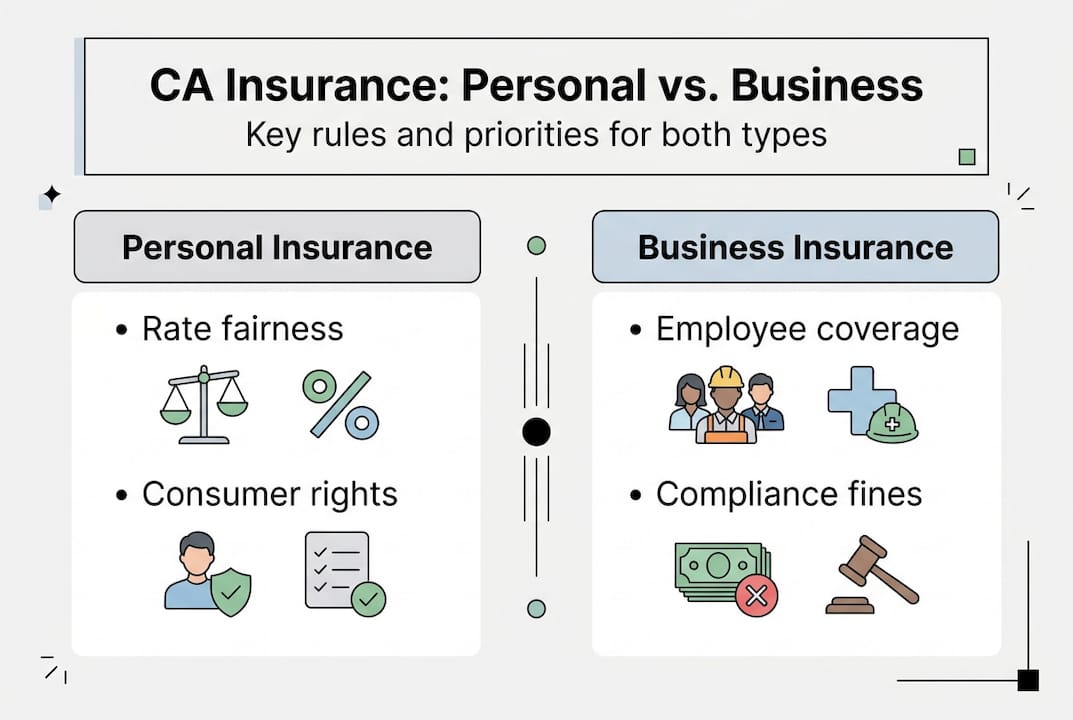
Business insurance regulations emphasize mandatory coverage to protect employees and the public. Workers’ compensation is non-negotiable, with severe penalties designed to ensure compliance. Commercial property and liability coverage, while not always legally required, become practically mandatory when landlords, lenders, or clients demand proof of insurance. Professional liability insurance is required by law for certain licensed professions like contractors, architects, and healthcare providers.
The penalty structures reflect these different priorities. Personal insurance violations typically involve administrative penalties like license suspension or registration holds. Business violations trigger financial penalties that can bankrupt a company, plus criminal charges for owners who deliberately evade coverage requirements. Understanding these distinctions helps you prioritize compliance efforts and allocate resources appropriately.
For comprehensive guidance on why business insurance matters for California small and medium businesses, consider both regulatory requirements and practical risk management. Similarly, understanding California auto insurance requirements helps you meet legal minimums while evaluating whether additional coverage makes sense for your situation.
How Jenkins Insurance Agency can help with insurance regulation compliance in California
Navigating California’s complex insurance regulations requires expertise and local knowledge. Jenkins Insurance Agency brings both to the table, helping you understand requirements and find coverage that meets your needs. Whether you’re securing homeowners insurance in Santa Rosa or establishing comprehensive business insurance coverage, our team guides you through regulatory requirements while identifying the best coverage options for your situation.

Our affiliation with Farmers Insurance provides access to a broad range of products backed by a recognized national carrier, while our local presence in Sonoma County means we understand the unique risks California residents and businesses face. From wildfire-prone properties requiring FAIR Plan coordination to businesses needing workers’ compensation coverage, we help you navigate compliance requirements confidently. We’ll review your current coverage, identify gaps, and recommend solutions that protect your interests while meeting state mandates. Contact us for auto insurance in Santa Rosa or any insurance need, and experience the difference local expertise makes.
Frequently asked questions about California insurance regulations
What is the role of the California Department of Insurance?
The California Department of Insurance regulates insurance companies, agents, and brokers to ensure consumer protection and compliance with state law. It licenses insurers, approves rates under Proposition 103, conducts market conduct examinations, and resolves consumer complaints. The CDI also enforces the California Insurance Code through investigations and penalties when violations occur.
What penalties do businesses face for not carrying workers’ compensation insurance in California?
Businesses can be fined up to $100,000, face stop-work orders that immediately halt operations, and potentially face criminal charges including jail time. Penalties also include minimum fines of $10,000 per violation, daily fines of up to $1,000 per uninsured employee, and license suspensions. Enhanced penalties under SB 291 apply specifically to worker misclassification cases.
How does Proposition 103 affect auto and homeowners insurance rates?
Rate changes must receive prior approval from the California Department of Insurance before insurers can implement them. The top rating factors must be driving safety record first, followed by annual miles driven, then years of driving experience. Insurers cannot use age, gender, or zip code as primary rating factors, ensuring rates reward safe driving behavior rather than demographic characteristics.
What coverage does the FAIR Plan provide and what are its limitations?
FAIR Plan offers basic dwelling coverage for high-risk properties that standard insurers decline, but excludes liability protection and Additional Living Expenses coverage. Coverage caps typically limit residential properties to $3 million, requiring wraparound policies for comprehensive protection. Recent reforms aim to expand commercial coverage to $20 million per building and incorporate catastrophe modeling for more accurate risk assessment.
How can I challenge an insurance rate increase in California?
You can submit comments during the public comment period when the CDI reviews proposed rate changes under Proposition 103. Consumer advocacy groups like Consumer Watchdog regularly intervene in rate proceedings and may represent consumer interests. The CDI also maintains a complaint process where you can report concerns about rate increases, though individual complaints typically don’t stop approved rate changes.
What happens if I misclassify workers as independent contractors?
Misclassification triggers enhanced penalties under SB 291, including doubled fines for first offenses and tripled fines for repeat violations. You’ll owe back premiums for workers’ compensation coverage, plus interest and penalties. The state may also issue stop-work orders, pursue criminal charges, and increase audit frequency for your business. California uses the strict ABC test to determine worker status, making it difficult to classify workers as contractors.
Recommended
- California auto insurance requirements 2026 guide – Jenkins Insurance Agency Inc.
- How to Choose Auto Insurance for California Residents – Jenkins Insurance Agency Inc.
- Step-by-step guide to business insurance in California 2026 – Jenkins Insurance Agency Inc.
- California Insurance Guide 2026: Save 25% with Bundling – Jenkins Insurance Agency Inc.