
TL;DR:
- Many California families view insurance as a routine expense, but it is essential for financial protection against disasters. Proper coverage addresses risks like income loss, medical emergencies, liability lawsuits, and property damage, especially considering California’s regional hazards. Regular reviews ensure policies accurately reflect changing family circumstances and regional risks, helping families avoid costly gaps when disasters occur.
Most California families think of insurance as just another monthly bill. Pay it, file it, forget it. But living in one of the most disaster-prone and litigious states in the country means that attitude can cost you everything you’ve worked to build. Wildfires, earthquakes, serious car accidents, unexpected illness — these aren’t rare events in California. They happen to real families in our communities every year. The right insurance isn’t a formality. It’s the financial foundation that keeps your family standing when everything else falls apart.
Table of Contents
- The real reasons families need insurance
- Core insurance types every California family should consider
- Protecting your home and assets: California’s unique risks
- Auto and liability insurance: From California minimums to real protection
- Tailoring insurance to your family’s actual needs
- A practical perspective: Insurance isn’t just a checkbox — here’s what most California families miss
- Ready to protect your family? Your next steps with expert guidance
- Frequently asked questions
Key Takeaways
| Point | Details |
|---|---|
| Insurance closes financial gaps | Coverage protects California families from risks that could threaten their home, assets, or financial security. |
| Customize for California risks | Standard policies usually don’t cover earthquakes, floods, or wildfire—families must consider add-ons or separate coverage. |
| Meeting legal minimums isn’t enough | State minimums may leave families exposed to lawsuits and high costs; real protection means adequate limits. |
| Review coverage often | Family needs change with time, so regular policy reviews help keep coverage effective. |
The real reasons families need insurance
Insurance gets misunderstood all the time. People see the monthly premium and think, “I’ve never filed a claim, so what’s the point?” That thinking changes fast after one major event. A serious car accident, a house fire, or a lawsuit from a neighbor’s injury on your property can cost hundreds of thousands of dollars. No family savings account absorbs that easily.
Families buy insurance to protect their household from financial shocks that simply can’t be covered by income or savings alone, especially risks tied to income loss, major medical events, and liability claims. That’s not a minor distinction. It’s the difference between recovering from a crisis and being financially wiped out by one.
Here are the core risks that insurance is designed to address:
- Income loss: If the primary earner in your family becomes disabled or passes away, how does the household survive financially? Life insurance and disability coverage fill that gap.
- Major medical events: Health insurance covers hospital stays, surgeries, and treatments that can run into six figures without warning.
- Liability lawsuits: If someone is injured on your property or in an accident involving your vehicle, you can be sued for amounts far beyond what basic policies cover.
- Property damage or loss: A wildfire, flood, or earthquake can destroy your home entirely. Without the right coverage, rebuilding falls on you.
“Real financial protection isn’t about owning every type of policy. It’s about matching the right coverage to the risks your family actually faces — and making sure the limits are high enough to matter.”
Families at different life stages face different risks. Young parents with two incomes and small children need strong income replacement coverage. A retired couple with a paid-off home in Sonoma County may prioritize property protection and liability coverage. The one-size-fits-all approach doesn’t work. Whole life insurance in California can make sense for some families as a long-term financial tool, while others may need to focus on term life first.
Pro Tip: If you’ve had a major life change in the last two years (marriage, a new baby, a home purchase), your current coverage probably doesn’t reflect your real needs anymore. It’s worth reviewing your policies now.
When it comes to updating life insurance after big life events, many families delay too long. Don’t wait for a crisis to figure out that your coverage has gaps. You can also use resources like life insurance explained to get clear on what type of policy fits your situation.
Now that we’ve highlighted why insurance is about more than just meeting requirements, let’s look at the core types families need.
Core insurance types every California family should consider
Insurance advisors emphasize several key pillars: life insurance for dependents, disability insurance for lost earned income, health insurance for medical expenses, and property and personal liability coverage for home and vehicle claims. For California families specifically, each of these comes with important regional considerations.
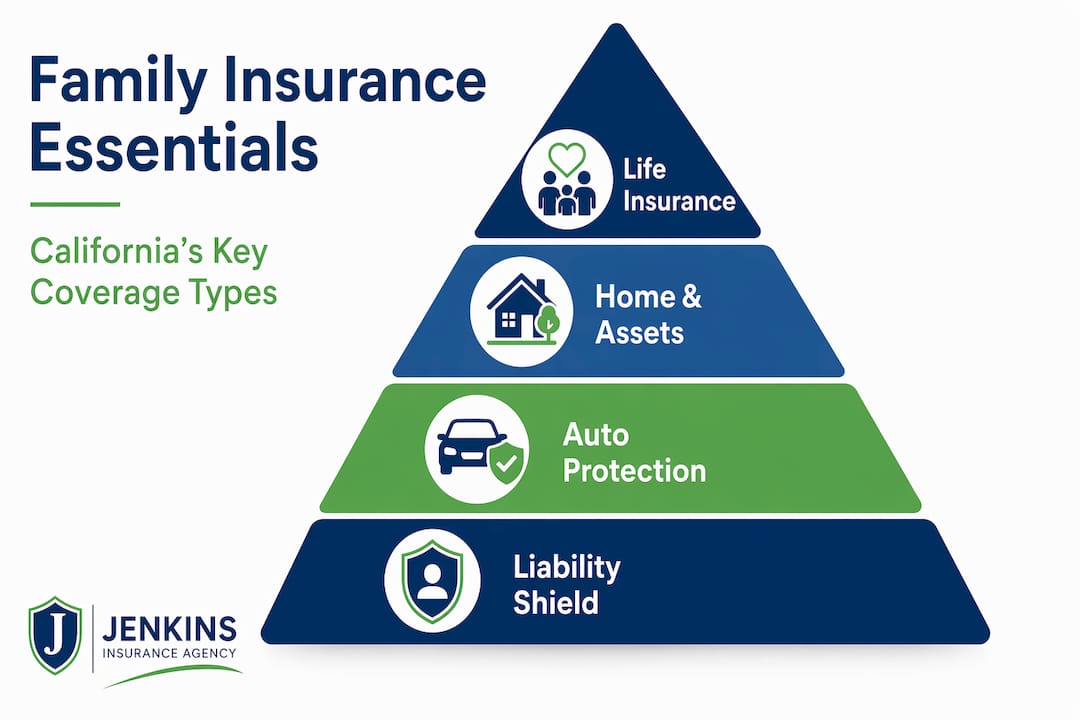
Here’s a quick overview of the core types and what California families need to know about each:
| Insurance type | What it covers | California-specific note |
|---|---|---|
| Life insurance | Income replacement if a breadwinner dies | Essential for families with dependents or a single income |
| Disability insurance | Income replacement if you can’t work | Often overlooked; employers rarely cover enough |
| Health insurance | Medical expenses, hospital stays | Required coverage, but review your plan’s network and limits |
| Homeowners insurance | Property and liability for your home | Standard policies exclude earthquake and flood in most cases |
| Auto insurance | Vehicle damage and liability | California raised minimums in 2025; minimums still may not be enough |
| Umbrella insurance | Extra liability beyond home/auto limits | Especially valuable in California’s legal environment |
For families exploring their options, understanding the types of life insurance available in Sonoma County is a smart starting point. Term life is affordable and straightforward. Whole life offers permanent protection and a savings component. The right choice depends entirely on your family’s financial picture.
One of the most common gaps we see is in homeowners insurance. California families often need to think beyond standard home policies because region-specific risks like earthquakes and floods are commonly excluded, and additional options such as separate flood or earthquake coverage and umbrella liability are often necessary to truly close those gaps.
Pro Tip: Review your homeowners policy declarations page and look for the word “exclusions.” That section tells you what your policy won’t cover. For California families, that list can be surprisingly long.
With a clear understanding of what insurance is meant to protect, let’s break down what types are most crucial for California families, and where there may be hidden gaps.
Protecting your home and assets: California’s unique risks
California is one of the most geographically diverse and disaster-prone states in the country. Families in Sonoma County know this firsthand. The 2017 Tubbs Fire and 2019 Kincade Fire destroyed thousands of homes, and the devastation revealed a painful truth: many families were underinsured or had coverage gaps they didn’t know about.

Standard homeowners policies exclude earthquake and flood coverage, which are real and recurring risks for California households. This means that if an earthquake cracks your foundation or a January storm floods your living room, a standard policy likely pays nothing toward those repairs.
Here’s a breakdown of the most common risk gaps for California homeowners:
| Risk | Covered by standard policy? | What to do |
|---|---|---|
| Wildfire damage | Usually yes, but verify limits | Check replacement cost coverage, not just market value |
| Earthquake damage | No | Purchase a separate earthquake policy |
| Flood damage | No | Purchase flood coverage through a separate program |
| Liability lawsuit | Yes, up to your policy limit | Add umbrella policy if your assets exceed the limit |
| Falling trees or debris | Varies by policy | Check your declarations page carefully |
Here are four practical steps to address home coverage gaps:
- Pull out your current policy and read the exclusions section. You need to know exactly what isn’t covered before you can fix it.
- Assess your local risk profile. Are you in a fire-prone area? A flood zone? Near a fault line? Your ZIP code shapes your risk significantly.
- Contact your agent to discuss add-on policies. Earthquake and flood coverage are available as separate policies and are more affordable than most families expect.
- Check your dwelling coverage limit against actual rebuild costs. Construction costs in California have risen sharply. Many families are insured for what their home was worth years ago, not what it would cost to rebuild today.
“Wildfire, earthquake, and flood risks aren’t edge cases in California. For many communities, they’re the most likely cause of a major insurance claim — and too many families discover their gaps only after disaster strikes.”
Exploring the types of home insurance available to Santa Rosa homeowners can help you understand which additional policies make sense for your specific property and location.
Understanding home and asset risk highlights the importance of not just having insurance, but having the right coverage for California’s environment.
Auto and liability insurance: From California minimums to real protection
California requires all drivers to carry auto liability insurance. As of 2025, the updated minimums are 30/60/15: $30,000 per person for bodily injury, $60,000 per accident, and $15,000 for property damage. That’s an increase from prior years and reflects the state’s recognition that older minimums were simply too low.
Here’s the problem. Even the new minimums can fall short quickly in a serious accident.
| Scenario | Estimated cost | 30/60/15 covers | Remaining liability |
|---|---|---|---|
| One person seriously injured | $150,000 in medical bills | $30,000 | $120,000 out of pocket |
| Two people injured in one accident | $200,000 combined | $60,000 | $140,000 out of pocket |
| New vehicle totaled | $45,000 | $15,000 | $30,000 out of pocket |
These are realistic numbers, not worst-case scenarios. A single serious car accident can generate costs that far exceed what minimum coverage provides. Auto insurance for California families is partly a legal requirement and partly an asset protection issue when accidents exceed minimum limits.
Umbrella insurance is repeatedly positioned as an affordable backup providing extra liability protection beyond your auto and home policy limits, because major lawsuits can exceed underlying policy caps. A $1 million umbrella policy typically costs between $150 and $300 per year. That’s a remarkably low cost for the protection it provides.
Here’s how to stress-test your liability coverage:
- Add up your assets: home equity, savings, retirement accounts, investment accounts. That’s what a lawsuit can go after.
- Compare your assets to your current liability limits. If your assets exceed your policy limits, you’re exposed.
- Ask about umbrella coverage. It’s affordable, easy to add, and provides a significant increase in liability protection.
- Review your coverage limits annually, especially after major financial changes.
Pro Tip: If you own a home and have significant savings, you almost certainly need more liability protection than state minimums provide. An umbrella policy is the most cost-effective way to close that gap.
For detailed guidance on making the right choices, take a look at choosing auto insurance and California auto insurance basics to understand your options in plain language.
Now that home coverage gaps are clear, let’s turn to cars and legal liability, where minimums might look sufficient but often leave families exposed.
Tailoring insurance to your family’s actual needs
There’s no single policy package that fits every California family. Insurance needs are about matching coverage to family circumstances and real risks, whether that means income replacement for working parents or property and liability protection for asset-heavy households.
Think about your family’s profile:
- Young families with children: Life insurance and disability coverage are top priorities. If one parent can’t work, the financial impact is immediate and severe.
- Single parents: Income protection is critical. There’s no second income to fall back on if you’re injured or seriously ill.
- Homeowners: Property coverage and liability protection become central, especially in California’s wildfire and earthquake zones.
- High-net-worth families: Umbrella liability coverage matters more as assets grow, since a successful lawsuit can target everything you own.
- Pre-retirement households: Long-term care insurance and life insurance reviews become more relevant as family financial priorities shift.
One key insight: your insurance needs change as your life does. Getting married, having a child, buying a home, changing jobs, or reaching retirement all shift your exposure significantly. A policy that was perfect five years ago may leave meaningful gaps today.
Regular insurance checkups, ideally once a year, help catch these shifts before they become problems. Bundling your home and auto policies is also worth considering. Families who bundle often save 10% to 25% on their premiums, and it simplifies the management of your coverage. Learn more about insurance bundling for savings and how it applies to California families.
With all the pieces on the table, the final step is making sure your coverage matches what your family truly needs, now and as life evolves.
A practical perspective: Insurance isn’t just a checkbox — here’s what most California families miss
We’ve worked with a lot of families in Sonoma County, and we’ve noticed a consistent pattern. Most people choose their insurance based on two things: price and what’s legally required. That’s it. They pick the cheapest policy that checks the box, and they assume they’re covered.
Then something happens.
A car accident sends two people to the hospital. A wildfire takes out a neighbor’s fence and the lawsuit that follows exceeds the homeowner’s liability limit. A breadwinner gets diagnosed with a serious illness and can’t work for eight months. Suddenly, the gap between “technically covered” and “actually protected” becomes painfully obvious.
Minimum auto liability can be legally sufficient but practically inadequate in serious accidents. Once your policy limits are exhausted, the risk shifts directly to your personal assets. Your savings. Your home equity. Your retirement accounts. All of it is on the table.
What we’ve seen work is simple: treat your insurance like you treat your finances. Review it once a year. Ask hard questions. Find out what your policy won’t cover, not just what it will. One conversation about umbrella coverage or a wildfire exclusion can completely change your family’s outcome after a major event.
The families who recover fastest from disasters aren’t the ones with the most savings. They’re the ones who had the right coverage in place before anything happened. Check out California auto insurance explained for a clearer picture of where common gaps show up and how to address them.
This isn’t about fear. It’s about being realistic about where you live and what your family stands to lose. A small coverage adjustment now can mean the difference between rebuilding your life and starting over from zero.
Ready to protect your family? Your next steps with expert guidance
Knowing what coverage you need is only half the work. The other half is making sure you actually have it — and that the limits are right for your family’s real situation.

At Jenkins Insurance Agency Inc., we work with California families every day to close coverage gaps, review existing policies, and build protection that fits their actual lives. We’re local, we know the risks in Sonoma County and throughout California, and we give you real guidance instead of a generic quote. Start by reviewing your homeowners insurance for California families, explore your auto insurance guidance options, and take a closer look at life insurance for families to see what fits your family best. We’re here to help you make sense of it all.
Frequently asked questions
Why isn’t standard homeowners insurance enough for California families?
Standard policies exclude earthquake and flood coverage, which are real and recurring risks in California, so separate policies are typically required to fully protect your home.
What are California’s new auto insurance minimum requirements?
California’s updated liability minimums for policies issued or renewed after January 1, 2025 are $30,000 per person, $60,000 per accident, and $15,000 for property damage, commonly written as 30/60/15.
How can umbrella insurance benefit California families?
Umbrella insurance provides backup liability protection beyond your auto and home policy limits, shielding your personal assets if you face a lawsuit that exceeds your underlying coverage.
Why do family insurance needs change over time?
Coverage needs shift with life events like marriage, a new child, or buying a home, because each change affects what you own, who depends on you, and what risks your household actually faces.
Recommended
- Whole life insurance in California: secure your family’s future – Jenkins Insurance Agency Inc.
- How insurance safeguards your California business assets – Jenkins Insurance Agency Inc.
- Insurance claims explained: secure your payouts in California – Jenkins Insurance Agency Inc.
- Why updating life insurance matters for California families – Jenkins Insurance Agency Inc.