
TL;DR:
- California homeowners face unique risks like earthquakes, floods, and wildfires that standard policies don’t fully cover.
- Deciding on adequate coverage, especially replacement cost and adequate limits, is essential to avoid costly gaps.
- Regularly reviewing policies and adding endorsements or separate policies ensures protection against state’s top hazards.
Owning a home in California means living with real risks. Wildfires, earthquakes, flooding, and rising repair costs make choosing the right homeowners insurance one of the most important financial decisions you can make. Yet many homeowners sign a policy without fully understanding what it covers or, more importantly, what it doesn’t. One surprise exclusion after a major loss can cost tens of thousands of dollars. This guide walks you through every key step, from understanding your basic policy to addressing California’s unique hazards, so you can choose coverage that truly protects your home and your peace of mind.
Table of Contents
- Understand what homeowners insurance covers (and what it doesn’t)
- Decide how much coverage you really need
- Address California’s top risks with endorsements or separate policies
- Compare, request quotes, and review policy details
- The uncomfortable truth about picking California homeowners insurance
- Ready to protect your California home?
- Frequently asked questions
Key Takeaways
| Point | Details |
|---|---|
| Know what’s covered | Standard policies exclude earthquake, flood, and mudslide—check for crucial gaps. |
| Match coverage to your needs | Choose replacement cost and review limits after upgrades or changes. |
| Address special California risks | Wildfire, earthquake, and flood require endorsements or separate policies. |
| Compare quotes wisely | Look beyond price and examine coverage, endorsements, and insurer reliability. |
Understand what homeowners insurance covers (and what it doesn’t)
Starting with the fundamentals ensures you know what to expect from your policy. Most homeowners in California carry what’s called an HO-3 policy. This is the standard form used by the majority of insurers, and it covers your home’s structure, personal belongings, personal liability, and additional living expenses if you’re displaced after a covered loss.
Here’s a quick look at what a standard HO-3 typically includes and excludes:
| Covered hazards | Not covered hazards |
|---|---|
| Fire and wildfire | Earthquake damage |
| Theft and vandalism | Flood damage |
| Wind and hail | Mudslide or earth movement |
| Personal liability | Sewer backup (without endorsement) |
| Loss of use (hotel stays, etc.) | Wear and tear or neglect |
As the HO-3 standard exclusions confirm, standard policies cover fire and wildfire, theft, and liability, but they exclude earthquakes, floods, and earth movement like mudslides. Those gaps matter enormously in California.
Here are the core coverage areas you’ll find in a standard policy:
- Dwelling coverage: Pays to repair or rebuild your home’s structure
- Personal property coverage: Covers furniture, clothing, electronics, and other belongings
- Liability coverage: Protects you if someone is injured on your property
- Loss of use coverage: Covers temporary housing costs after a covered loss
For California homeowners, the exclusions are where things get tricky. Earthquakes are one of the biggest risks in the state, yet no standard policy covers them. The same goes for flood damage and mudslides. If you live in a fire-prone area, it’s also worth checking the fine print on wildfire-related coverage limits, since some insurers add conditions or sublimits.
You can review California policy coverage basics or explore home insurance types to get a clearer picture before you shop. For homeowners in Sonoma County and surrounding areas, understanding wildfire coverage explained is especially important given the region’s fire history.
Endorsements are additions you can attach to your base policy to fill specific gaps. Separate policies, like earthquake or flood insurance, are purchased independently. Knowing which gaps exist in your standard coverage helps you build the right combination.
Decide how much coverage you really need
Now that you know what’s generally covered and where the gaps are, the next step is deciding how much coverage you actually need. This is where many homeowners underestimate their exposure.
The most important number to get right is your dwelling coverage limit. This should reflect the cost to rebuild your home from the ground up, not its market value or what you paid for it. Construction costs in California have climbed significantly, so a figure that felt adequate three years ago may no longer be enough.
Here’s a straightforward coverage checklist to work through:
- Dwelling: Get a rebuild estimate from a contractor or use your insurer’s cost estimator tool
- Personal property: Add up the value of your belongings room by room; most people are surprised by the total
- Liability: Standard limits start at $100,000, but $300,000 or more is often a smarter choice
- Loss of use: Make sure limits reflect realistic temporary housing costs in your area
One of the most consequential choices you’ll make is between actual cash value (ACV) and replacement cost value (RCV) coverage. ACV pays you what your belongings are worth today, after depreciation. RCV pays what it actually costs to replace them with new items. For a five-year-old laptop or a sofa, that difference can be hundreds of dollars per item.

| Coverage type | What you receive after a loss |
|---|---|
| Actual cash value | Depreciated value of item |
| Replacement cost value | Full cost to replace with new item |
As noted in guidance on replacement cost vs. ACV, prioritizing replacement cost over actual cash value for contents is strongly recommended, especially when paired with inflation guard endorsements that automatically adjust your limits as costs rise.
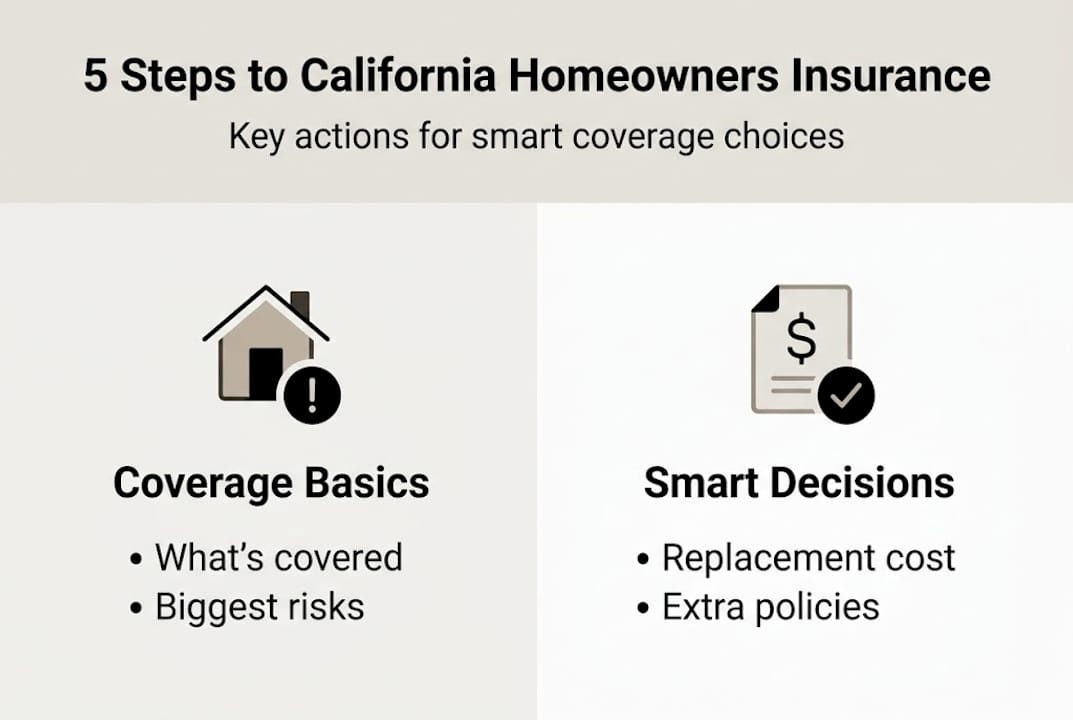
You can also review property valuation steps to make sure your estimate is accurate.
Pro Tip: If you’ve recently renovated your kitchen, finished a basement, or made any major upgrades, revisit your dwelling coverage limit right away. Those improvements add rebuild value that your original policy may not reflect.
Address California’s top risks with endorsements or separate policies
With the basics and coverage levels decided, now make sure you’re protected from what truly threatens your home. California homeowners face a combination of risks that simply don’t exist in most other states, and a standard HO-3 policy alone won’t cover them.
Here are the key hazards that require extra coverage:
- Earthquake: Not covered by any standard policy. The California Earthquake Authority (CEA) offers standalone policies available through many carriers.
- Flood: Excluded from standard policies. Coverage is available through the National Flood Insurance Program (NFIP) or private flood insurers.
- Mudslide and earth movement: Also excluded. Some endorsements cover ensuing water damage, but full earth movement coverage usually requires a separate policy.
- Extended replacement cost: An endorsement that pays above your dwelling limit if rebuild costs spike after a widespread disaster.
- Sewer backup: A relatively affordable endorsement that covers water damage from backed-up drains or sump pump failure.
As confirmed by California exclusion guidelines, standard HO-3 policies exclude earthquakes, floods, and earth movement, so separate endorsements or policies are essential for complete protection in this state.
“Don’t wait for a loss to find out what you’re missing. The time to understand your policy gaps is before a wildfire or earthquake, not after.”
Wildfire risk has also become a coverage eligibility issue in California. Some insurers have restricted or non-renewed policies in high-risk fire zones. If you live in a wildfire-prone area, understanding wildfire insurance details is critical. You can also explore additional coverage types to see all your options.
Pro Tip: Some mortgage lenders require specific endorsements, such as flood coverage in a designated flood zone. Check your loan documents to confirm what’s mandatory before you finalize your policy.
This is exactly the kind of situation where working with a local agent makes a real difference. A local agent who knows your neighborhood understands the specific risks your home faces and can recommend coverage that fits your unique situation.
Compare, request quotes, and review policy details
Once you’ve identified the right coverage and addressed special risks, it’s time to shop around and finalize your decision. Don’t settle for the first quote you receive. Comparing at least three options almost always turns up a meaningful difference in price, coverage, or both.
Here’s how to approach the comparison process efficiently:
- Gather your home details: Square footage, year built, roof type, recent upgrades, and any previous claims
- Request quotes from multiple sources: A local independent agent, your current carrier, and at least one online tool
- Compare on equal terms: Make sure every quote uses the same dwelling limit, deductible, and coverage types
- Check insurer reliability: Look at claims satisfaction ratings and financial strength scores, not just price
- Review endorsements separately: Add the same endorsements to every quote so the comparison is apples to apples
Before you sign anything, review these key policy details carefully:
- Coverage limits: Are dwelling, personal property, and liability limits sufficient?
- Deductibles: Is there a separate wildfire or wind deductible? What can you realistically afford to pay out of pocket?
- Exclusions: Read the exclusions section, not just the declarations page
- Endorsements included: Are any added automatically, and are they appropriate for your home?
- Cancellation terms: Understand how easily a policy can be non-renewed, especially in fire-risk zones
It’s also worth knowing that bundling your home and auto insurance can reduce your total premium by up to 25%. The bundling discounts guide explains how to maximize savings without cutting necessary coverage. And as noted in guidance on inflation guard coverage, choosing replacement cost and inflation guard endorsements is a smart investment that pays off when you actually file a claim.
For ongoing guidance and updates on policy changes, the Jenkins Insurance blog is a helpful resource to revisit each year.
The uncomfortable truth about picking California homeowners insurance
Here’s something we see often from behind the desk: homeowners who focus almost entirely on finding the lowest premium, then discover after a major loss that their policy had gaps they didn’t know about. It’s one of the most painful conversations we have.
The uncomfortable truth is that insurance only works when it’s built for real-life scenarios. A policy that saves you $200 a year means nothing if it pays $80,000 less than your rebuild cost after a wildfire. In California, the stakes are too high to optimize for price alone.
What we’ve learned is that the best protection comes from understanding your specific exposures and choosing coverage that actually matches them. That means checking earthquake eligibility, confirming wildfire limits, and choosing replacement cost over actual cash value, even when it costs more. A solid property insurance resource can help you think through each layer.
The other habit that truly matters is re-evaluating your coverage every year. California’s risk landscape and construction costs change quickly. A policy that was right for you two years ago may have meaningful gaps today. Make it a calendar reminder. Review, upgrade if needed, and stay ahead of the curve.
Ready to protect your California home?
You now have a clear picture of what a solid homeowners insurance policy looks like in California and what questions to ask before you commit. Knowing the details puts you in a much stronger position than most homeowners who simply sign what’s placed in front of them.

At Jenkins Insurance Agency, we work with homeowners across Sonoma County and California every day. We help you find the right California homeowners insurance for your home, your risks, and your budget. Whether you need wildfire protection details or want to explore ways to lower your premium with California insurance savings, we’re here to guide you with real, personal service. Reach out to our local team today.
Frequently asked questions
Are wildfires covered by standard homeowners insurance in California?
Wildfire damage is typically covered under standard HO-3 policies, but wildfire policy limits and conditions vary by insurer, and some policies in high-risk zones carry special requirements or sublimits worth reviewing closely.
What is the difference between replacement cost and actual cash value?
Replacement cost pays to replace your damaged property with new items at current prices, while actual cash value deducts depreciation and typically results in a much lower payout. For most California homeowners, replacement cost coverage is the stronger choice.
Do I need earthquake or flood insurance separately?
Yes. Both earthquake and flood damage are excluded from standard California homeowners policies, and each requires a separate policy or endorsement to be properly covered.
How often should I review my homeowners insurance policy?
Review your policy at least once a year, and always after major home improvements or significant changes in your property’s value, to make sure your coverage limits are still adequate.
What’s the best way to lower my homeowners insurance premium in California?
Bundle your home and auto policies, raise your deductible if you can afford the out-of-pocket cost, invest in home safety upgrades, and compare quotes from multiple carriers each renewal cycle to find the best combination of price and protection.
Recommended
- How to Choose Auto Insurance for California Residents – Jenkins Insurance Agency Inc.
- Step-by-Step Guide to Property Insurance California – Jenkins Insurance Agency Inc.
- California Insurance Guide 2026: Save 25% with Bundling – Jenkins Insurance Agency Inc.
- Insurance claims explained: secure your payouts in California – Jenkins Insurance Agency Inc.
- How to choose repair services: a 2026 guide for homeowners