
TL;DR:
- Insurance transfers financial risk, protecting assets, liabilities, and ensuring business continuity in California.
- Key policies include property, liability, workers’ compensation, and cyber insurance, with specific exclusions.
- Proactive review and tailored coverage provide strategic advantages by filling gaps and managing climate and legal risks.
How insurance safeguards your California business assets
Running a business in California is rewarding, but it carries real financial risk. Nearly 40% of small businesses will face a property or liability claim within ten years, and many of those claims are large enough to seriously threaten daily operations. Insurance is not a formality or a box to check. It is the financial foundation that keeps your business standing when something unexpected hits. This guide will walk you through the core functions of business insurance, the specific policies you need to know, the gaps that catch owners off guard, and the practical questions you should ask before signing anything.
Table of Contents
- What does insurance do for California businesses?
- Key types of insurance and what they cover
- Critical exclusions, climate risks, and modern challenges
- What insurance can’t do—and what to look for in a policy
- Why proactive insurance is a strategic advantage, not just a safety net
- Protect your business—get personalized coverage guidance
- Frequently asked questions
Key Takeaways
| Point | Details |
|---|---|
| Insurance is a business safeguard | The majority of California businesses face significant claims risk, making comprehensive coverage essential. |
| Know your coverage gaps | Standard policies often exclude flood, earthquake, and modern threats like cyber attacks. |
| Treat insurance as strategy | Proactive risk management and policy selection build resilience and competitive advantage. |
| Review policies regularly | Update your insurance to address evolving risks and market changes unique to California. |
What does insurance do for California businesses?
Most business owners know they need insurance, but fewer understand what it actually does at a mechanical level. At its core, insurance transfers financial risk from your business to an insurer. You pay a regular premium, and in return, the insurer absorbs the cost of covered losses. That simple exchange is what keeps a single bad event from wiping out years of work.
For California businesses specifically, insurance provides a financial safety net that protects your operations, assets, and liabilities through risk transfer to insurers. This matters more in California than in most states because of the state’s unique combination of natural disaster exposure, high litigation rates, and strict employment regulations.
Here is what insurance does for your business in practical terms:
- Protects physical assets like your building, equipment, inventory, and vehicles from damage or theft
- Covers liability claims when a customer, supplier, or member of the public holds your business responsible for injury or financial harm
- Keeps you legally compliant since California mandates certain coverages like workers’ compensation for any business with employees
- Preserves cash flow by preventing large, unplanned expenses from draining your operating capital
- Supports business continuity by funding recovery costs so you can reopen after a covered loss
One of the most common misconceptions we hear from business owners is that insurance is mainly about regulatory compliance. That mindset leads people to buy the minimum required coverage and stop there. The reality is that compliance coverage often leaves significant gaps, especially for smaller businesses that cannot absorb large out-of-pocket losses.
Insurance is not just about meeting a legal requirement. It is about protecting the thing you have worked hardest to build.
Another misconception is that insurance is only relevant when something dramatic happens, like a fire or a lawsuit. In practice, claims happen for everyday reasons: a customer slips on a wet floor, a piece of equipment breaks and delays orders, or an employee is injured lifting something heavy. These routine events can generate costs in the tens of thousands of dollars if you are not covered.
Pro Tip: Review your policy limits annually, not just when you first purchase coverage. As your revenue, staff count, and physical assets grow, your old coverage limits may no longer match your actual exposure. Understanding why insuring your business matters is the first step, but keeping that coverage updated is what actually protects you over time.
The business insurance importance for California owners goes beyond simple protection. It signals credibility to partners, clients, and lenders who often require proof of coverage before doing business with you. Insurance is woven into nearly every stage of business growth.

Key types of insurance and what they cover
Once you understand the purpose of insurance, the next step is to see how specific types provide relevant coverage. California business owners typically need a combination of several policies, because no single policy covers every risk your business faces.
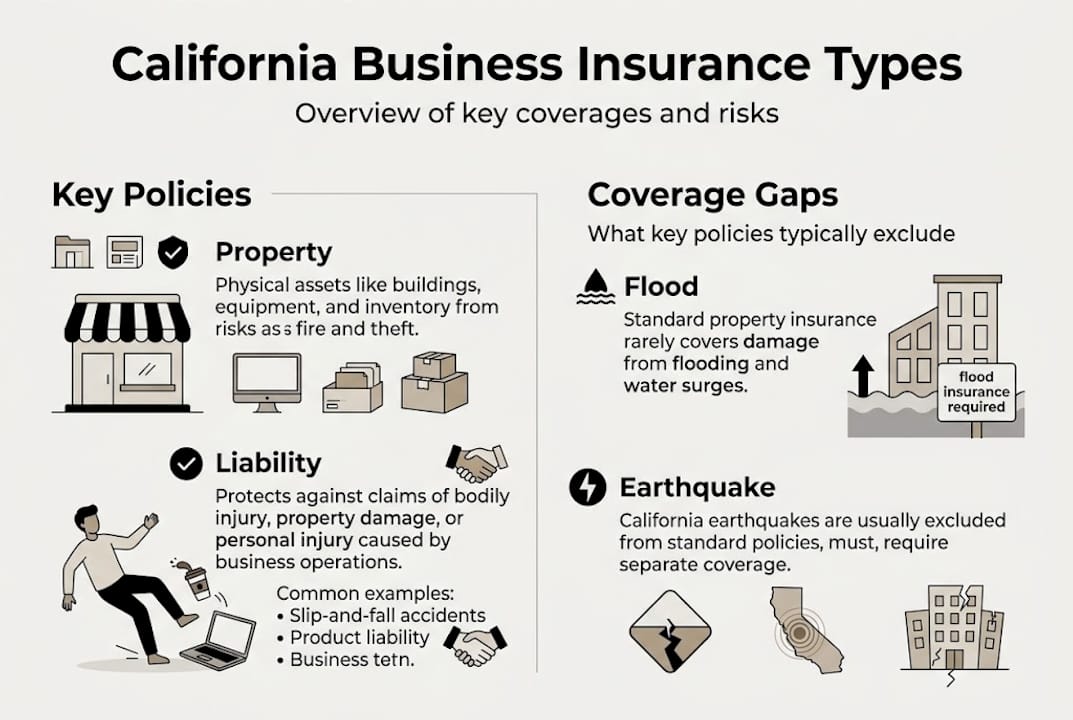
Here is a clear look at the core policies and what each one does:
| Policy type | What it covers | Common gap |
|---|---|---|
| Commercial property | Buildings, equipment, inventory | Floods and earthquakes excluded |
| General liability | Third-party injury and property damage claims | Professional errors excluded |
| Workers’ compensation | Employee injuries and illnesses on the job | Contractor misclassification disputes |
| Business interruption | Lost income during a covered shutdown | Waiting periods and income caps |
| Commercial auto | Vehicles used for business operations | Personal vehicles used for work |
| Cyber liability | Data breaches and network attacks | Social engineering may need endorsement |
California workers’ compensation claims run at approximately 5.2 per 100 employees among public self-insured entities in fiscal year 2024/25. That figure highlights how frequently employee injury claims occur, even in office or retail environments that might not seem physically hazardous.
Here is a numbered breakdown of the most important policies for California business owners and what to prioritize within each one:
- Commercial property insurance should be based on replacement cost, not actual cash value. Replacement cost pays what it actually costs to rebuild or replace. Actual cash value deducts depreciation, which can leave you significantly underinsured after a major loss.
- General liability insurance is almost always the first policy a new business buys. It covers bodily injury, property damage, and personal injury claims. Most commercial leases require it, and many clients ask for a certificate of insurance before signing a contract.
- Workers’ compensation insurance is legally required in California for any business with even one employee. Failing to carry it exposes you to serious penalties and personal liability for injured workers’ medical costs.
- Business interruption insurance is frequently overlooked until it is too late. If a fire forces you to close for three months, this policy replaces lost revenue and covers fixed expenses like rent and payroll during the shutdown.
- Cyber liability insurance is growing in importance for any business that stores customer data or processes digital transactions. Breach costs average well into six figures when you factor in notification, legal defense, and regulatory fines.
Looking at types of business insurance across industries, specialty coverages like professional liability (also called errors and omissions) and product liability are often necessary for service providers and manufacturers respectively.
Pro Tip: Bundle related policies into a Business Owners Policy, commonly called a BOP. A BOP typically combines commercial property and general liability at a lower combined premium than buying both separately. You can explore common business insurance policies and the business insurance steps that make sense for your specific industry.
Critical exclusions, climate risks, and modern challenges
Even with good coverage, gaps and new threats require careful attention. California’s geography and legal environment create a set of insurance challenges that owners in other states simply do not face at the same scale.
Standard commercial policies exclude floods and earthquakes. Full stop. If your business sits in a flood zone, near a fault line, or in a wildfire-prone area, you need separate policies or endorsements to cover those risks. Difference in Conditions (DIC) policies and parametric insurance products have emerged specifically to fill these gaps. Parametric insurance pays a set amount when a triggering event reaches a defined threshold, like a certain earthquake magnitude, rather than requiring you to document individual losses.
California’s wildfire reality is reshaping the insurance market. Standard policies exclude floods and earthquakes, and climate-driven risks like wildfires are already leading insurers to issue non-renewals or apply sharply higher premiums in high-risk areas across the state. This is not a distant future problem. Many Sonoma County and Northern California businesses have already received non-renewal notices on commercial policies due to wildfire proximity.
Here is a comparison of how standard policies handle common California risks versus what specialized coverage looks like:
| Risk | Standard policy response | Specialized solution |
|---|---|---|
| Wildfire damage to structure | Covered (if not excluded) | Confirm no high-risk exclusion clause |
| Earthquake structural damage | Not covered | California Earthquake Authority or DIC policy |
| Flood damage | Not covered | NFIP commercial flood policy |
| Cyber attack and data breach | Usually not covered | Standalone cyber liability policy |
| Employee violence incident | May trigger assault exclusion | Negligent supervision may still be covered |
On the cyber front, the changing cyber insurance landscape has become more demanding. Insurers now routinely require businesses to demonstrate minimum cybersecurity controls, like multi-factor authentication and regular data backups, before they will issue a policy or renew an existing one. Premiums have risen significantly as breach frequency increases across all industries.
Other common exclusions that catch California business owners off guard include:
- Employee dishonesty and theft (requires a crime or fidelity bond)
- Professional errors and omissions (requires a separate professional liability policy)
- Damage from normal wear and tear or poor maintenance
- Losses from intentional acts by the insured
Review your underinsurance risks carefully and use an insurance checklist to systematically identify where your current coverage may fall short. This kind of structured review is one of the most practical things you can do before your next renewal date.
What insurance can’t do—and what to look for in a policy
Now that you understand exclusions and risks, it is important to recognize what insurance truly can and cannot deliver for your business.
Insurance cannot prevent losses. It cannot undo reputational damage from a public lawsuit. It cannot replace irreplaceable relationships or restore years of customer trust. What it can do is provide the financial resources to rebuild, defend, and continue operating after a covered event. That distinction matters because some business owners expect insurance to make them whole in every sense. It does not work that way.
Insurance is an investment in resilience. Those who treat it as a cost to minimize often discover the hard way that the cost of being underinsured is far greater.
The idea of insurance as investment in resilience versus expense is gaining traction in boardrooms and among small business owners alike. In California’s litigious environment, where employment claims and customer lawsuits are common, having solid coverage is often the difference between a manageable setback and a business-ending crisis.
There are also practical insurance conditions attached to every policy that affect how and when claims are paid. Conditions include requirements like timely reporting of losses, cooperation with the insurer’s investigation, and maintaining your property in a reasonable state of repair. Failing to meet these conditions can reduce or void a claim payout, even when the underlying loss is covered.
Here are the key questions to ask when evaluating any business insurance policy:
- What is the per-occurrence limit and the aggregate limit? The per-occurrence limit is the maximum payout for a single event. The aggregate is the total for a policy year. Both matter.
- What is the deductible, and can you realistically cover it? A lower premium often means a higher deductible. Make sure you can absorb that amount without disrupting operations.
- What specific exclusions apply to my industry? Some exclusions are industry-specific. A contractor faces different exclusions than a restaurant owner.
- Does the policy include defense costs inside or outside the limits? When defense costs are inside the limit, legal fees reduce what is available to pay a settlement. Outside the limits is almost always better.
- How does the insurer handle claims? Ask about average claim response times and whether you get a dedicated adjuster or a general pool.
Understanding the insurance benefits available to you and the relevant insurance concepts will help you ask better questions and make smarter decisions when comparing policies or working with an agent.
Why proactive insurance is a strategic advantage, not just a safety net
Here is the part that most business insurance articles skip. The owners who come through major losses in the best shape are not always the ones with the most coverage. They are the ones who reviewed their policies thoughtfully, understood what they had, and built risk management into their regular business planning rather than treating it as a one-time purchase.
Conventional wisdom says to buy the coverage you are required to carry and revisit it every few years. That mindset makes sense as a minimum, but it leaves real value on the table. Smart California business owners use coverage decisions as a tool for competitive positioning. Having broad, well-documented coverage allows you to take on larger contracts, attract better suppliers, and give customers confidence that you can honor your commitments even after a disruption.
We have seen firsthand how clients who anticipated risk recovered faster and with less stress than those who scrambled after the fact. The difference often came down to one thing: they understood their insurance strategy concepts well enough to know exactly what would happen when a claim occurred. They were not surprised by exclusions. They had already filled the gaps. That kind of clarity is genuinely a strategic advantage in a market as competitive and legally active as California.
Protect your business—get personalized coverage guidance
You have worked hard to build your business. It deserves protection that actually fits your unique situation, not a generic policy pulled from a shelf.

At Jenkins Insurance Agency Inc., we specialize in helping California business owners identify real gaps in their coverage and build policies that make sense for their industry, size, and risk profile. We are local, we know Sonoma County, and we treat every client like a neighbor, not a policy number. Whether you need to review business insurance in Santa Rosa or want to explore essential business policies in plain language, we are here to help you take the next step with confidence. Reach out to us today for a personalized coverage review.
Frequently asked questions
What is the most common insurance claim for California businesses?
Property and liability claims are the most common, with nearly 40% of small businesses experiencing one within a decade. Slip-and-fall incidents and minor property damage are especially frequent.
Are flood and earthquake damages covered by standard insurance policies?
Standard policies exclude floods and earthquakes, so additional specialized policies like NFIP flood coverage or a DIC policy are required to cover these risks.
How are workers’ compensation claims trending in California?
California sees about 5.2 workers’ comp claims per 100 employees, and average paid losses have climbed to $5,076 per claim, up 8.4% year over year, with cumulative trauma claims driving much of the increase.
Does business insurance cover lawsuits from customers or suppliers?
General liability insurance can provide legal defense and cover some damages from customer or supplier lawsuits, as long as the claim does not fall under a specific exclusion. Review your policy terms carefully with a licensed agent to understand exactly where coverage applies in your situation.
Recommended
- Why insure business property? Protecting your California assets – Jenkins Insurance Agency Inc.
- Why business insurance matters for California SMBs in 2026 – Jenkins Insurance Agency Inc.
- The essential business insurance checklist for California owners – Jenkins Insurance Agency Inc.
- Why Insure Your Business: Protecting Sonoma County Owners – Jenkins Insurance Agency Inc.