
TL;DR:
- Fire insurance for businesses covers physical damage, lost income, and extra costs caused by fire incidents, which are especially critical in wildfire-prone California. The right policy includes building, contents, business interruption, and extra expense coverage, with special open perils policies offering the broadest protection. Preparing documentation and implementing fire safety improvements can lower insurance costs and ensure better claim outcomes after a fire.
Fire insurance for businesses is defined as commercial property coverage that pays for physical damage, lost income, and extra operating costs caused by fire-related incidents. In California, where wildfires destroyed more than 1 million acres in recent years, this coverage is not optional. It is the financial foundation that keeps a business alive after a fire. Whether you run a restaurant in Santa Rosa, a warehouse in Petaluma, or a retail shop in Sonoma County, the right commercial fire insurance policy determines whether you rebuild or close permanently.
What does fire insurance for businesses actually cover?
Commercial property policies come in three standard forms: Basic, Broad, and Special (also called open perils). Basic covers a narrow list of named perils. Broad adds a few more, including water damage from firefighting efforts. Special form covers all risks unless specifically excluded, and it is the recommended standard for almost every business.
Each policy type can include several coverage components:
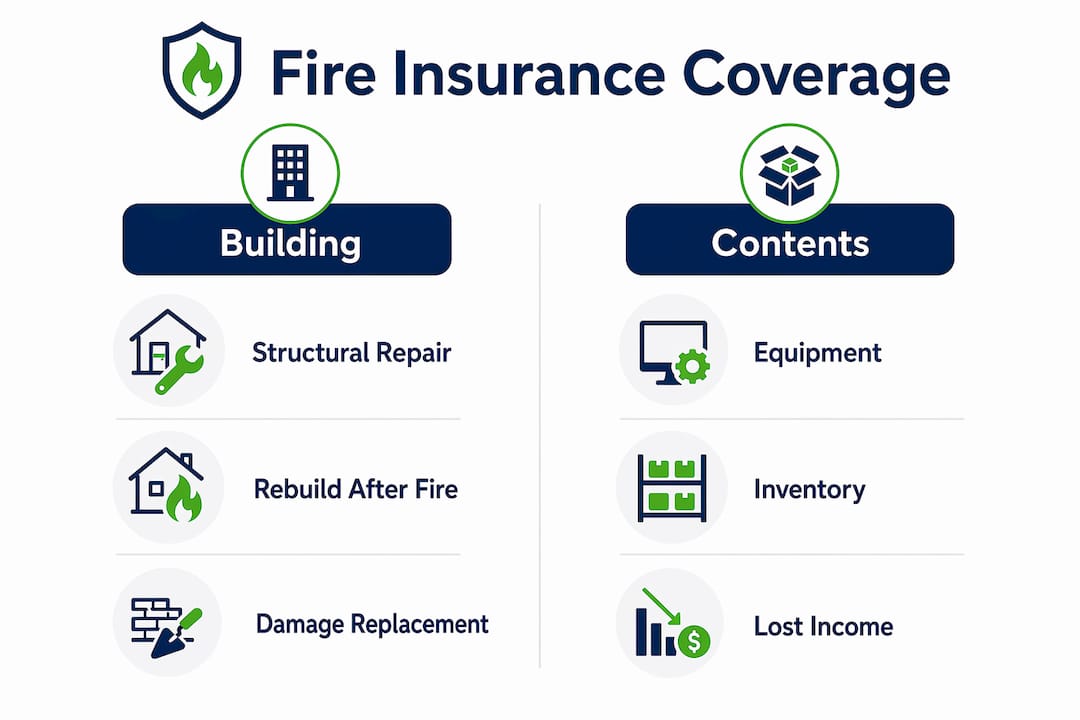
- Building coverage: Pays to repair or rebuild the physical structure after fire damage.
- Contents coverage: Replaces equipment, inventory, furniture, and tenant improvements.
- Business interruption coverage: Replaces lost revenue and covers continuing expenses like rent and payroll while your business is closed for repairs.
- Extra expense coverage: Pays for temporary facilities or expedited repairs to reduce business downtime after a fire. This coverage is frequently overlooked and can be the difference between staying open and shutting down.
Pro Tip: Always confirm whether your policy pays replacement cost value or actual cash value. Replacement cost rebuilds at today’s prices. Actual cash value deducts depreciation, which can leave you tens of thousands of dollars short on a claim.
One policy detail that catches many business owners off guard is the coinsurance clause. Coinsurance clauses require you to insure at least 80% of your property’s full replacement value. If you fall short of that threshold, your insurer will reduce your claim payout proportionally on any partial loss. For a business with $500,000 in assets, that miscalculation can cost you more than $100,000 in a real claim.
| Coverage Type | What It Pays For |
|---|---|
| Building | Structural repair or rebuild after fire |
| Contents | Equipment, inventory, and tenant improvements |
| Business Interruption | Lost revenue and fixed expenses during closure |
| Extra Expense | Temporary relocation and expedited repair costs |
| Special Form (Open Perils) | All risks not specifically excluded by the policy |
How much does commercial fire insurance cost in california?
Premium costs for commercial fire insurance in California vary widely based on location, building type, and risk profile. Businesses in low-risk urban areas with strong fire department access typically pay far less than those in wildfire-prone zones. California wildfire zone premiums can range from $10,000 to $60,000 or more annually. Some businesses in high-risk areas face non-renewal entirely and must turn to the California FAIR Plan, the state’s insurer of last resort.

One of the most significant pricing factors is the ISO Protection Class rating assigned to your location. Urban Protection Class ratings of 1–4 can result in premiums three to five times lower than rural ratings of 9–10, where no fire department response is available. A restaurant in downtown Santa Rosa and a warehouse in a remote Sonoma County foothills area face dramatically different premium calculations because of this single factor.
Business type also shapes your rate. Here is a general breakdown:
- Office buildings in urban areas: lower risk, lower premiums.
- Restaurants: higher risk due to cooking equipment and grease fires.
- Warehouses: risk depends heavily on what is stored and sprinkler status.
- Retail shops near wildland-urban interface zones: elevated risk, possible FAIR Plan territory.
Pro Tip: Ask your agent to pull your building’s ISO Protection Class before you shop for quotes. That single number explains more about your premium than almost any other factor.
Building construction matters too. Wood-frame buildings cost more to insure than masonry or fire-resistant construction. Installing a NFPA-compliant sprinkler system can meaningfully reduce your premium and improve your eligibility with standard carriers rather than specialty markets.
How should you prepare for and handle a fire insurance claim?
Claim preparation starts long before a fire occurs. Business owners need thorough documentation of all assets and losses to recover the full value of a claim. Adjusters often rely on rough estimates that ignore full replacement costs. Without your own detailed records, you have no leverage to dispute a low initial offer.
Follow these steps to protect your claim recovery:
- Build a digital asset inventory now. Photograph and list every piece of equipment, furniture, and inventory. Store copies offsite or in cloud storage like Google Drive or Dropbox.
- Keep purchase receipts and maintenance logs. These records establish value and show that equipment was in working condition before the fire.
- Document business income. Save tax returns, profit and loss statements, and bank records for at least three years. These are the foundation of any business interruption claim.
- File your proof of loss on time. Most policies require a formal proof of loss within 60 days of a fire. Missing this deadline can void your claim entirely.
- Track every extra expense. If you rent temporary space or pay overtime to maintain operations, save every receipt. Extra expense coverage reimburses these costs, but only with documentation.
- Consider a public adjuster for large losses. A licensed public adjuster works for you, not the insurer, and can negotiate a higher settlement on complex claims.
For more guidance on the proof of loss process and claim best practices, the insurance claims guide from Jenkinsinsuranceagencyinc walks through the full process for California business owners.
Pro Tip: Do not throw away any damaged property before the adjuster inspects it. Disposing of evidence, even charred debris, can give an insurer grounds to reduce or deny your claim.
Can fire safety improvements lower your insurance costs?
Proactive fire safety compliance with NFPA standards not only meets regulation but directly impacts premium rates and claims acceptance. Insurers reward businesses that reduce risk. The investments you make in fire protection often pay back through lower premiums within one to two renewal cycles.
Key improvements that affect your coverage eligibility and cost:
- Install NFPA-compliant sprinkler systems. Sprinklers are the single most effective fire suppression tool for commercial buildings. Insurers treat sprinklered buildings as a lower risk class.
- Upgrade fire alarm and detection systems. Monitored alarms that alert the fire department automatically reduce response time and potential damage.
- Use fire-resistant building materials. Replacing wood siding or roofing with fire-rated alternatives lowers your building’s risk profile and can shift your ISO Protection Class.
- Schedule annual fire safety inspections. Keep written records of every inspection. Insurers may request these during underwriting or after a claim.
- Train employees on fire prevention and evacuation. Documented training programs show insurers that your business takes risk management seriously.
Improving your Protection Class through these upgrades can meaningfully lower insurance costs, especially for businesses in rural or wildland-urban interface areas. Even rural businesses can reduce costs by investing in certified fire suppression systems and regular sprinkler inspections.
You can find a full business insurance checklist from Jenkinsinsuranceagencyinc that covers NFPA compliance requirements and inspection standards in detail.
What do california business owners get wrong about fire coverage?
Several common misunderstandings lead business owners to discover gaps in their coverage only after a fire has already occurred.
- General liability does not cover fire damage. General liability insurance typically excludes fire-related property losses. Fire damage to your own building and contents must be covered under a commercial property or fire insurance policy.
- Basic property coverage is not the same as business interruption coverage. A standard property policy pays to repair your building. It does not replace your lost revenue while you are closed. Business interruption must be added separately.
- Fire damage is not limited to burn damage. Smoke damage, water damage from firefighting, and structural compromise from heat all qualify as fire-related losses under most Special form policies.
- Nominal policy limits create serious underinsurance risk. Many business owners set their coverage limits based on their original purchase price, not today’s replacement cost. Construction costs have risen sharply. A policy that felt adequate three years ago may now leave you $200,000 or more short.
- Extra expense coverage is frequently missing. Most business owners do not realize this coverage exists until they need it. Adding it is usually inexpensive relative to the protection it provides.
Key takeaways
California businesses face fire risks that demand more than basic property coverage. The right commercial fire insurance policy combines building protection, business interruption, and extra expense coverage to keep your business financially intact after a fire.
| Point | Details |
|---|---|
| Choose Special form coverage | Open perils policies cover all risks unless excluded, giving the broadest fire protection. |
| Know your ISO Protection Class | Your location’s rating can make premiums three to five times higher or lower than nearby businesses. |
| Document assets before a fire | Digital inventories and financial records are the foundation of a full claim recovery. |
| Add business interruption coverage | Lost revenue during closure is often the largest financial threat after a fire. |
| Invest in NFPA-compliant systems | Sprinklers, alarms, and inspections lower premiums and improve claims acceptance. |
What i have learned working with california business owners on fire claims
After working with business owners across Sonoma County, the pattern I see most often is not a lack of coverage. It is the wrong kind of coverage, or not enough of it. A business owner buys a commercial property policy, assumes they are protected, and never looks closely at the limits or the exclusions. Then a fire happens and the claim comes back far below what they expected.
The most painful cases involve business interruption. A restaurant owner loses three months of revenue while the kitchen is rebuilt. The property claim covers the equipment. But without business interruption coverage, the owner is paying rent, payroll, and loan payments out of pocket with zero income coming in. That is the scenario that causes permanent closures, not the fire itself.
California’s wildfire exposure adds another layer that business owners in other states simply do not face. If your business sits near a wildland-urban interface zone, your insurer may non-renew your policy without warning. I have seen this happen to businesses that had no prior claims. The solution is to work with an agent who knows the California market and can access specialty carriers or the FAIR Plan before you are forced into it under pressure.
My honest advice: review your coverage limits every year, not just when you renew. Replacement costs change. Your business grows. Your policy needs to keep up.
— Jason
How Jenkinsinsuranceagencyinc helps california businesses get the right fire coverage
If you are a California business owner trying to sort through policy types, wildfire zone risks, and coverage gaps, you do not have to figure it out alone.

Jenkinsinsuranceagencyinc is a local agency based in Santa Rosa, serving businesses throughout Sonoma County and broader California. Through our affiliation with Farmers Insurance, we access a wide range of carriers and can compare options built for your specific risk profile. We help you understand your ISO Protection Class, identify coverage gaps like missing business interruption or extra expense coverage, and build a policy that actually fits your business. Reach out to our local team for a personalized consultation, or start by exploring your business insurance options on our website.
FAQ
What is fire insurance for businesses?
Fire insurance for businesses is commercial property coverage that pays for physical damage to buildings, contents, and equipment caused by fire, as well as lost income through business interruption coverage. The industry standard term is commercial property insurance with fire coverage included.
Does general liability insurance cover fire damage to my business?
No. General liability insurance excludes fire damage to your own property. You need a separate commercial property or fire insurance policy to cover building and contents losses.
How much does commercial fire insurance cost in california?
Costs vary significantly by location and risk. Businesses in California wildfire zones can pay $10,000 to $60,000 or more annually, while low-risk urban businesses typically pay far less.
What is business interruption coverage and do i need it?
Business interruption coverage replaces lost revenue and pays continuing expenses like rent and payroll while your business is closed for fire-related repairs. For most California businesses, it is the most financially critical coverage to carry.
What happens if my insurer non-renews my fire policy in california?
If a standard carrier non-renews your policy due to wildfire risk, you can apply for coverage through the California FAIR Plan, the state’s insurer of last resort. Working with a local agent before non-renewal happens gives you more options and better terms.
Recommended
- California Business Insurance Workflow: 2026 Guide – Jenkins Insurance Agency Inc.
- Small business insurance California 2026: 30% underinsured – Jenkins Insurance Agency Inc.
- Why business insurance matters for California SMBs in 2026 – Jenkins Insurance Agency Inc.
- Step-by-step guide to business insurance in California 2026 – Jenkins Insurance Agency Inc.