
TL;DR:
- Business insurance exclusions specify risks that policies do not cover, making understanding them vital to prevent financial losses. Common exclusions include intentional acts, wear and tear, cyber risks, pollution, employee claims, floods, and earthquakes, which often require separate policies or endorsements. Regularly reviewing exclusions and consulting with knowledgeable agents helps business owners identify and address coverage gaps effectively.
Exclusions in business insurance are specific conditions, events, or risks that a policy explicitly will not cover, and knowing them is the difference between a paid claim and a devastating out-of-pocket loss. Most business owners focus on what their policy covers, but the real financial risk lives in what it does not. Standard commercial general liability policies exclude professional errors, cyber risks, employment claims, and pollution events as a matter of course. These are not hidden traps. They are defined boundaries that insurers set to price risk accurately and direct certain exposures toward specialized coverage. If you run a business in California, understanding business policy exclusions before a claim happens is one of the most practical things you can do to protect what you have built.
What are the most common exclusions in business insurance policies?

An exclusion clause in a policy is the insurer’s way of saying, “This specific risk falls outside the scope of what we agreed to cover.” Exclusions define policy boundaries rather than function as hidden loopholes, and reading them carefully gives you a clear picture of your actual coverage.
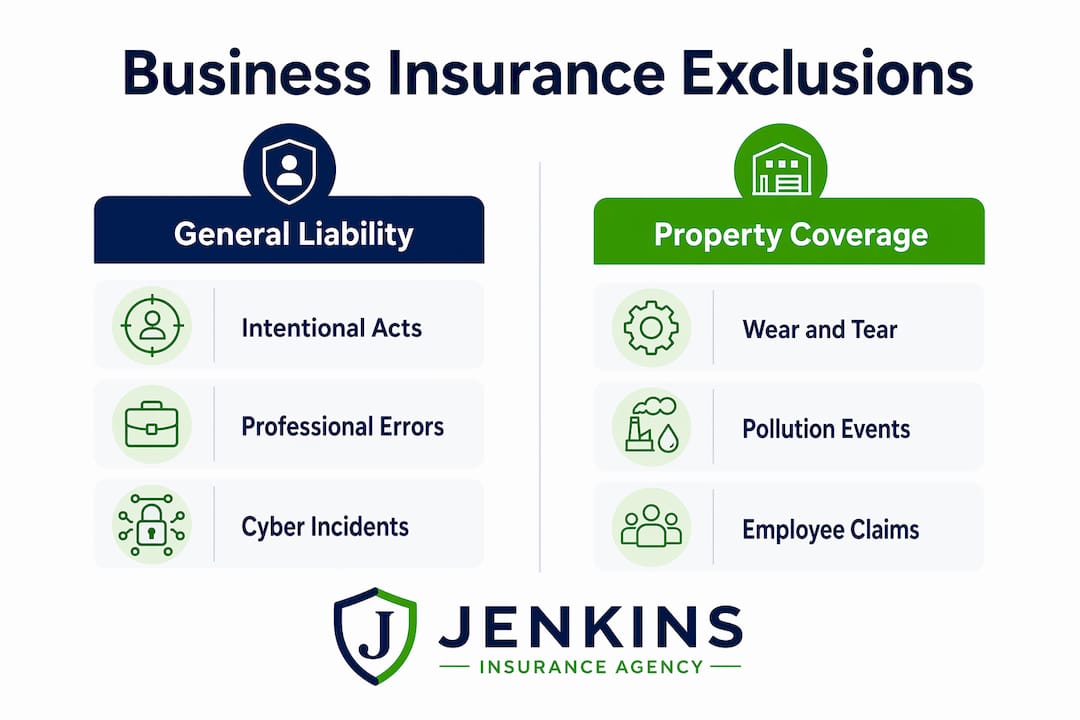
The most frequently encountered business insurance limitations fall into these categories:
- Intentional acts. If you or an employee deliberately causes damage or injury, no standard policy will respond. This exclusion exists because insurance is designed for accidental loss, not willful conduct.
- Wear and tear. Failure to maintain property can void coverage for related damage entirely, leaving repair costs on you. Routine deterioration is considered a maintenance responsibility, not an insurable event.
- Cyber risks. A general liability policy does not cover data breaches, ransomware, or network interruptions. Cyber claims average $264,000, yet many businesses carry no standalone cyber coverage.
- Pollution events. Contamination from chemicals, waste, or pollutants is excluded in most standard policies. This catches contractors, manufacturers, and even dry cleaners off guard.
- Employee claims. Discrimination, wrongful termination, and harassment allegations are not covered under general liability. These require Employment Practices Liability Insurance, known as EPLI.
- Natural disasters. Floods and earthquakes are excluded from base commercial property policies across the board.
To see how exclusions differ between the two most common policy types, the table below breaks it down clearly.
| Coverage type | Common exclusions |
|---|---|
| General liability | Intentional acts, professional errors, cyber incidents, pollution, employee claims |
| Commercial property | Floods, earthquakes, wear and tear, intentional damage, government seizure |
Pro Tip: Look beyond the main exclusion list and check for sub-limits buried inside your policy. A policy might technically cover a category like cyber fraud but cap the payout at $25,000 while your actual exposure runs into six figures.
How do exclusions impact your business insurance claims and financial liability?
The practical consequence of an unreviewed exclusion is a denied claim at the worst possible moment. Sub-limits and clauses like anti-concurrent causation can cause unexpected denials even when you believe you have coverage.
Here is how coverage gaps create real financial exposure:
- A retail business suffers a cyberattack and files a claim under its general liability policy. The claim is denied because cyber risk is a standard exclusion. Without a standalone cyber liability policy, the business absorbs the full cost of the breach, notification, and legal fees.
- A restaurant owner files a property claim after flooding damages the kitchen. The claim is denied because flood damage requires a separate flood policy or endorsement. The Terrorism Risk Insurance Act provides a limited federal backstop for terrorism losses, but floods and earthquakes require separate policies with no equivalent federal program.
- A construction firm faces an employee discrimination lawsuit. The general liability policy excludes employment claims. Without EPLI, the firm pays legal defense costs and any settlement entirely out of pocket.
The anti-concurrent causation clause deserves special attention. This clause states that if an excluded peril and a covered peril contribute to the same loss at the same time, the entire claim can be denied. For businesses in multi-peril regions like Sonoma County, where wildfires and wind events can combine, this clause is a serious risk.
Sub-limits on expensive scenarios like cyber fraud are often far lower than total policy limits, which means a business can exhaust its coverage early in a major incident. This is one of the most common and costly misconceptions we see among business owners who assume their coverage limit equals their protection ceiling.
Pro Tip: Review your exclusions every year and immediately after any significant operational change, such as adding a new service line, hiring employees, or moving to a new location. Experts recommend policy reviews at renewals and after major business changes as a baseline practice.
What steps can business owners take to identify and manage exclusions?
Finding and understanding the specific risks not covered in your policy requires knowing where to look and what to read. Here is a practical process:
- Locate the exclusions section. Every commercial policy has a dedicated exclusions section, typically labeled “Section II: Exclusions” or similar. Read it in full, not just the declarations page summary.
- Read the definitions carefully. Exclusion language often hinges on how a term is defined earlier in the policy. The word “occurrence” or “bodily injury” may have a narrower legal definition than you expect, which can change whether a claim qualifies.
- Check endorsements and riders. Endorsements are amendments attached to the base policy. Some add coverage back for excluded risks. Others narrow coverage further. Both matter equally.
- Map exclusions to your operations. List the specific activities your business performs, then check each one against the exclusions. A marketing consultant who also gives strategic advice carries professional liability exposure that a standard policy will not cover.
- Ask your agent direct questions. Bring a list of your top five business risks and ask your agent to confirm whether each is covered, excluded, or subject to a sub-limit. A good agent will walk through this with you clearly.
- Address gaps with endorsements or standalone policies. Many exclusion clauses can be purchased back through endorsements or separate policies. Flood damage, for example, is excluded from base policies but can be added through a flood endorsement or a standalone National Flood Insurance Program policy.
The California business insurance checklist from Jenkinsinsuranceagencyinc includes reviewing exclusions as a core step, which reflects how central this process is to building real protection.
How can specialized policies fill the gaps left by standard coverage?
Most business insurance exclusions exist because the risk is better priced and managed through a dedicated policy. Most exclusions represent risks better insured by specialized coverages, not intentional denial by the insurer.
The specialized policies that address the most common insurance coverage gaps include:
- Errors and Omissions (E&O) / Professional Liability. Covers claims arising from professional mistakes, negligent advice, or failure to deliver a promised service. Any business that provides professional services needs this coverage.
- Cyber Liability Insurance. Covers data breaches, ransomware response, notification costs, and legal fees. Given that cyber claims average $264,000, this is not optional for businesses that handle customer data.
- Employment Practices Liability Insurance (EPLI). Covers claims from employees alleging discrimination, harassment, or wrongful termination. California’s employment laws make this especially relevant for Sonoma County businesses.
- Pollution Liability. Covers cleanup costs and third-party claims from pollution events. Contractors, auto shops, and any business handling chemicals should carry this.
- Flood and Earthquake Insurance. Both are excluded from standard commercial property policies. California’s seismic activity and Sonoma County’s flood-prone areas make these real exposures, not theoretical ones.
Working with a local agent who knows your industry and region makes it far easier to identify which of these policies apply to your situation. The top insurance policies for small businesses guide from Jenkinsinsuranceagencyinc covers how these specialized coverages work alongside your base policy.
Pro Tip: Ask your agent about bundling specialized coverages into a Business Owner’s Policy (BOP) or commercial package. Local agents often have access to carrier programs that price bundled coverage more favorably than purchasing each policy separately.
Key takeaways
Understanding exclusions in business insurance is the foundation of real financial protection, because a policy that does not cover your actual risks is not protection at all.
| Point | Details |
|---|---|
| Exclusions define coverage scope | They are not hidden traps but clear boundaries that tell you exactly what is and is not covered. |
| Cyber and employment claims are excluded | Standard general liability policies do not cover data breaches or employee lawsuits, requiring separate policies. |
| Sub-limits can exhaust coverage early | A policy may cover a category but cap the payout far below your actual exposure. |
| Exclusions can often be bought back | Endorsements and standalone policies like flood or E&O coverage can close most gaps. |
| Annual review is non-negotiable | Reviewing exclusions at renewal and after operational changes prevents unintended coverage gaps. |
Why I think most business owners are looking at this the wrong way
Most business owners I talk to treat their insurance policy like a receipt. They buy it, file it away, and assume they are covered. The exclusions section is the part nobody reads until they are sitting across from an adjuster hearing the word “denied.”
Here is what I have learned working with business owners in Sonoma County: the gap between what you think your policy covers and what it actually covers is almost always found in the exclusions. Not in the limits. Not in the deductible. In the exclusions. A contractor who assumes their general liability policy covers a pollution event from a chemical spill, a tech consultant who thinks their business owner’s policy covers a professional error, a restaurant owner who does not know flood is excluded until water is already in the dining room. These are real situations, and they are entirely preventable.
The other thing I want to push back on is the idea that exclusions are the insurer acting in bad faith. They are not. Legal interpretation of exclusions can be challenged when the language is genuinely ambiguous, and that is worth knowing. But most of the time, exclusions are doing exactly what they are supposed to do: directing a specific risk toward the right type of coverage. The problem is not the exclusion. The problem is the business owner who was never told it existed.
My honest advice: treat your annual policy review the same way you treat your annual tax review. Bring your agent a list of what your business does, what has changed in the past year, and what keeps you up at night. A good agent will match that list against your exclusions and tell you where you are exposed. That conversation is worth more than any amount of coverage you could buy without it.
— Jason
How Jenkinsinsuranceagencyinc helps you manage coverage gaps
At Jenkinsinsuranceagencyinc, we work with business owners throughout Santa Rosa and Sonoma County to make sure their coverage actually matches their operations. We review your policy exclusions with you, explain what they mean in plain language, and recommend endorsements or specialized policies where gaps exist.

Whether you need to add cyber liability, EPLI, or a flood endorsement, our local team knows the specific risks California businesses face. We are affiliated with Farmers Insurance, which gives us access to a broad range of products, and we use that access to build coverage that fits your unique situation. Reach out to us for a personalized business insurance review and find out exactly where your current policy leaves you exposed.
FAQ
What is a business insurance exclusion?
A business insurance exclusion is a specific condition, event, or risk that a policy will not cover. Exclusions define the boundaries of your coverage and are listed in a dedicated section of your policy document.
What are the most common exclusions in commercial policies?
The most common exclusions include intentional acts, wear and tear, cyber incidents, pollution events, employee claims, floods, and earthquakes. Standard general liability and commercial property policies exclude all of these by default.
Can exclusions be removed from a business insurance policy?
Many exclusions can be addressed through endorsements or separate standalone policies. Flood coverage, professional liability, and cyber liability are all examples of excluded risks that can be covered by adding the right policy.
What is an anti-concurrent causation clause?
An anti-concurrent causation clause voids an entire claim if an excluded peril and a covered peril contribute to the same loss at the same time. This clause is particularly significant for businesses in regions prone to multiple simultaneous hazards, like wind and flooding.
How often should business owners review their policy exclusions?
Experts recommend reviewing exclusions at every renewal and after any significant operational change, such as adding services, hiring staff, or relocating. Annual reviews with your agent are the most reliable way to catch new coverage gaps before a claim occurs.
Recommended
- Business Insurance – Jenkins Insurance Agency Inc.
- The Top 7 Insurance Policies Every Small Business Owner Needs – Jenkins Insurance Agency Inc.
- Why Insure Your Business: Protecting Sonoma County Owners – Jenkins Insurance Agency Inc.
- 7 Essential Common Business Insurance Policies Explained – Jenkins Insurance Agency Inc.