
TL;DR:
- Running a business in California requires strict compliance with insurance requirements, especially for workers’ compensation before employee start dates.
- Effective management involves thorough documentation, timely renewals, and leveraging technology alongside expert guidance to prevent coverage gaps and penalties.
Running a business in California means managing more moving parts than most states require. Your business insurance workflow california obligations alone can catch you off guard if you’re not prepared. Miss a deadline on workers’ compensation coverage, use the wrong documentation during a claim, or fail to update policies after hiring new staff, and you’re looking at penalties, lawsuits, or both. This guide walks you through every stage of building and managing a compliant, organized insurance process so you can protect what you’ve built without the guesswork.
Table of Contents
- Key takeaways
- Your business insurance workflow California starts here
- Managing the insurance lifecycle from quote to renewal
- Compliance pitfalls California business owners must avoid
- Using technology and expert guidance to work smarter
- What a well-run workflow looks like in practice
- My take on managing insurance workflows in California
- Work with a local team that knows California coverage
- FAQ
Key takeaways
| Point | Details |
|---|---|
| No grace period for workers’ comp | California law requires coverage before your first employee’s first workday, with zero exceptions. |
| Documentation drives compliance | Payroll records, employee details, and vehicle info must be ready before requesting quotes or binding policies. |
| Workflow breakdowns happen at handoffs | The gap between proposal and policy renewal is where most California businesses lose track and face gaps. |
| Technology speeds up the process | Specialized tools can cut proposal generation from hours to minutes, reducing costly delays. |
| Annual reviews protect your business | Policies that aren’t updated as your business grows can leave you underinsured when it matters most. |
Your business insurance workflow California starts here
Before you request a single quote, you need to know what California actually requires and what the market will expect from you. Getting this foundation right saves significant time and prevents coverage gaps that regulators and landlords will notice immediately.
California law is specific. Workers’ compensation is mandatory for all employees, including part-time workers, and coverage must be in place before the first workday. There is no grace period. Owners and their spouses can be excluded, but everyone else must be covered from day one.
Beyond workers’ comp, the following insurance types are either legally required or practically unavoidable for most California businesses:
- General liability: Not mandated by state law, but landlords commonly require it before signing a commercial lease, and most clients include it in their contracts.
- Professional liability: Also called errors and omissions coverage. Clients in professional service industries regularly require this before work begins.
- Commercial auto: Required if vehicles are used for business purposes. Personal auto policies typically exclude business use.
- Commercial property: Protects your physical assets including equipment, inventory, and your space.
Here is a quick reference table comparing required and recommended coverage by business type:
| Business type | Required by law | Strongly recommended |
|---|---|---|
| Retail with employees | Workers’ comp | General liability, property |
| Professional services | Workers’ comp | Professional liability, general liability |
| Contractor / trades | Workers’ comp | General liability, commercial auto |
| Sole proprietor, no employees | None (state-mandated) | General liability, professional liability |
| Delivery / fleet-based | Workers’ comp, commercial auto | Property, cargo insurance |
Before you contact any carrier or broker, gather your documentation. You will need current payroll figures, a full employee list with job classifications, vehicle information for any business-use cars or trucks, your business license, and any existing policy numbers. Walking into the process with this information ready cuts your timeline considerably.
Pro Tip: If you’re unsure whether a vehicle counts as a business-use vehicle, ask your agent directly. Using a personal vehicle for business deliveries or client visits without commercial auto coverage is one of the most common and costly mistakes California business owners make.
Managing the insurance lifecycle from quote to renewal
A well-managed business insurance workflow has clear stages. Most California business owners treat insurance as a once-a-year task, and that mindset creates exactly the kind of gaps that lead to claims being denied or penalties being issued.
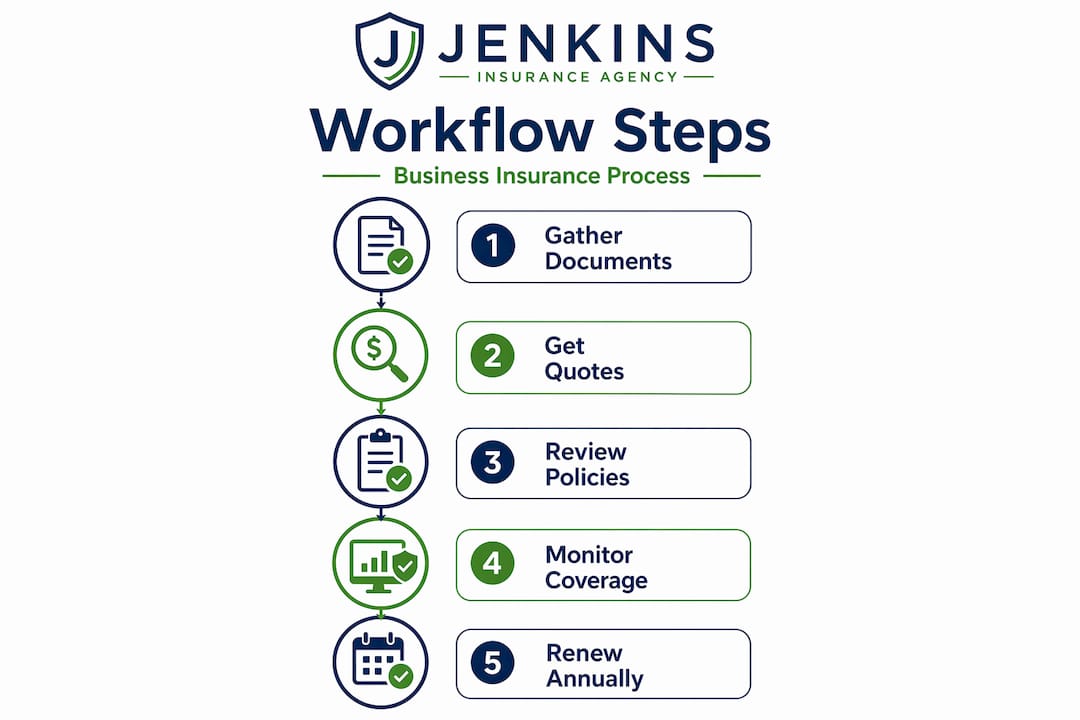
Here is a practical step-by-step process built around California’s regulatory expectations:
- Gather your documentation (2-3 weeks before binding): Pull payroll records, employee rosters, vehicle details, and any prior claims history. Having this ready before you request quotes prevents back-and-forth delays.
- Request quotes from multiple carriers (3-4 weeks out): Work with a broker who has access to multiple carriers. California’s insurance market is under real stress. FAIR Plan policies doubled between 2020 and 2024, reaching over 450,000 policies, which signals how many standard carriers have pulled back from the state.
- Compare proposals carefully: Look beyond the premium. Review deductibles, exclusions, and claim response times. A lower premium with poor claims handling is not a good deal, as recent regulatory enforcement has made clear.
- Bind coverage and confirm effective dates: For workers’ comp especially, confirm the exact effective date in writing. Coverage must begin before your first employee starts work.
- Document everything at policy issuance: Store declarations pages, policy numbers, carrier contact information, and payment schedules in one central location. Digital storage with backups is strongly recommended.
- Set renewal reminders 90 days out: Do not wait for your carrier to contact you. Set your own calendar alerts so you have time to shop, compare, and update before coverage lapses.
- Review and update at renewal: Report payroll changes, new vehicles, added locations, and staffing changes. Policies based on outdated information leave you exposed.
Clients tend to lose track of their coverage between the proposal and renewal stages. That gap is where workflow bottlenecks concentrate, and where compliance problems tend to emerge.
Pro Tip: Ask your broker to set up a shared document or portal where all your current policy documents live in one place. When a claim happens or a contract requires proof of insurance, you should be able to pull that certificate in under two minutes.

Compliance pitfalls California business owners must avoid
California is not a forgiving state when it comes to insurance compliance. The regulatory environment has grown more aggressive, and the consequences of mismanaging your workflow can be severe.
Here are the most common compliance red flags we see and how to address each one:
- Letting workers’ comp lapse, even for one day: The state can assess fines of up to $10,000 per employee for gaps in coverage. There is no warning letter first.
- Failing to update payroll estimates: Workers’ comp premiums are based on payroll figures. Significant discrepancies trigger audits and surprise premium adjustments.
- Poor claims documentation: Vague incident records, missing photos, and delayed reporting give carriers and regulators reasons to question your claims.
- Using personal auto for business without commercial coverage: Claims can be denied outright if the vehicle’s use doesn’t match the policy type.
- Ignoring new regulatory requirements: Cal/OSHA’s workplace violence prevention standard introduces documentation and compliance protocols that directly intersect with your existing insurance workflows, including post-incident response and trauma counseling requirements.
Recent regulatory enforcement makes this very concrete. California regulators found 398 violations across 114 files related to delayed investigations and poor communication in one major enforcement case, with license suspension and record penalties on the table. That case involved a carrier, but the documentation failures it exposed mirror the same issues that create claims denials for policyholders.
“Regulatory compliance in California isn’t a one-time checkbox. It’s an ongoing process that must be built into your regular business operations.”
Your compliance posture should be audit-ready at all times. Keep signed certificates of insurance on file, document all claims and incidents with dates and details, and review your policies whenever your business changes significantly. This is especially relevant as evolving regulations require business owners to extend their insurance workflows well beyond purchase into claims, compliance, and documentation management.
Using technology and expert guidance to work smarter
California’s insurance market is complicated enough that doing everything manually creates real risk. The good news is that both technology and the right professional relationships can take a lot of that weight off your plate.
On the technology side, specialized sales tools can reduce proposal generation from several hours down to a matter of minutes by organizing carrier comparisons and automating document preparation. Standard agency management systems often can’t handle the conditional logic California’s rules require. Configurable rules engines automate conditional routing and approvals to keep your claims processing in step with California’s specific regulatory timelines.
For a practical example, consider a Santa Rosa contractor managing a crew of 12. When renewal season arrives, manually pulling together payroll figures, updating vehicle schedules, and comparing carriers across three or four policies takes days. An organized digital workflow with a broker who knows California requirements can cut that to a single afternoon meeting.
The broker relationship matters enormously here. California workers’ compensation costs per claim rose 6% in 2025, driven by indemnity benefits, medical payments, and benefit delivery costs. A broker who tracks these trends can help you anticipate premium changes and build that into your budget before renewal, not after.
Pro Tip: When evaluating a broker, ask them specifically how they handle California workers’ comp audits and what documentation they require from you at renewal. A broker who gives a vague answer is not the right fit for a California business with employees.
What a well-run workflow looks like in practice
Once you’ve built an organized insurance process, you will notice the difference quickly. Here’s what a healthy, optimized insurance workflow produces versus a reactive, disorganized one:
| Metric | Before optimization | After optimization |
|---|---|---|
| Time to pull proof of insurance | 30 to 60 minutes | Under 5 minutes |
| Renewal preparation start time | Days before expiration | 90 days before expiration |
| Claims documentation quality | Incomplete, reactive | Complete, pre-organized |
| Compliance audit readiness | Requires scrambling | Ongoing, current |
| Policy accuracy at renewal | Often outdated | Reviewed and updated |
Ongoing verification is just as important as the initial setup. Use your business insurance checklist to run a quarterly review of your coverage. Confirm that your payroll figures match your workers’ comp policy, that new vehicles are added to your commercial auto schedule, and that any new service lines are covered under your liability policy.
Handling claims well is also part of the workflow. Report incidents immediately, document everything with dates, photos, and witness information, and follow up with your carrier within their required response windows. California’s claims processing regulations set specific timelines for acknowledgment and approvals, and missing those windows can jeopardize your payout. For a deeper look at that process, the guidance on securing claim payouts in California is worth bookmarking.
My take on managing insurance workflows in California
I’ve seen what happens when a business owner treats insurance as an annual chore rather than an ongoing operational responsibility. The pattern is predictable. Something changes, like a new hire, a new vehicle, or a new location, and the policy never gets updated. Then a claim comes in and the coverage doesn’t fit the situation anymore.
What working closely with California business owners has taught me is this: tightening your insurance workflow almost always surfaces risks you didn’t know you had. When you sit down to organize your documentation and map out your coverage, you start asking questions you hadn’t thought to ask before. That process alone is worth the time.
California’s regulatory environment has become more active in recent years. Enforcement is real, and the penalties are not symbolic. Businesses that stay proactive treat compliance as a living part of their operations, not a box to check once a year.
The combination of the right technology and a broker who genuinely knows California requirements is the most reliable path forward. Neither one alone is enough. Technology without expertise misses the nuance. Expertise without organized systems creates bottlenecks. Together, they give you a workflow you can actually rely on when it matters.
Stay proactive. Review early. Document everything. That approach has never failed a business owner I’ve worked with.
— Jason
Work with a local team that knows California coverage

At Jenkinsinsuranceagencyinc, we work with business owners throughout Sonoma County and California every day to build insurance programs that are both compliant and practical. We understand the california business insurance requirements that apply to your specific industry, and we know how to build a workflow that keeps you covered without creating extra administrative burden. Whether you need help evaluating your business insurance options in Santa Rosa or sorting out commercial auto coverage for your fleet, we’re here to guide you through the process with real answers, not generic advice. We also help you explore bundling strategies that can meaningfully reduce your overall insurance costs. Reach out to us directly and let’s talk through your unique situation.
FAQ
What insurance is legally required for California businesses?
California requires workers’ compensation insurance for all businesses with employees, effective before the first workday with no grace period. Commercial auto insurance is also required when vehicles are used for business purposes.
How do I start a business insurance workflow in California?
Begin by gathering your payroll records, employee list, vehicle details, and any existing policy information. Then work with a licensed broker to request quotes from multiple carriers and confirm coverage effective dates before binding.
What happens if my workers’ comp coverage lapses?
California can fine your business up to $10,000 per employee for any lapse in workers’ compensation coverage. There is no warning period, and the penalty applies from the first day of the gap.
How often should I review my business insurance policies?
Review your policies at least once a year at renewal, and also any time your business changes significantly, such as adding employees, purchasing vehicles, or expanding your services.
Can technology help manage my insurance workflow?
Yes. Specialized workflow tools can reduce proposal generation time significantly and help automate compliance tracking. Pairing those tools with an experienced California broker gives you the most reliable and efficient process.
Recommended
- Step-by-step guide to business insurance in California 2026 – Jenkins Insurance Agency Inc.
- California Insurance Guide 2026: Save 25% with Bundling – Jenkins Insurance Agency Inc.
- Why Updating Business Insurance Protects California Companies – Jenkins Insurance Agency Inc.
- The essential business insurance checklist for California owners – Jenkins Insurance Agency Inc.