
Most California business owners assume that having any policy means they’re covered. That assumption can be costly. Workers’ Compensation penalties can reach $100,000 per violation, and that’s before stop-work orders or denied claims enter the picture. Running a business in California means navigating strict legal requirements, unpredictable natural disasters, and contracts that demand specific coverage. This checklist walks you through every required and recommended policy, explains the edge cases many owners miss, and gives you a clear action plan to protect your business today and every year going forward.
Table of Contents
- Why a business insurance checklist matters in California
- California business insurance checklist: Required coverages
- Optional but essential: Policies that fill the gaps
- Edge cases and exemptions: What to watch for
- Annual review checklist: Keep your insurance current
- What affects your business insurance costs in California?
- Summary: Build and apply your California insurance checklist
- Need help? Talk to California business insurance experts
- Frequently asked questions
Key Takeaways
| Point | Details |
|---|---|
| Mandatory coverages | California requires Workers’ Compensation for any employees and Commercial Auto for business vehicles. |
| Essential optional policies | EPLI, cyber, and property add-ons address major risks that standard coverage misses. |
| Annual review | Update your insurance annually to reflect business changes and to add natural disaster endorsements. |
| Regional exposures | Earthquake, wildfire, and flood add-ons are critical as California policies often exclude these events. |
| Cost factors | Industry, payroll, location, and bundling policies all impact your premium costs. |
Why a business insurance checklist matters in California
California is one of the most regulated states for business insurance in the country. The business insurance importance goes beyond just following the law. It’s about making sure a single missed policy doesn’t wipe out years of hard work.
Here’s what’s actually at stake:
- Workers’ Compensation (WC) is mandatory the moment you hire even one employee. Non-compliance penalties can reach $100,000 plus stop-work orders that shut your doors immediately.
- Contracts and leases often require General Liability Insurance even though the state doesn’t mandate it. Miss that clause and you could lose a client or a lease.
- Natural disaster exclusions in standard policies mean wildfire, earthquake, and flood damage may not be covered unless you add specific endorsements.
- Operational changes like adding a vehicle, hiring staff, or moving locations can create coverage gaps if your policy isn’t updated.
The underinsurance risks for California businesses are real and often invisible until a claim is denied. Review the official insurance requirements from the California Department of Insurance to understand what applies to your industry.
“There’s no universal mandate beyond Workers’ Compensation and commercial auto, but contracts create real coverage obligations that can be just as binding as state law.”
With the risks clear, let’s dive into the must-have elements of a California business insurance checklist.
California business insurance checklist: Required coverages
These are the policies with a legal trigger in California. If the condition applies to your business, the coverage is not optional.
| Coverage | Legal trigger | Minimum requirement |
|---|---|---|
| Workers’ Compensation | Any employee, full or part-time | State-set benefit schedule |
| Commercial Auto | Business-owned or leased vehicles | 30/60/15 limits (bodily injury/property damage) |
| General Liability | Required by most contracts and leases | Varies by contract |
California mandates Workers’ Compensation for all businesses with employees, and commercial auto minimums are set at 30/60/15 for business-use vehicles. Here’s a numbered checklist to work through:
- Confirm employee count. Even one part-time worker triggers WC requirements.
- Identify all business vehicles. Owned, leased, and regularly used vehicles may all need commercial auto coverage.
- Review every active contract and lease. Look for insurance requirements clauses and note the minimum limits requested.
- Check your contractor license status. Licensed contractors face additional requirements under California law.
- Verify your General Liability limits match what your clients and landlords require.
For a full walkthrough of how to set up each policy, the California business coverage steps guide is a solid starting point. If you use vehicles for work, review covering business vehicles and the auto insurance requirements for 2026. Trades businesses should also check this trades insurance guide for industry-specific context.
Pro Tip: Licensed contractors may be required to carry Workers’ Compensation even as solo operators by 2028. If you’re in the trades, start planning for that change now rather than scrambling at the deadline.
With the core legal requirements spelled out, next we’ll look at essential but often-overlooked optional policies.

Optional but essential: Policies that fill the gaps
These policies aren’t required by California law, but skipping them leaves serious holes in your protection.
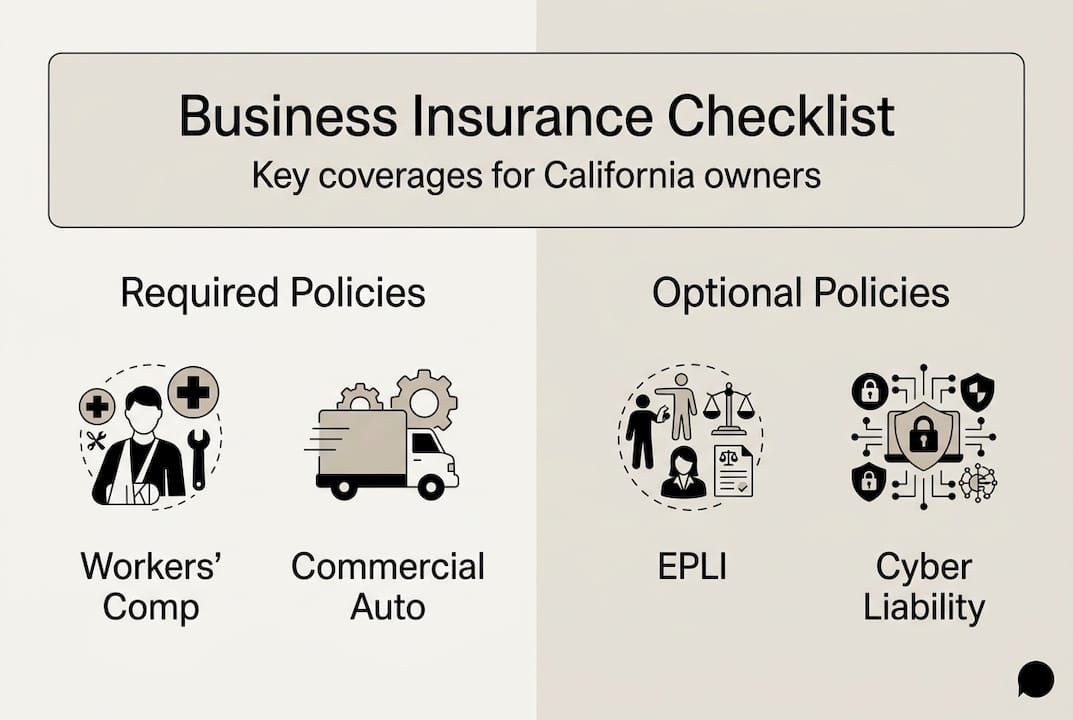
| Policy | What it covers | Why it matters in CA |
|---|---|---|
| Employment Practices Liability (EPLI) | Discrimination, wrongful termination, harassment claims | CA has some of the strictest employment laws in the US |
| Professional Liability / E&O | Errors or omissions in your professional services | Critical for consultants, designers, and service providers |
| Cyber Liability | Data breaches, ransomware, CCPA violations | CA’s CCPA creates significant data liability exposure |
| Commercial Property | Building, equipment, inventory damage | Standard policies often exclude wildfire and earthquake |
| Business Interruption | Lost income during covered shutdowns | Especially valuable after natural disasters |
EPLI is increasingly important for HR legal risks like discrimination and wrongful termination, particularly in California where employment law is aggressive. Review the explained essential policies page for a deeper look at each one.
Key gaps to watch for:
- Wildfire, earthquake, and flood are commonly excluded from standard Commercial Property policies. You need separate endorsements or standalone policies.
- Cyber coverage is not just for tech companies. Any business storing customer data faces CCPA exposure.
- EPLI is often overlooked by small businesses, but EPLI comparison data shows claims are rising across all business sizes.
Pro Tip: Many claims are denied not because the event wasn’t covered in theory, but because the owner didn’t add the right endorsement for their local risk. In California, that almost always means wildfire and earthquake.
Now, let’s clarify edge cases and special eligibility scenarios that many owners miss.
Edge cases and exemptions: What to watch for
Not every rule applies to every business. But the exceptions have their own fine print.
- Sole proprietors and single-member LLCs with no employees are currently exempt from mandatory Workers’ Compensation. That changes for contractors by 2028, so solo contractors needing WC should start preparing now.
- Hired and Non-Owned Auto (HNOA) coverage protects you when employees use their personal vehicles for work tasks. Even if you have no company vehicles, this gap can expose you to significant liability.
- Earthquake and flood are standard exclusions in most property policies. California’s geography makes these add-ons a practical necessity, not a luxury.
- CCPA compliance means businesses collecting customer data face real cyber liability. Cyber insurance has moved from optional to near-essential for most California businesses.
- Wildfire endorsements are increasingly difficult to obtain in high-risk zones. Securing coverage early matters.
“California-specific risks like earthquake, flood, and wildfire are commonly excluded from standard policies. Add-ons are needed. And with CCPA in effect, cyber risk is a higher priority here than in most other states.”
For a full breakdown of how California regulates these requirements, the California insurance rules guide covers the details clearly.
Armed with the basics and edge cases, your next focus should be making sure your policies actually keep pace with your changing business.
Annual review checklist: Keep your insurance current
A policy that was right for your business two years ago may leave you exposed today. Here’s how to run a solid annual review:
- Update your revenue, payroll, and inventory figures. Insurers use these numbers to calculate your premiums and coverage limits. Outdated data means inaccurate coverage.
- Review all active policies for exclusions. Look specifically for wildfire, earthquake, flood, and cyber exclusions that may have been added or changed at renewal.
- Match your coverage to current operations. Added a new service line? Hired staff? Moved locations? Each change can create a gap.
- Check equipment and property valuations. Replacement costs rise over time. Make sure your limits reflect current values, not what you paid years ago.
- Add or confirm endorsements for California-specific risks including wildfire, earthquake, and flood.
- Meet with your agent. A quick conversation can catch gaps you’d never spot on your own.
The annual review checklist approach is strongly recommended: update revenue, payroll, and inventory, match operations to your policy, check limits, and add endorsements for California-specific risks. Pair your review with the insurance bundling guide to see where you might consolidate and save.
Pro Tip: Set a recurring calendar reminder 60 days before your policy renewal date. That gives you enough time to gather updated business data, meet with your agent, and make changes before the renewal locks in.
Completing your annual review may reveal surprising cost differences. Let’s explore what drives pricing and how to save.
What affects your business insurance costs in California?
Premiums aren’t random. They’re calculated based on specific factors, and understanding them helps you manage costs.
- Business type and industry. A retail shop and a construction company pay very different rates. Higher-risk industries carry higher premiums.
- Payroll size. Workers’ Compensation premiums are directly tied to your total payroll and the class codes assigned to your employees’ job types.
- Claims history. A clean record lowers your rates. Frequent claims push them up.
- Location. Businesses in high-risk zip codes, including parts of Los Angeles and San Francisco, pay more due to crime rates, traffic density, and natural disaster exposure.
- Policy limits and deductibles. Higher limits cost more. Higher deductibles lower your premium but increase your out-of-pocket cost after a claim.
To give you a rough sense of ranges: General Liability typically runs $40 to $115 per month for small businesses, while Workers’ Compensation varies widely based on payroll and class code. Costs vary by industry, payroll, and location across California.
Bundling policies can save 15 to 25% on your total premium. Combining General Liability, Commercial Property, and other coverages into a Business Owner’s Policy (BOP) is one of the most straightforward ways to reduce costs.
Risk-mitigation programs, updated safety procedures, and working with an agent who knows your industry can also bring rates down. See how insurance benefits Sonoma County businesses specifically, and review insurance pricing explained for a broader look at cost drivers.
Summary: Build and apply your California insurance checklist
You now have a clear picture of what’s required, what’s recommended, and what to watch for. Here’s your action plan:
- Start with the legal requirements. Workers’ Compensation and Commercial Auto are non-negotiable if the triggers apply to your business.
- Layer in the essential optional policies. EPLI, Cyber, Professional Liability, and Commercial Property with the right endorsements protect you from the risks that don’t make headlines until they happen to you.
- Address California-specific exclusions. Wildfire, earthquake, and flood add-ons are not extras here. They’re necessities.
- Run an annual review every year and after any major business change.
- Work with a licensed agent for complex situations, rapid growth, or any time you’re unsure whether your coverage matches your actual exposure.
- Save this checklist and set a calendar reminder so the review actually happens.
For a step-by-step walkthrough of setting up your coverage from scratch, get started with insurance using our full guide.
Need help? Talk to California business insurance experts
Knowing what coverage you need is one thing. Making sure you actually have it, at the right limits, with the right endorsements, is another. That’s where we come in.

At Jenkins Insurance Agency Inc., we work with business owners across Sonoma County and California to build coverage that fits your real situation, not just a generic template. Whether you’re starting fresh, doing your annual review, or trying to figure out a tricky edge case, our local team is here to help. Explore our custom business insurance solutions, review top business policies every owner should consider, or get started with a personalized guide today. We’d love to be your neighbor in this.
Frequently asked questions
What business insurance is legally required in California?
Workers’ Compensation and commercial auto are the two legally mandated core policies in California. Other coverages like General Liability may be required by your contracts or lease agreements even if the state doesn’t mandate them.
Do sole proprietors in California need Workers’ Compensation Insurance?
Not currently, unless you hire employees. However, solo contractors will need WC by 2028, and Hired and Non-Owned Auto coverage is recommended even for owner-only operations.
What is usually excluded from standard business insurance in California?
Earthquake, flood, and wildfire damages are commonly excluded from standard Commercial Property policies. Separate endorsements or standalone policies are needed to cover these risks in California.
How often should I review my business insurance policies?
You should review all policies at least once per year. An annual review is strongly recommended after any major business change, new asset purchase, or shift in operations.
Recommended
- Step-by-step guide to business insurance in California 2026 – Jenkins Insurance Agency Inc.
- Why business insurance matters for California SMBs in 2026 – Jenkins Insurance Agency Inc.
- Auto Insurance for Business Owners in California – Jenkins Insurance Agency Inc.
- Small business insurance California 2026: 30% underinsured – Jenkins Insurance Agency Inc.
- Why California painters need insurance: liability and coverage