
TL;DR:
- California’s minimum auto insurance limits have increased but may still leave coverage gaps in accidents.
- Additional coverages like collision, comprehensive, and UM/UIM are essential for full protection.
- Working with local, independent agents offers personalized support and better coverage options.
Many California drivers assume that carrying state minimum auto insurance means they are fully protected. That assumption can be costly. The truth is, California’s minimums were recently raised, and even the updated limits may leave gaps in real-world accidents. Whether you are a new driver in Santa Rosa or a longtime Sonoma County resident, understanding what your policy actually covers helps you make smarter, more affordable decisions. This article walks you through California’s legal requirements, the most useful coverage types, affordable programs for budget-conscious drivers, and why working with a local, community-focused agency makes a real difference.
Table of Contents
- California’s auto insurance laws: What you must carry
- Essential coverages: What do the options mean?
- Affordable options: Accessing the California Low Cost Auto Program (CLCA)
- Claims, hit-and-run, and the realities of California accidents
- Personalized service: Why local agencies and brokers matter
- Our take: What most Californians get wrong about auto insurance
- Get personalized, affordable auto insurance help today
- Frequently asked questions
Key Takeaways
| Point | Details |
|---|---|
| Understand state minimums | California’s required auto insurance minimums are higher than many expect and may not fully protect you. |
| Explore affordable programs | Programs like CLCA can help you find liability coverage that fits your budget if you qualify. |
| Know your coverages | It pays to understand the difference between basic and additional coverages to avoid costly gaps. |
| Use local expertise | Independent, community-focused agencies offer service and advice that big companies often cannot match. |
California’s auto insurance laws: What you must carry
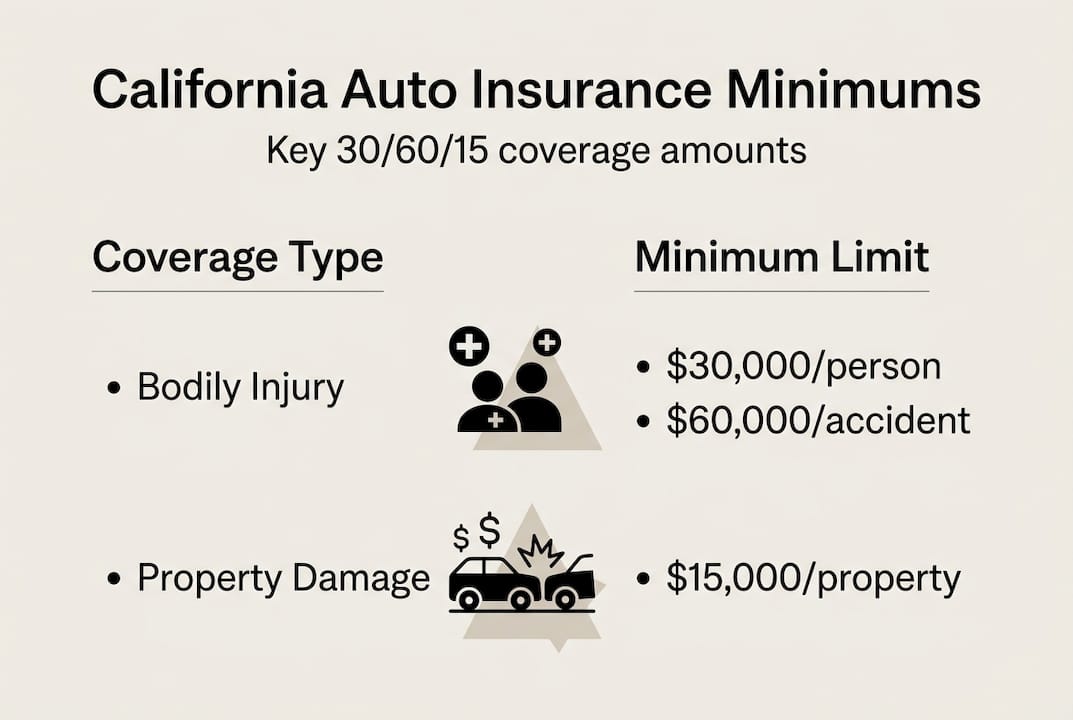
Let’s start with the legal foundation. California updated its minimum liability requirements, and as of 2025, California requires 30/60/15 in minimum liability coverage. That means $30,000 per injured person, $60,000 per accident, and $15,000 for property damage. These are the numbers you need to know for auto insurance requirements for 2026.
Here is what those numbers mean in practice:
| Coverage type | Minimum limit |
|---|---|
| Bodily injury per person | $30,000 |
| Bodily injury per accident | $60,000 |
| Property damage per accident | $15,000 |
Think about what a single emergency room visit costs today. It can easily exceed $30,000. If the other driver’s medical bills go beyond your limit, you are personally responsible for the rest. That is the real risk of relying only on minimums.
What the minimums do NOT cover is just as important:
- Your own medical bills after an accident
- Repairs to your own vehicle
- Damage caused by uninsured drivers
- Theft, weather events, or fire
The California DMV’s insurance guidelines confirm that driving without at least this coverage can result in fines, license suspension, and vehicle impoundment. The penalties are serious. More importantly, being underinsured can wipe out savings you have spent years building.
Understanding the difference between liability vs. full coverage is one of the most important steps any California driver can take. Liability only protects others. Full coverage protects you too.
Essential coverages: What do the options mean?
Once you understand the state minimum, the next step is knowing what additional protection is available and when it matters.
Here is a quick comparison of the most common coverage types:
| Coverage | What it pays for | Required? |
|---|---|---|
| Liability | Other people’s injuries and property | Yes |
| Collision | Your car after a crash | No |
| Comprehensive | Theft, fire, weather damage | No |
| UM/UIM | Injuries from uninsured or hit-and-run drivers | No, but strongly recommended |
Uninsured and underinsured motorist coverage, often called UM/UIM, deserves special attention. California has one of the highest rates of uninsured drivers in the country. UM/UIM covers injuries from uninsured or hit-and-run drivers and follows you even as a pedestrian or cyclist. That is a level of protection most people do not realize they have, or could have.
Here are four coverages worth considering beyond the minimum:
- Collision coverage pays for your car repairs after an accident, regardless of fault.
- Comprehensive coverage handles non-collision events like wildfire damage, theft, or flooding.
- Rental reimbursement covers a rental car while your vehicle is being repaired.
- Roadside assistance helps with breakdowns, flat tires, and lockouts.
For a deeper look at how each option works, auto coverage explained can walk you through the specifics.
Pro Tip: Full coverage is not just for new cars or lenders. If your vehicle is worth more than $5,000 or you depend on it daily, the cost of collision and comprehensive is usually worth it. Review the essential California coverages to see what fits your situation.
Affordable options: Accessing the California Low Cost Auto Program (CLCA)
Cost is one of the biggest reasons Californians drive without enough coverage. The good news is there is a state program designed specifically for this problem.
The California Low Cost Auto Program, or CLCA, provides basic liability insurance at reduced rates for income-eligible drivers. CLCA premiums range from $199 to $920 per year, depending on your county and driving record. That is a fraction of what standard policies often cost.
To qualify, you generally need to meet these criteria:
| Requirement | Details |
|---|---|
| Driver’s license | Valid California license |
| Vehicle value | $25,000 or less |
| Driving record | No major violations |
| Income | At or below program income limits |
Here is what you will typically need to apply:
- Proof of California residency
- Valid CA driver’s license number
- Vehicle registration information
- Recent income documentation (pay stubs or tax return)
The CLCA is a real lifeline for many families in Sonoma County and across the state. It keeps drivers legal and protected without creating financial strain.
Pro Tip: Pair CLCA coverage with a safe driver discount if your record qualifies. Many insurers offer meaningful reductions for drivers with no claims or violations in the past three years. Check out available auto insurance discounts to stack savings wherever possible.
Claims, hit-and-run, and the realities of California accidents
Having coverage is one thing. Knowing how to use it when something goes wrong is another.
Here is a straightforward step-by-step for handling an accident or hit-and-run in California:
- Stay safe and move to a safe location if possible.
- Call 911 and report the accident, especially in a hit-and-run.
- Document everything: photos, witness names, plate numbers, and damage.
- Contact your insurer as soon as possible to start your claim.
- Follow up with a written statement and any police report numbers.
Hit-and-run situations have specific rules in California. UM claims for hit-and-run require police contact documented within 24 hours and proof of physical contact between vehicles. If you cannot show that contact occurred, some policies will deny the UM property damage claim.
“The biggest mistake we see after a hit-and-run is waiting too long to file a police report. That 24-hour window is critical for protecting your UM claim.”
Common pitfalls to avoid:
- Skipping the police report because the damage seems minor
- Failing to photograph the contact point on your vehicle
- Assuming UM covers property damage automatically (it varies by policy)
For more guidance on navigating the insurance claims process or choosing auto insurance in California, we have resources ready for you. And for detailed hit-and-run compensation advice, reviewing your options before an incident happens is always the smarter move.
Pro Tip: Keep a simple accident checklist in your glove box. It takes two minutes to prepare and can save you hours of frustration when stress is high.
Personalized service: Why local agencies and brokers matter
Not all insurance experiences are created equal. Shopping online for the cheapest rate might seem efficient, but it often means missing coverage gaps that only a real conversation would catch.
Local agencies in California understand risks that national call centers simply do not prioritize. Wildfires in Sonoma County, high uninsured driver rates in urban areas, and specific local road conditions all affect what coverage makes sense for you. The independent insurance benefits of working with a community agency go well beyond price.
Here is what sets local agencies apart:
- Real people: You speak with someone who knows your community, not a script.
- Multiple options: Independent agents compare policies across several insurers to find your best fit.
- Ongoing support: A local agent helps you update coverage as your life changes.
- Community accountability: Local reputation matters. Agents who live and work nearby have strong incentive to treat you right.
The numbers back this up. Community-level guidance from independent agencies consistently earns top ratings, with some agencies reaching 4.7 out of 5 stars based on real client reviews. That kind of trust is earned through consistent, personal service.
Working with a local agent also means someone is in your corner when a claim gets complicated. That personal touch is hard to put a price on.
Our take: What most Californians get wrong about auto insurance
We have seen a clear pattern over the years. Many drivers in our community believe that meeting the state minimum means they are covered. They are covered legally, yes. But financially? Often not.
The minimum limits were designed as a floor, not a safety net. A single serious accident can generate medical bills and legal costs that exceed those limits many times over. When that happens, the driver at fault is personally liable for the difference.
We also see people assume that all insurance agencies offer the same level of support. They do not. A policy bought through an impersonal online portal may look identical on paper but leave you without real guidance when a claim gets complicated.
Local brokers go beyond price. We look at your full picture, your car’s value, your daily commute, your family situation, and your budget. That is how we find coverage that actually protects you, not just coverage that satisfies a legal checkbox.
Review your must-have auto coverages at least once a year. Laws change, life changes, and your coverage should keep up.
Pro Tip: Set a calendar reminder every January to review your auto policy. It takes less than 30 minutes and could save you from a costly gap in coverage.
Get personalized, affordable auto insurance help today
You now have a solid foundation for understanding California auto insurance. But knowing the basics is just the starting point. Finding the right coverage for your unique situation takes a real conversation with someone who understands your local risks and your budget.

At Jenkins Insurance Agency Inc., we help drivers throughout Santa Rosa and Sonoma County find affordable auto insurance options without sacrificing the protection they need. We compare policies across multiple insurers and give you honest, straightforward advice. No pressure, no jargon. Just real help from a team that is part of your community. Reach out today to start a personalized quote, and discover the benefits of independent agencies working for you.
Frequently asked questions
What is the minimum auto insurance required in California in 2026?
As of 2026, you must carry liability coverage of $30,000 per person, $60,000 per accident, and $15,000 for property damage. These updated minimums took effect in 2025 and represent a significant increase from prior limits.
Am I eligible for the California Low Cost Auto Program?
You may qualify if you have a valid CA driver’s license, your car is worth $25,000 or less, your driving record is clean, and your income meets program limits. The CLCA program is designed specifically to keep low-income drivers legally insured.
What does uninsured motorist (UM) coverage do in California?
UM covers your injuries if you are hurt by a driver with no insurance or in a hit-and-run, and it follows you as a pedestrian or cyclist too. It is one of the most valuable optional coverages given California’s uninsured driver rates.
How do I file an auto insurance claim after a hit-and-run in California?
To use UM coverage, the incident must involve physical contact and be reported to police within 24 hours. Some policies will not cover hit-and-run property damage without documented proof of contact.
Can local agencies really help me save on auto insurance?
Yes. Local independent agencies compare several insurers, often find better rates, and provide advice tailored to your situation. Community-focused agencies consistently earn strong reviews precisely because they treat clients as neighbors, not policy numbers.
Recommended
- California auto insurance requirements 2026 guide – Jenkins Insurance Agency Inc.
- How to Choose Auto Insurance for California Residents – Jenkins Insurance Agency Inc.
- Insurance claims explained: secure your payouts in California – Jenkins Insurance Agency Inc.
- What is auto coverage? A clear guide for California drivers 2026 – Jenkins Insurance Agency Inc.
- How to Lower Insurance Costs When Buying a Car | ReVroom