
TL;DR:
- Teen auto insurance is the most expensive driver category, with rates up to $855 monthly for 16-year-olds in 2026. Families can save thousands by adding teens to their existing policy, maintaining proper liability limits, and selecting safe, affordable vehicles. Applying available discounts and choosing regional carriers further lowers costs while ensuring adequate coverage.
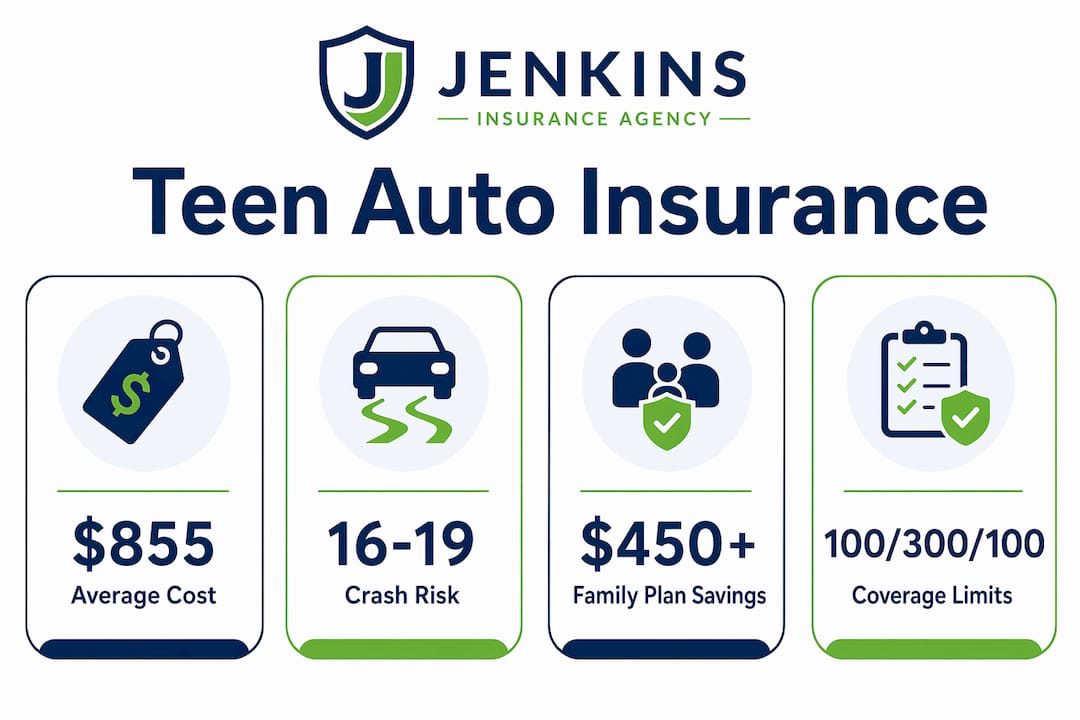
Auto insurance for teens is the highest-cost driver category in personal insurance, with 16-year-olds paying up to $855 per month on a standalone policy in 2026. The industry term for this coverage is “youthful operator” insurance, though most parents simply call it teen auto coverage. The good news is that smart decisions about policy structure, coverage limits, and available discounts can cut that cost significantly. This guide walks you through exactly what to do.
Why is auto insurance for teens so expensive?
Teen drivers are statistically the riskiest group on the road. Drivers age 16–19 crash at nearly four times the rate of drivers 20 and older. That single fact drives every premium calculation an insurer makes for a young driver.

Insurers also treat teens more harshly than drivers with prior offenses. Teens cost at least $450 more per year than drivers with prior speeding tickets or accidents. The reason is simple: insurers price based on individual driving history, and a new teen has none.
Geography adds another layer of complexity. A 16-year-old in Hawaii pays $203 per month, while the same driver in Louisiana pays $1,013 per month for identical coverage. That sevenfold difference shows why shopping locally and comparing regional carriers matters as much as comparing national ones.
Here is what 2026 rate data shows for full coverage by policy structure:
| Driver Age | Family Plan (Monthly) | Standalone Policy (Monthly) | Annual Difference |
|---|---|---|---|
| 16 years old | $663 | $855 | $2,304 savings on family plan |
| 17 years old | $610 | $790 | ~$2,160 savings on family plan |
| 18 years old | $560 | $700 | ~$1,680 savings on family plan |
| 19 years old | $490 | $590 | ~$1,200 savings on family plan |
Savings shrink as teens age, but the family plan advantage holds through the teen years.
What coverage limits do teen drivers actually need?
Minimum state coverage is not enough for a teen driver. Liability limits of at least 100/300/100 are the recommended standard. That means $100,000 per person, $300,000 per accident, and $100,000 for property damage.
The reason to go higher is asset protection, not just legal compliance. Think of teen auto coverage as protecting family assets, not just managing a monthly bill. A serious accident involving a teen driver can generate claims that exceed minimum limits quickly, leaving your family exposed to lawsuits.
Here is a clear breakdown of the coverage types worth considering:
| Coverage Type | What It Covers | Recommended for Teens? |
|---|---|---|
| Liability (100/300/100) | Injuries and property damage to others | Yes, always |
| Collision | Damage to teen’s vehicle in a crash | Yes, for newer cars |
| Comprehensive | Theft, weather, non-collision damage | Yes, for newer cars |
| Uninsured Motorist | Accidents with uninsured drivers | Yes, strongly recommended |
| Medical Payments | Teen’s medical costs after a crash | Optional but useful |
One important exception: if your teen drives an older car worth less than $8,000–$10,000, dropping collision and comprehensive coverage can save 40–50% on premiums. That trade-off only makes sense if your family can cover a vehicle loss out of pocket.
Pro Tip: Review the current market value of your teen’s vehicle before renewing coverage. Paying full coverage premiums on a $6,000 car often costs more than the car is worth to insure.
How can parents lower car insurance rates for teens?
Cost reduction starts before you even call an insurer. The vehicle your teen drives is one of the biggest premium factors. Safer, less expensive vehicles lower teen insurance costs by hundreds of dollars annually. A used Honda CR-V or Toyota Camry will cost far less to insure than a sports car or a large pickup truck.
Beyond vehicle choice, these discounts are available at most carriers:
- Good student discount: Teens with a B average or better qualify. Good student discounts typically range from 5% to 15% off the total premium.
- Driver’s education discount: Completing a state-approved course reduces premiums at most carriers, including those affiliated with Farmers Insurance.
- Telematics programs: Apps like Farmers Signal track driving behavior and reward safe habits. Telematics discounts reward careful driving with measurable premium reductions.
- Student away discount: If your teen attends college more than 100 miles from home without a car, most carriers offer a significant rate reduction.
- Multi-vehicle discount: Keeping your teen on the family policy with multiple vehicles often unlocks additional bundling savings.
You can find a full breakdown of California-specific savings at auto insurance discounts in California.
Pro Tip: Enroll your teen in a telematics program from day one. The first 12 months carry the highest accident risk, and a telematics discount gives you a financial incentive to keep the conversation about safe driving ongoing.
Family policy vs. standalone: which is better for teen drivers?
Adding a teen to your existing policy almost always saves money. Keeping a 16-year-old on a family plan saves approximately $2,304 per year compared to a standalone policy. The savings come from risk pooling: your established driving record offsets some of the teen’s risk profile in the insurer’s calculation.
Here is how to decide which approach fits your situation:
- Check your current policy’s structure. Some policies have exclusions or surcharge rules that make adding a teen more expensive than expected.
- Compare total family premium before and after adding the teen. The increase should be lower than a standalone policy cost.
- Consider the teen’s age. At 16, the family plan advantage is largest. By 18, savings between the two options narrow, and a standalone policy may start to make sense if the teen is financially independent.
- Review liability exposure. On a family plan, a serious accident by your teen can affect your policy’s claims history and future rates.
- Ask about separate vehicle listing. You can often list the teen’s car separately on the family policy, keeping coverage distinct while still benefiting from multi-vehicle discounts.
For most families with a 16 or 17-year-old, the family plan is the clear financial winner. The math shifts gradually as teens build their own driving record.
How do you choose the right insurer for teen auto coverage?
Not all insurers price teen drivers the same way. Regional insurers often offer more competitive rates than national carriers for teen drivers, depending on your state. In California, this difference can be meaningful, especially in Sonoma County where local market conditions affect pricing.
When evaluating insurers, focus on three things: discount availability, claims handling reputation, and the ability to customize coverage. A carrier that offers a good student discount, a telematics program, and a driver’s education credit will almost always beat a carrier with a lower base rate but no discount stack.
You can learn more about how local and national carriers compare at local vs. national carriers. The difference in service and pricing can be significant, especially for non-standard situations like teen drivers.
Pro Tip: Work with an independent or local agent who can compare multiple carriers at once. A local agent knows which carriers are most competitive for teen drivers in your specific zip code, which online quote tools rarely reflect accurately.
Key takeaways
The most cost-effective approach to teen auto insurance is keeping your teen on a family policy with liability limits of at least 100/300/100, applying every available discount, and choosing a safe, affordable vehicle.
| Point | Details |
|---|---|
| Family plan saves the most | Adding a 16-year-old to a family policy saves approximately $2,304 per year over a standalone policy. |
| Coverage limits protect assets | Liability limits of 100/300/100 are the recommended minimum to protect family finances after a serious accident. |
| Discounts stack meaningfully | Good student, telematics, and driver’s education discounts can combine for 15–25% in premium reductions. |
| Vehicle choice affects rates | Safer, lower-value vehicles reduce premiums by hundreds annually compared to sports cars or trucks. |
| Location changes everything | Teen rates vary by up to sevenfold by state, making local carrier comparisons as important as national ones. |
What i’ve learned after years of helping families insure teen drivers
The most common mistake I see parents make is treating teen auto insurance as a cost to minimize rather than a risk to manage. They drop coverage to save $40 a month, then face a $150,000 liability claim after their teen rear-ends someone on the freeway. The math never works out in their favor.
The second mistake is assuming the cheapest quote is the best quote. I have seen families switch to a bare-minimum policy, only to discover at claim time that their limits were exhausted before the other driver’s medical bills were paid. That is a financially devastating outcome that a slightly higher premium would have prevented entirely.
What actually works is this: keep your teen on your policy, set liability limits at 100/300/100 or higher, apply every discount available, and review the policy every six months as your teen builds a driving record. Teen drivers face the highest accident risk in their first 12 months, so the early period is exactly when you want the most protection in place.
One more thing: talk to your teen about the policy. When teens understand that a speeding ticket raises the family’s rates by hundreds of dollars, they tend to drive more carefully. That conversation is free, and it works.
— Jason
How Jenkinsinsuranceagencyinc helps sonoma county families with teen drivers
At Jenkinsinsuranceagencyinc, we work with families throughout Santa Rosa and Sonoma County to find the right coverage for teen drivers without overpaying. We compare options across multiple carriers, identify every discount your teen qualifies for, and help you set liability limits that actually protect your family.

Whether you are adding a new driver to your existing policy or starting fresh, our local team gives you a real conversation, not an algorithm. We know the California market, we know the carriers that price teen drivers fairly, and we are here to make this process straightforward. Reach out to us at Jenkins auto insurance or explore our family coverage guide to get started.
FAQ
How much does it cost to add a teen to a car insurance policy?
Adding a 16-year-old to a family policy costs approximately $663 per month for full coverage in 2026. A standalone policy for the same driver averages $855 per month, making the family plan the more affordable option by about $2,304 per year.
What is the best coverage level for a teen driver?
Liability limits of 100/300/100 are the recommended minimum for teen drivers. Full coverage including collision, comprehensive, and uninsured motorist protection is also advised for any vehicle worth more than $10,000.
Do good grades actually lower teen car insurance rates?
Yes. Good student discounts typically reduce premiums by 5% to 15% at most major carriers. Teens need a B average or better to qualify, and the discount usually applies until age 25.
Should my teen have their own separate car insurance policy?
For most families, keeping a teen on the family policy saves significantly more money than a standalone policy. The savings are largest at age 16 and gradually shrink as the teen builds their own driving record by age 18 or 19.
Does the type of car my teen drives affect insurance rates?
The vehicle choice directly affects premiums. Safer, lower-cost vehicles like used sedans or small SUVs cost hundreds less to insure annually than sports cars or high-value trucks. Choosing the right car is one of the fastest ways to reduce teen insurance costs.
Recommended
- Auto Insurance for Families: Your 2026 Coverage Guide – Jenkins Insurance Agency Inc.
- California auto insurance requirements 2026 guide – Jenkins Insurance Agency Inc.
- 6 Essential Tips for Basic Auto Insurance Coverage – Jenkins Insurance Agency Inc.
- What is auto coverage? A clear guide for California drivers 2026 – Jenkins Insurance Agency Inc.